


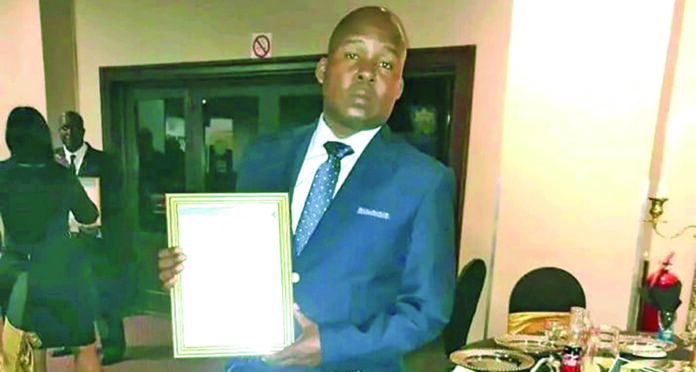
The case that sent award-winning detective Bonginkosi Anthony Dlamini to prison did not rest on a single meeting, witness or payment.
The Pinetown Regional Court viewed a series of events involving money, police officers, a murder accused’s family and repeated attempts to persuade a State witness to withdraw charges as parts of one plan.
READ MORE: The rise and fall of a star PKTT cop
Felokwakhe Ndlovu, a KwaNdengezi headman faced trial for the murder of African National Congress (ANC) leader Thulani Nxumalo. His wife, Sibongile Ndlovu, became accused number 2 in the corruption case. Then his brother, Lieutenant-Colonel Khephu Ndlovu, became accused number 4. Lastly, his son, Lindokuhle Ndlovu, was accused number 5.
Dlamini, the detective who had previously investigated the murder and arrested Felokwakhe, was accused number 1.
He was the only accused outside the Ndlovu family circle.
The State alleged that R120,000 was mobilised to influence Celani Selby Dlamini, a former murder accused who had become a State witness against Felokwakhe. The aim, prosecutors alleged, was to get Celani to withdraw or change his evidence and weaken the murder case.
One of the key witnesses was Goodman Bonginkosi Mpofu.
The meeting that linked Dlamini to the money
Mpofu told the court that Sibongile asked him to accompany her to Durban because she was meeting people she did not know well and wanted him to observe them.
At Durban Central police station, Mpofu said Sibongile met Khephu Ndlovu.
A white double-cab then arrived.
Mpofu identified its driver as Dlamini.
According to his evidence as summarised in the judgment, another vehicle arrived while the group was talking. Dlamini greeted its driver and followed that person away on foot.
READ MORE: PKTT scores another victory as gunman gets 13 years for attack on ANC councillor
The judgment records that he “did not come back”.
Only afterwards did Sibongile ask Mpofu to fetch her bag. She removed a money bag, gave it to Mpofu and instructed him to place it inside the white double-cab.
Mpofu complied.
He said nobody told him why they were there or what the money was for. Dlamini disputed Mpofu’s identification and challenged the description of the vehicle as a Ford Ranger.
The magistrate rejected that argument.
The court found that witnesses could easily confuse similar double-cab vehicles and accepted Mpofu’s evidence that he had seen Dlamini clearly in broad daylight.
For the court, the meeting formed part of a larger circumstantial picture. But the judgment’s narration leaves questions that Dlamini now highlights.
The money Dlamini was never seen receiving
Mpofu’s evidence placed Dlamini at the meeting, but Dlamini appears to have left before the money was put into the vehicle.
The judgment does not spell out separate evidence showing him physically receiving or counting the money. Instead, the court inferred his acceptance from the meeting, the placement of the money in the vehicle associated with him and what happened afterwards.
There was also another strand.
Celani testified that Sibongile later told him R120,000 had been paid to Ndlovu in his office.
The judgment treated that evidence and Mpofu’s account as parts of the same conspiracy.
What is not immediately clear from the judgment extract is whether the money allegedly paid to Ndlovu and the money placed in Dlamini’s vehicle were the same funds moving between participants or whether another explanation was given during the trial.
READ: ‘PKTT kidnapped me to implicate Mkhwanazi rivals’ – KZN cop
The State’s strongest case against award-winning detective, Dlamini, came from Celani.
Celani testified that on October 21, 2019, he learned that someone had been looking for him at home.
A cellphone number had been left.
When he called, Dlamini answered.
They arranged to meet the following day at Celani’s workplace.
Celani said Dlamini arrived in a white double-cab and suggested they speak where the person accompanying him could not hear them.
The warning that came became evidence of conspiracy
According to Celani, Dlamini warned him that he would be killed before that Friday by hitmen associated with Felokwakhe and police officers because of his statement.
Celani said the detective told him the only way to protect himself was to approach the prosecutor and withdraw his statement.
He told Dlamini that he wanted to consult his lawyer. Two days later, according to Celani, Dlamini followed up and asked whether he had done so.
Dlamini allegedly sent him one prosecutor Xaba’s telephone number. Celani then contacted Captain Khumalo and reported what had happened.
READ MORE: Puleng Dimpane hails PKTT breakthrough after witness-tampering cops jailed
According to the judgment, further approaches followed from Sibongile and eventually Felokwakhe himself from prison.
For the magistrate, these were not isolated incidents. The court found they demonstrated a common purpose to remove Celani from the murder prosecution.
Dlamini’s explanation was that he had genuinely believed Celani’s life was in danger.
The court rejected it.
Why court rejected Dlamini’s defence
The magistrate found that because Dlamini had already been removed from the investigation, he should have reported any threat through a Captain Khumalo, the prosecutor, police intelligence or senior SAPS management.
The court also rejected his claim that he had struggled to reach Khumalo.
Most damagingly, the magistrate rejected Dlamini’s claim that police colleagues were falsely implicating him. “There was nothing to gain by anybody in the police force by doing so,” the judgment found.
The court ultimately concluded that Dlamini’s version could not reasonably possibly be true.
He was convicted.
The award-winning detective who had built murder cases for the State was now found to have joined a scheme to undermine one.
- Detective Bonginkosi Anthony Dlamini was convicted for conspiring to influence a State witness, Celani Selby Dlamini, to withdraw charges in a murder case involving Felokwakhe Ndlovu.
- The court viewed a series of events, including money handling and meetings involving Dlamini and the Ndlovu family, as part of one plan to weaken the murder case.
- Testimony from Goodman Bonginkosi Mpofu and Celani linked Dlamini to a meeting where money was placed in a vehicle associated with him and involved attempts to threaten and persuade Celani to change his evidence.
- Dlamini claimed he genuinely believed Celani was threatened but was found by the court to have failed to report the threats appropriately and his defense was rejected.
- The court found no motive for other police officers to falsely implicate Dlamini and concluded his version of events was implausible, leading to his conviction.


