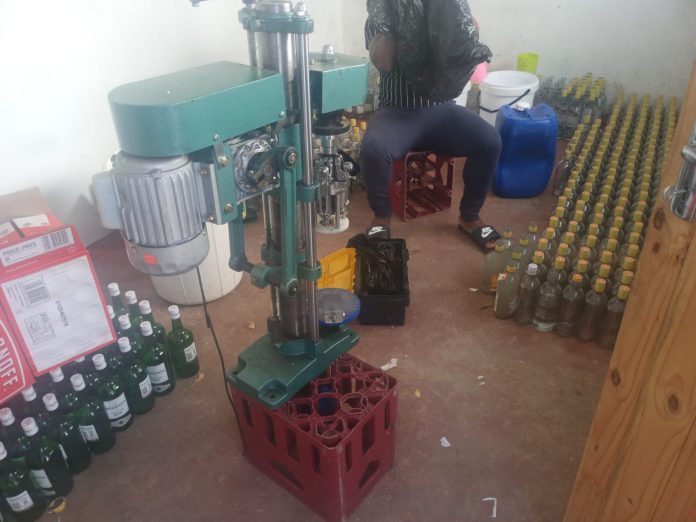
The South African Breweries (SAB) has painted a stark picture of the local industrial landscape and tells this as a warning that the growing illicit alcohol trade is not merely a tax compliance issue but an existential threat to the country’s localisation agenda.
As SAB has long been a major off-taker for local barley and maize farmers, quantifying the direct impact that the shrinkage of the legal market due to illicit trade has on these agricultural communities is one of the biggest concerns.
According to Fatsani Banda, senior manager of excise tax and public policy at SAB, at a micro level, the report on the illicit alcohol market sized the impact the growing illicit industry has on the overall value chain.
“Both upstream and downstream quantify together that our GDP [gross domestic product] contribution is around R80-billion, and a lot of it sits with local procurement and suppliers, but we do value our malt and barley being locally produced,” Banda said.
She also said that farmers, the value chain’s most vulnerable part, need protection. The damage extends far beyond the farm.
Banda describes the illicit alcohol industry as manufacturers who want to protect the industry’s upstream value chain, including local farmers, who are at the whims of global market volatility and change and who do require the stability of lengthy contracts that SAB provides to commercial farmers.
Manufacturing multiplier
When a legal sale is displaced by an illicit product, it doesn’t just hurt SAB’s bottom line; it removes a shipment from a hauler and an order from a packaging plant.
And according to Banda, SAB has been committed to making capital expenditure (CapEx) investments in President Cyril Ramaphosa’s drive to increase CapEx because it can create multiplier effects through logistics chains and procurement.
Each time the illicit alcohol industry grows by only 20%, they become more profitable but do not contribute positively through jobs or to the local economy.
“The indirect impact is that the commitment we have with our logistics and our procurement partners is substantially reduced,” Banda said. The growth of the black market sweeps away sales and value.
“This growth impacts the faces we do not see; suppliers of glass and cans and the logistics guys are the faceless people impacted by this,” Banda said.
Recent data presents a concerning picture of an industry facing significant challenges.
The latest Euromonitor International study reveals deep financial, structural, and social consequences that demand urgent attention and action, according to the Drinks Federation of South Africa.
It reveals that one in every five alcoholic drink purchases is illicit. Fiscal loss due to illicit alcohol was R16.5-billion in 2024, R11.3-billion in 2020, and R6.4-billion in 2017, representing a growth of 55% of the industry in seven years.
This parallel economy is bleeding the fiscus dry, with the government losing an estimated R16.5-billion in tax revenue in the last year alone.
Tax evasion and employment
Tax evasion stands as a huge part of the illicit alcohol market, and the revenue service, according to Banda, is losing R16.5-billion.
A lot of enforcement work with the police is necessary, as Banda outlines, and she explains that any money that is not going into the fiscus and GDP is money lost to the government.
Banda added that SAB has created 250 000 jobs, and if the government were to put back into the ecosystem the R25-billion lost, it could create a lot of jobs in the formal market.
“It looks more profitable and viable to be an illicit seller than to be a tavern owner who pays taxes and is compliant, and these cost something to the tavern owners and retailers but nothing for the illicit seller,” Banda said.
Consumer health stands at the forefront of the fight against illicit trading, as Banda urges illicit traders to see if there are incentives for being compliant and legal and not risking consumer lives.
Beer, gin production costs
Because production costs are higher than those for higher alcohol percentages, illicit production is not as prominent in beer.
For that reason, it costs more to produce beer or cider than it is for gin and other strong products.
“Consumers are looking for value for money, specifically for cheaper products with higher alcohol content; therefore, it becomes easy to form syndicates,” Banda said.
This, according to Banda, is a critical dynamic to curb as soon as resources become available and enforcement programmes are put in place.
Future localisation investment
Many jobs are lost as soon as illicit industries come to play and local investment becomes impossible. Having an industrialised manufacturing base is determined by a no-illicit-operations industry.
“We are looking forward to what the establishment of a national illicit economy disruption programme, what it means and having collaboration with the government regarding that. We do think there are not enough penalties on illicit alcohol,” Banda told Sunday World at the Proudly South African 14th edition of their annual flagship event, the Buy Local Summit & Expo.
- The South African Breweries (SAB) has painted a stark picture of the local industrial landscape and tells this as a warning that the growing illicit alcohol trade is not merely a tax compliance issue but an existential threat to the country’s localisation agenda.
- As SAB has long been a major off-taker for local barley and maize farmers, quantifying the direct impact that the shrinkage of the legal market due to illicit trade has on these agricultural communities is one of the biggest concerns.
- According to Fatsani Banda, senior manager of excise tax and public policy at SAB, at a micro level, the report on the illicit alcohol market sized the impact the growing illicit industry has on the overall value chain.
- “Both upstream and downstream quantify together that our GDP [gross domestic product] contribution is around R80-billion, and a lot of it sits with local procurement and suppliers, but we do value our malt and barley being locally produced,” Banda said.
- She also said that farmers, the value chain’s most vulnerable part, need protection.