


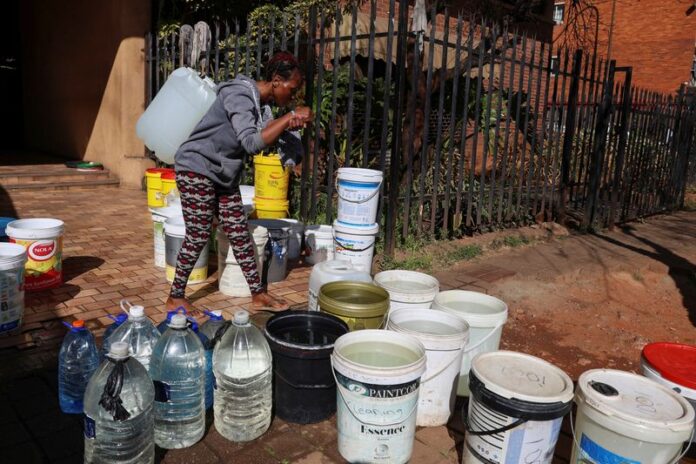
Dry taps have become a daily frustration for residents of Johannesburg, a city haemorrhaging more than a third of its water supply, or an estimated 655 million litres a day, through burst pipes.
“I feel really broken,” 17-year-old student Thandani Masangu said after spending three hours wheeling empty containers on a trolley through the peeling and trash-strewn urban neighbourhood of Hillbrow searching for water.
His block has had none for more than three years.
Masangu and his friend Raymond Maleka spotted a tank being refilled by a municipal water truck, but a security guard told them there was only enough for residents of the adjacent tower-block.
As South Africa prepares for local elections expected by November, water shortages have become a symbol of municipal failures that have angered voters and eroded support for the ruling African National Congress (ANC).
Wealthier inhabitants of the commercial capital are increasingly taking matters into their own hands: drilling boreholes to bypass the municipality, starving it of funds needed to fix the mess.
‘The infrastructure is old’
Johannesburg Water, the utility owned and run by the local authority, acknowledges there is a problem.
“The infrastructure is old. A lot of it is more than 50 years old,” its senior manager for innovation and technology, Zakhele Khuzwayo, told Reuters in an interview.
“The city are aware of the limitations. We know where we’d like to be … Now it’s a matter of paving the way to get there.”
That acknowledgement, and the regular promises of progress, have done little to stop the once mundane issue of maintenance rising up the list of electoral grievances.
“Maintenance is not sexy. It’s always more interesting to allocate funds to other areas,” Craig Sheridan, director and founder of the Centre in Water Research and Development at the city’s University of the Witwatersrand, told Reuters.
“This is not only evident in our water … we see it in all our public infrastructure,” added Sheridan, who collected the data on the city’s haemorrhaging pipes.
Analysts say climate change is worsening the city’s water woes by increasing the amount lost to evaporation.
Another underlying problem is the mounting budgetary crisis at the City of Johannesburg Metropolitan Municipality.
In July, the National Treasury withheld funding from Johannesburg, a city that makes up more than a sixth of the country’s GDP, after several failures to meet financial management requirements.
It has said the city’s latest R97.1 billion budget is unfunded, with planned spending, including higher municipal wages, exceeding realistic revenue projections.
Read More: Joburg’s audit regression signals a governance crisis
A spokesperson for Johannesburg mayor Dada Morero did not respond to an emailed request for comment on the problems with water supplies and the broader budget. Last month, national press quoted Morero as attributing unpaid debts to system glitches that disrupted payments.
‘We’re overwhelmed, to be honest’
The ruling ANC has paid the price for poor services in the past. In local elections in 2021, public anger lowered its share of the vote to under half for the first time since the end of apartheid — and it went on to lose its majority in national polls less than three years later.
Masangu’s friend Maleka will be old enough to vote in this year’s polls, and said he won’t be choosing the ANC.
Neither will Lindiwe Ndlovu, 53, former ANC member and owner of a flat in the Hillbrow high rise being supplied by the tanker.
Ndlovu and three other residents said authorities cut them off in 2019 for non-payment. But they said the utility was using excessive estimates, a meter to determine actual usage was broken and never replaced, despite repeated promises.
A court had ordered the utility to restore the water in May, but they had not yet done so, they added.
“People are tired of these problems,” Ndlovu said.
Johannesburg Water’s Khuzwayo said he could not comment on individual cases. “We’re overwhelmed, to be honest.”
Read More: DA heads to court over persistent water crisis in Johannesburg
Richer residents drilling boreholes
Out in the suburbs, richer residents have been drilling boreholes alongside the solar panels they set up to cope with power cuts, and the contracts they signed with private recycling collectors.
Albertus Lombaard of the Borehole Water Association estimates that residents of Gauteng province, which includes Johannesburg and the capital Pretoria, have drilled 10,000 boreholes over the past decade.
Litigation lawyer Thea Kilian said that after one particularly frustrating shutdown, she spent R100,000 drill, and to install tanks and filters that now kept her swimming pool full and her lawn green.
“On our WhatsApp group for the street, you get constant … reports of water problems,” the 53-year-old said.
She felt awful for those less fortunate, but “it’s a terrible thing to say, (the water problem) doesn’t bother me at all anymore”.
- Johannesburg is losing more than a third of its water supply daily, estimated at 655 million litres, mainly due to burst pipes and aging infrastructure over 50 years old.
- Residents in areas like Hillbrow have experienced water outages for years, with some blocks having no water for over three years, causing people to rely on municipal water trucks with limited supply.
- The City of Johannesburg faces a budget crisis, with National Treasury withholding funds due to financial management failures, while its R97.1 billion budget is unfunded.
- Wealthier residents are coping with water shortages by drilling boreholes, with an estimated 10,000 boreholes drilled across Gauteng province in the past decade.
- The ruling ANC has lost voter support partly due to water supply issues, with some residents refusing to vote for the party in upcoming elections because of ongoing service failures.
Dry taps have become a daily frustration for residents of Johannesburg, a city haemorrhaging more than a third of its water supply, or an estimated 655 million litres a day, through burst pipes.
"I feel really broken," 17-year-old student Thandani Masangu said after spending three hours wheeling empty containers on a trolley through the peeling and trash-strewn urban neighbourhood of Hillbrow searching for water.
His block has had none for more than three years.
Masangu and his friend Raymond Maleka spotted a tank being refilled by a municipal water truck, but a security guard told them there was only enough for residents of the adjacent tower-block.
As South Africa prepares for local elections expected by November, water shortages have become a symbol of municipal failures that have angered voters and eroded support for the ruling African National Congress (ANC).
Wealthier inhabitants of the commercial capital are increasingly taking matters into their own hands: drilling boreholes to bypass the municipality, starving it of funds needed to fix the mess.
Johannesburg Water, the utility owned and run by the local authority, acknowledges there is a problem.
"The infrastructure is old. A lot of it is more than 50 years old," its senior manager for innovation and technology, Zakhele Khuzwayo, told Reuters in an interview.
"The city are aware of the limitations. We know where we'd like to be ... Now it's a matter of paving the way to get there."
That acknowledgement, and the regular promises of progress, have done little to stop the once mundane issue of maintenance rising up the list of electoral grievances.
"Maintenance is not sexy. It's always more interesting to allocate funds to other areas," Craig Sheridan, director and founder of the Centre in Water Research and Development at the city's University of the Witwatersrand, told Reuters.
"This is not only evident in our water ... we see it in all our public infrastructure," added Sheridan, who collected the data on the city's haemorrhaging pipes.
Analysts say climate change is worsening the city's water woes by increasing the amount lost to evaporation.
Another underlying problem is the mounting budgetary crisis at the City of Johannesburg Metropolitan Municipality.
In July, the National Treasury withheld funding from Johannesburg, a city that makes up more than a sixth of the country's GDP, after several failures to meet financial management requirements.
It has said the city's latest R97.1 billion budget is unfunded, with planned spending, including higher municipal wages, exceeding realistic revenue projections.
Read More: Joburg's audit regression signals a governance crisis
A spokesperson for Johannesburg mayor Dada Morero did not respond to an emailed request for comment on the problems with water supplies and the broader budget. Last month, national press quoted Morero as attributing unpaid debts to system glitches that disrupted payments.
The ruling ANC has paid the price for poor services in the past. In local elections in 2021, public anger lowered its share of the vote to under half for the first time since the end of apartheid — and it went on to lose its majority in national polls less than three years later.
Masangu's friend Maleka will be old enough to vote in this year's polls, and said he won't be choosing the ANC.
Neither will Lindiwe Ndlovu, 53, former ANC member and owner of a flat in the Hillbrow high rise being supplied by the tanker.
Ndlovu and three other residents said authorities cut them off in 2019 for non-payment. But they said the utility was using excessive estimates, a meter to determine actual usage was broken and never replaced, despite repeated promises.
A court had ordered the utility to restore the water in May, but they had not yet done so, they added.
"People are tired of these problems," Ndlovu said.
Johannesburg Water's Khuzwayo said he could not comment on individual cases. "We're overwhelmed, to be honest."
Read More: DA heads to court over persistent water crisis in Johannesburg
Out in the suburbs, richer residents have been drilling boreholes alongside the solar panels they set up to cope with power cuts, and the contracts they signed with private recycling collectors.
Albertus Lombaard of the Borehole Water Association estimates that residents of Gauteng province, which includes Johannesburg and the capital Pretoria, have drilled 10,000 boreholes over the past decade.
Litigation lawyer Thea Kilian said that after one particularly frustrating shutdown, she spent R100,000 drill, and to install tanks and filters that now kept her swimming pool full and her lawn green.
"On our WhatsApp group for the street, you get constant ... reports of water problems," the 53-year-old said.
She felt awful for those less fortunate, but "it's a terrible thing to say, (the water problem) doesn't bother me at all anymore".


