


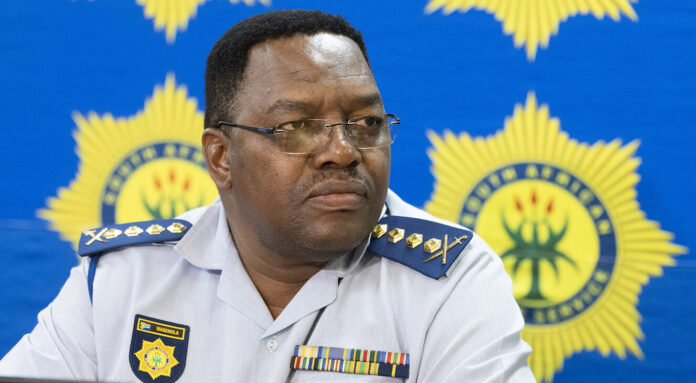

President Cyril Ramaphosa moved quietly to prepare for the possibility that his police chief might not survive the storm when speculation first surfaced last year that National Commissioner Fannie Masemola could face arrest – in connection with matters understood to be separate from the case now before court.
With Masemola this week formally charged in relation to a R360-million health services contract awarded to Medicare 24 Tshwane District, pressure is mounting on Ramaphosa to suspend him, and legal sources warn that the current charges may only be the beginning, as earlier lines of investigation that triggered last year’s arrest were linked to the activities of crime intelligence.
According to the charge sheet, Masemola is accused of acting “unlawfully, wilfully and/or in a grossly negligent way” in failing “to take effective and appropriate steps to prevent unauthorised, irregular and or fruitless and wasteful expenditure”.
The charges relate to the awarding and management of a SAPS health services contract to Medicare 24 Tshwane District – a tender the state says became tainted by criminal conduct and noncompliance.
Prosecutors further allege that Masemola failed to intervene even as the contract deteriorated. “You failed to manage contractual liabilities… by failing to stop the acceptance of orders… and payment of invoices… that had not fully complied with their contractual obligations,” the charge sheet reads.
In addition, the state claims he did not ensure that the contractor met basic compliance requirements, alleging that he “failed to ensure that Medicare 24 Tshwane District was properly screened and tax compliant”.
The charge sheet extends beyond the tender itself to Masemola’s internal leadership responsibilities, accusing him of failing to act against those implicated within SAPS.
He is alleged to have “failed to comply with the duty to take effective and appropriate disciplinary steps against officials… involved in the unlawful procurement”. In doing so, the state argues, he contravened section 86(1) of the Public Finance Management Act.
As the legal process unfolds, attention has turned sharply to who might step in should Ramaphosa suspend Masemola – a question complicated by deep factional divisions within the SAPS.
“When Masemola’s legal troubles first surfaced, contingency planning started immediately,” a senior police source said.
“But every name comes with complications.”
One of the names initially considered was Lt-Gen Tebello Mosikili, but her prospects are clouded by an ongoing police watchdog-linked matter stemming from allegations that she misused state resources over a dispute about a microwave purchased at Makro.
“Mosikili cannot be considered in isolation,” the source said. “There is already a cloud around her, and in this climate, perception alone is enough to disqualify a candidate.”
Her public fallout with senior colleague Lt-Gen Shadrack Sibiya has also placed her within the factional contestation that has defined SAPS leadership battles in recent years.
Another potential candidate is Lt-Gen Michael Mohlala, who heads Protection and Security Services – a division under scrutiny following a report by Daily Maverick that police are probing R3-million allegedly claimed by officers rendering protection duties to Ramaphosa. The proximity of that unit to the Presidential Protection Services, headed by Ramaphosa’s ally Maj-Gen Wally Rhoode, has heightened sensitivities around any appointment linked to it, particularly given the lingering political fallout from the Phala Phala scandal.
Amid the competing interests, police insiders have pointed to a less politically entangled option: Lt-Gen Maropeng Mamotheti, divisional commissioner for Human Resource Management. “She is one of the few who came up without needing a lobby,” a police insider said. “That makes her both credible and, in this environment, quite unusual.”
The broader pool of potential acting commissioners includes provincial police bosses and other lieutenant generals, but even that field is constrained by politics, relationships and ongoing investigations. Also, others are due to retire.
In this context KwaZulu-Natal police boss Nhlanhla Mkhwanazi’s name inevitably enters the conversation, but those close to him say he would be reluctant to accept an acting role at the expense of Masemola, whom he is understood to have a personal relationship with. “It would be seen as a betrayal,” a source close to Mkhwanazi said.
His own position is also complicated by ongoing investigations in which his name has surfaced, as well as political discomfort within government over his public posture – most notably his explosive media briefing last year, which created a public relations crisis for the ANC-led administration.
His public attacks on his colleagues have similarly weakened crime intelligence’s Lt-Gen Feroz Khan’s standing as a potential consensus candidate, further narrowing Ramaphosa’s options.
Meanwhile, questions are beginning to emerge about the strength and structure of the state’s case. Police insiders have raised concerns about the reliance on the doctrine of common purpose to link multiple accused to the Matlala tender.
Insiders claim Matlala only knew five of the 12 co-accused. If the state cannot prove that the seven unknown officers shared a common purpose with Matlala – meaning that they knew they were part of a corrupt scheme – the case against them weakens.
Also, warning statements, which are formal documents given to suspects before arrest to clarify the allegations and the identities of co-accused, were seemingly not served.
The case has been postponed to May for further investigation, with Masemola expected back in court in April – a timeline that could prove decisive both for his legal fate and his future and that of others at the helm of the country’s police service.


