


In 2024, while on sabbatical in China, I visited the Shanghai Party School, where one of the departments I was introduced to was responsible for communications training.
The Party School had well-equipped facilities, including simulated television and radio studios and a facility for practising press conferences under conditions designed to approximate the pressures of the real thing. Senior Shanghai government officials are sent there for communications training. Throughout the programme, they undergo emotional intelligence assessments whose results are used to tailor interventions to the needs of individual senior managers and political leaders.
Like many other big things in China, it was impressive, but what stuck was not just the scale or sophistication of the facilities. It was another marker of the seriousness with which the Chinese approach statecraft. They do not assume that appointment to a senior public office automatically equips a person to communicate under pressure, manage hostility, control emotion or respond appropriately when an encounter takes an unexpected turn. These are treated as capabilities that have to be developed, tested and continuously improved. The institution prepares people for situations that can change very quickly, including encounters in which an otherwise routine engagement suddenly becomes hostile.
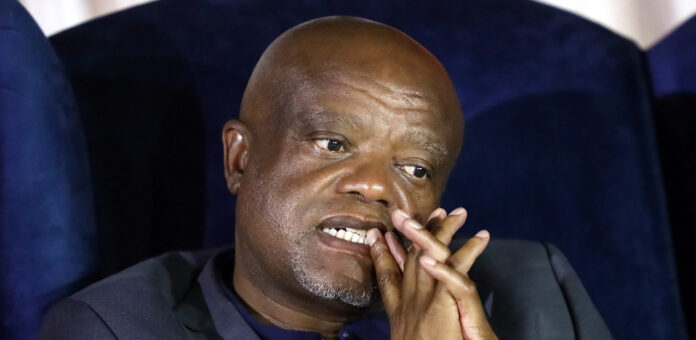
That visit came back to me this weekend as I declined several media interview requests about the Water and Sanitation Minister’s run-in with a member of the public. I had similarly stayed away from commentary on the rather infantile remarks by the Secretary-General of the ANC, who declared himself the “boss” amid controversy over the handling of local government candidate lists, and, earlier, the confrontation between the Mayor of Johannesburg and a member of the public.
I felt conflicted.
Instead of commenting on the scandal, I became more interested in a different question. Why do people who have spent years in public life and who are certainly no strangers to angry citizens, political contestation or hostile audiences sometimes lose their composure when an encounter suddenly turns hostile? Is there something about the present political moment that might help us understand what we are seeing, without explaining it away, and are we doing enough to prepare political leaders for an environment in which an ordinary walkabout, community meeting, interview or conversation with a citizen can change character within seconds?
READ: Dada Morero apologises for swearing at Joburg resident, party calls it un-ANC
Almost coincidentally, one of those algorithmic reminders appeared on the phone this week, reminding me that at about this time in 2021, I had spent several days in aviation simulators, exploring how the principles of flight planning and aviation safety might be applied to general management in the public sector. That experience and my visit to Shanghai began to connect around a question that has interested me for some time: how do we prepare people to respond when a familiar situation changes suddenly, and what do institutions learn when the response goes wrong?
Firstly, we are in the silly season of elections, when emotions run high, politicians become more visible, citizens become more assertive, and political competition becomes sharper. Elections reduce the normal social distance between political leaders and citizens because politicians who ordinarily operate through offices, officials and formal programmes suddenly spend considerably more time on the streets, in churches, at taxi ranks, in homes and at community meetings.
The emotions produced by this proximity move in different directions. Some politicians become extraordinarily compassionate, hugging babies and vagrants alike, patronising churches and singing at the highest possible tune, while others find themselves drawn into arguments with citizens or political opponents as temperatures rise. Elections do not suddenly change politicians’ personalities, but they do increase the frequency and intensity of direct encounters, some of which can move remarkably quickly from cordiality to confrontation.
There is also a temporary reversal in the relationship between political power and the citizen. For much of the political cycle, it is the citizen who approaches government because they need something from the state, whether it is water, electricity, housing, a grant, a job opportunity or simply an official willing to listen. During an election, the politician approaches the citizen because the politician now needs something equally consequential from them: their vote. Elections compress the distance between political power and the citizen, creating greater intimacy but also considerably more opportunity for friction.
Secondly, the argument we eventually see on a small screen or social media seldom begins when the recording starts. A citizen may arrive at a public meeting carrying years of frustration about water, electricity, housing, unemployment or unsuccessful encounters with government, while the politician may arrive carrying the accumulated pressures of public office, criticism, political competition and repeated confrontation. What may have begun as a routine encounter can turn hostile very quickly because the immediate disagreement is sometimes carrying the weight of frustrations accumulated long before the two people met.
Thirdly, social media complicates this further because almost every citizen now carries what is effectively a broadcasting station in their hand. An exchange that might once have ended among the people who witnessed it can become a national event within minutes, often stripped of what happened before the camera started recording and what happened after it stopped. Politicians know this and citizens know this, so both enter public encounters conscious that the audience may extend far beyond the people physically present.
Fourthly, we should be candid that members of the public can be extremely provocative, sometimes for legitimate reasons arising from anger and frustration, and sometimes for less defensible ones. Social media takes this to another level, where insults, ridicule and personal attacks can go into overdrive, often encouraged by the prospect of a viral moment and the strange licence that people sometimes give themselves when communicating through the small screen. Nor are journalists entirely outside this problem. Robust questioning is indispensable to democratic accountability, but there are occasions when an interviewer is not objectively asking a difficult question but is pressing, interrupting, or even provoking in ways that can elicit a sharp reaction. A political leader has to be prepared not only for the hostility that is anticipated but also for the moment when an apparently manageable encounter suddenly changes character.
READ: Hein Wyngaard | Majodina, public discourse and the dignity of Cape mothers
None of this removes personal responsibility, and I should not be misunderstood for making excuses. The existence of provocation is one reason the standard expected of a public representative has to be higher. Politicians are human beings and experience anger, humiliation and frustration like everyone else, and they can certainly be provoked, insulted or unfairly confronted. Public office nevertheless carries a higher burden because society expects those entrusted with authority to exercise judgment when circumstances make it difficult.
The question is whether we adequately prepare public representatives to do so.
Aviation is useful in thinking about this. Its remarkable safety record rests not on the assumption that pilots are unusually calm, but on the recognition that they are human, that human beings can become frightened, confused or overwhelmed and that an otherwise routine flight can confront them with something unexpected that requires an immediate response. Pilots are trained not only for what is likely to happen, but also for circumstances that everyone hopes will never arise.
A pilot approaching a runway might encounter something as improbable as a python lying across it, but nobody expects the pilot to panic, open the window and start shouting at the snake. We expect training to take over, not because the pilot is somehow less human than the rest of us, but because the system has prepared the pilot to respond when an ordinary situation suddenly becomes anything but ordinary.
Aviation also learns systematically from incidents. When something serious occurs, the response does not end with establishing who was at fault. It asks what happened, what conditions produced it, how the crew responded, what warning signs were missed, whether the procedures were adequate and what could have been done differently. Where necessary, the manual and training are updated so that one pilot’s experience becomes knowledge that others benefit from.
Former President, Kgalema Motlanthe elaborated on this aviation metaphor for public service training when addressing the Professor Stan Sangweni memorial lecture at Freedom Park last Sunday. He said: “Even an experienced pilot cannot simply move from one class or type of aircraft to another without the appropriate conversion training and time in the simulator… Public administration deserves the same seriousness about professional formation. The public service must consequently become an institution that learns continuously and, equally importantly, retains what it learns.”
Politics could learn from these practices: preparation before the encounter and institutional learning afterwards. An angry citizen is hardly an unforeseeable event in South African politics. Neither is a hostile community meeting, an insult, aggressive questioning, political provocation, nor a mobile phone recording of an encounter. What is less predictable is when these things will occur, how quickly an ordinary engagement will become hostile and how the individual politician will respond when it does. The ability to manage such situations cannot be left entirely to personality, instinct or whatever experience a person happened to acquire before entering public office.
Political parties, Parliament, legislatures, councils and institutions responsible for public-sector training should consider much more deliberate preparation of public representatives in conflict management, communications, emotional intelligence and de-escalation, with a stronger emphasis on simulation. Put the politician in a room with the angry citizen, the hostile interviewer, the provocative political opponent, the difficult press conference and the community meeting that suddenly begins to unravel and allow them to make mistakes there rather than discovering for the first time how they respond to pressure when somebody has already taken out a cell phone.
There is also a case for periodic emotional intelligence assessment, not as a crude exercise in deciding who has a good or bad personality, but as a means of understanding how different people behave under pressure and where they may require additional preparation. This is one of the things that stayed with me from Shanghai. Their communications training was not confined to teaching officials what to say; it also paid attention to the person delivering the message and what happens to that person when the carefully prepared communication meets the unpredictability of an actual human encounter.
The same preparation should extend to the people around political leaders. Political leaders travel with advisers, communicators, officials and security personnel, yet we seldom ask whether these people are adequately prepared to recognise when an encounter is becoming unnecessarily confrontational and whether they know when and how to intervene without making matters worse. Needless to say, some of these have neither the talent nor the acumen to offer any sensible advice.
My argument, therefore, is that actual incidents should then become case studies. What triggered the confrontation? At what point did the encounter change, and could that have been anticipated or de-escalated? What could the politician have done differently, and what could those around the politician have done? Most importantly, what should the next mayor, councillor, MEC, minister or MP learn from what happened?
The public is entitled to expect greater judgment and restraint from people entrusted with political authority because, in these encounters, they are not acting as private individuals. But that expectation should also force us to ask whether the institutions that produce, deploy and support political leaders are doing enough to prepare them for encounters that can change without warning and in which a few seconds of poor judgement can undermine years of public service.
That is what connects Shanghai, the aviation simulator and the incidents that prompted this reflection. Serious statecraft cannot depend on the hope that everybody appointed or elected to positions of authority will somehow possess the temperament required for every situation they experience. People can be trained for these situations, and institutions can learn from mistakes when they occur.
We can condemn each incident, insist upon accountability and demand apologies where they are warranted, but if that is where the response ends, the next incident returns us to the beginning. The hostility may arrive without warning; our preparation for it should not.
- The Shanghai Party School in China provides communications training for senior government officials, including emotional intelligence assessments tailored to individual needs.
- The author reflects on the importance of preparing politicians for hostile encounters, especially during the heightened tensions of election season.
- Political encounters often carry accumulated frustrations from citizens and the pressures experienced by politicians, sometimes escalating conflicts quickly.
- Social media amplifies and broadcasts confrontations, influencing both politicians' and citizens' behavior during public interactions.
- The article advocates for systematic training and institutional learning for politicians, drawing parallels with aviation safety practices to improve conflict management and emotional intelligence.


