


“The strange career of a troublesome word”, is the subtitle of African-American legal scholar Randall Kennedy’s 2002 book on the N-word, regarded as “the nuclear bomb of racial epithets” and “arguably the most consequential social insult in American history”.
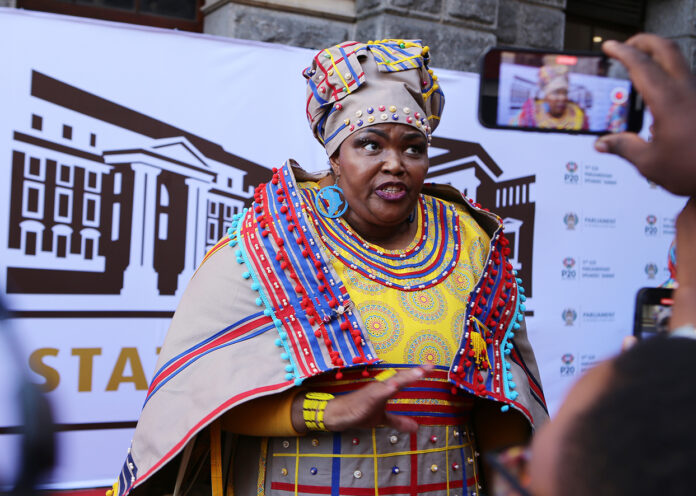
This past week, a major South Africa talking point has been Water and Sanitation Minister Pemmy Majodina’s use of a local “troublesome word” or expression, namely “jou ma se p****”, referring to someone’s mother’s private parts.
READ: Moegoe: Does Pemmy deserve your ma se vote?
The expression first made headlines in September 1997 when cartoonist Zapiro depicted a bergie, or homeless person in Cape Town, expressing his disappointment at Athens beating Cape Town to host the 2004 Olympic Games by saying: “Athens se ma se @*#&!!”.
It was funny and not intended to cause any personal harm to anyone (only to a distant country) and so South Africans burst out laughing at the sight of the cartoon.
Then there was the (more serious and more concerning) incident in 2011 when an advocate, Nehemiah Ballem, snapped and spit that same epithet at Judge Lee Bozalek – inside the Western Cape High Court – after being reprimanded by the honourable judge about his alleged tardiness and attitude.
And now this: Majodina being caught on video while hurling “jou ma se @*#&” back at a man who seemingly threw the profanity at her first. “Disgraceful” is how her political opponents have responded to the incident, happening during a departmental meeting with community members in Kouga in the Eastern Cape.
The use of this epithet, although not racial in its nature, must raise questions similar to those posed by Kennedy about the N-word: How should the expression be defined? Do all communities have the right to use it? And would provocation, such as seemingly was the case at the Majodina meeting, be a strong enough defence against culpability for the use thereof?
Writing for Netwerk24 about another recent incident – Johannesburg mayor Dada Morero telling a resident that he was “talking sh*t” – linguist Professor Hein Willemse introduces his readers to the Latin term maledicta, which translates to the use of profane and insulting language.
“Yet, maledicta does have a place in public discourse,” he opines.
“Sometimes it functions as an expression of frustration or to emphasise or strengthen a message. It can also, if used in a rhetorically clever way, ease the tension.”
But what we witnessed in the case of Majodina was exactly the opposite: Instead of easing the tension, she allowed herself to be provoked by her angry critic in the audience to such an extent that she repeated his degrading words. What makes it worse is that she is a woman, seemingly unaware at that moment of the origin and true meaning of the words uttered.
“Jou ma se @*#&” has over generations been used in traditional Coloured areas, particularly in the Western Cape, as the ultimate insult to another person from the same group. It is meant to strip you and your mother of any respect and dignity and, perhaps also, deserving of any humaneness.
READ: Securing the country’s water future requires collective action
Anyone who is familiar with this history – to borrow from Kennedy – “arguably the most consequential social insult in [Coloured] history”, would be very careful to use it, especially because mothers from these communities are suffering the most from the “nuclear bomb” of socio-economic challenges afflicting their families.
If anything, they deserve to be praised for being – as National Coloured Congress leader Fadiel Adams said at a Cape Forum elections dialogue this past Wednesday – “the most resolute that God created”. That is to say, being determined, firm believers and unwavering in your actions or ideas.
Being ignorant of the meanings and effects of the n-word, warned Kennedy, as if he also had the use of “jou ma se @*#$” in mind, “is to render oneself vulnerable to all manner of peril”. This is the situation that Majodina finds herself in now, and she has got only herself to blame for it.
– Hein Wyngaard is a socio-political commentator.
- Randall Kennedy's 2002 book discusses the N-word as "the nuclear bomb of racial epithets" and a significant social insult in American history.
- South Africa's Water and Sanitation Minister Pemmy Majodina was recently recorded using the local insult "jou ma se p****" during a meeting in Kouga, Eastern Cape.
- The phrase "jou ma se @*#&" has historical roots as a severe insult in traditional Coloured communities, particularly in the Western Cape, aimed at disrespecting a person and their mother.
- Linguist Professor Hein Willemse notes that profane language, or maledicta, can serve to express frustration or ease tension, but in Majodina's case, it escalated the conflict.
- National Coloured Congress leader Fadiel Adams praised mothers in these communities as "the most resolute that God created," contrasting with the degrading nature of the epithet.


