


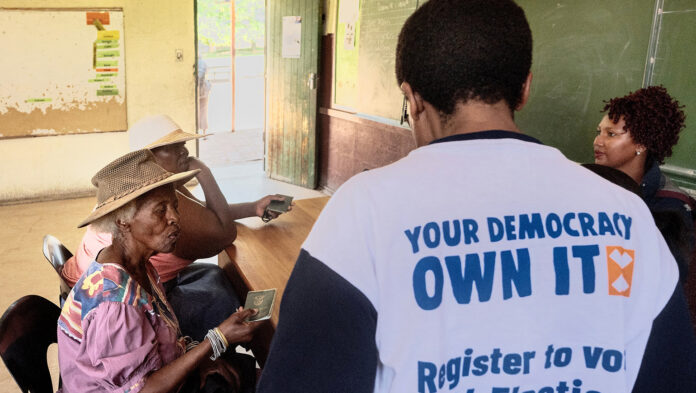
When South Africa’s Electoral Commission (IEC) introduced online voter registration ahead of the 2021 local government elections, it was seen as a welcome convenience. Five years later, it has become something much more significant.
The steady rise in online voter registration, particularly among women and young people, suggests that South Africans are changing how they engage with democracy. They are embracing digital public services that fit into their daily lives, and in doing so, they are sending government a powerful message: accessibility matters.
The IEC’s latest figures ahead of the November 4 local government elections reveal a noticeable shift. Women account for 61% of all online registration activities, while people aged between 16 and 29 make up half of all online transactions.
Gauteng, KwaZulu-Natal and the Eastern Cape are leading the country in online registrations, demonstrating that digital participation is no longer confined to a handful of urban professionals. It is increasingly becoming the preferred way for millions of South Africans to interact with one of the country’s most important democratic institutions.
This is encouraging because democracy should evolve alongside society. South Africans bank online, study online, run businesses online and access government information through their smartphones. It would have been unusual if voter registration had remained tied exclusively to long queues at registration stations.
The growth of digital registration also reflects broader changes in internet access across the country. According to DataReportal’s 2026 Digital South Africa report, internet penetration continues to increase, with tens of millions of South Africans now connected through mobile devices. Smartphones have become the primary gateway to banking, education, employment opportunities and government services. For many young people, their phone is their first point of contact with the state.
Against this backdrop, the IEC’s decision to provide a data-free online registration portal deserves recognition. In a country where the cost of mobile data remains a significant barrier for many households, removing data charges from voter registration makes democratic participation more accessible.
Convenience, however, should not be underestimated. Around the world, governments have learnt that people are far more likely to use public services when they are simple, fast and available outside traditional office hours. This matters because South Africa continues to struggle with voter participation. While registration numbers remain relatively strong, turnout has steadily declined over the past decade.
The 2021 local government elections recorded the lowest voter turnout since the advent of democracy, with just under 46% of registered voters casting their ballots. That decline was influenced by several factors, including political disillusionment, service delivery frustrations and growing distrust in public institutions.
Digital registration cannot solve those deeper political challenges. Trust in democracy is earned through accountable governance, reliable service delivery and political leaders who deliver on their promises.
The strong uptake among women is equally significant. Women often carry greater caregiving responsibilities and face tighter time constraints than men. Digital services that reduce travel and waiting times make civic participation more manageable.
The enthusiasm shown by younger South Africans is perhaps the most promising development. Rather than rejecting democracy, many appear willing to engage when democratic processes reflect the digital world they already inhabit.
The success of online voter registration demonstrates that when government invests in digital transformation that genuinely improves people’s experience, citizens respond positively.
Also, the IEC’s hybrid approach is the right one. The final voter registration weekend, supported by more than 48 000 trained electoral staff across nearly 23 000 voting stations, ensures that no eligible voter is excluded simply because they cannot access digital services.
• Dusani is interning at Decode, a Pan-African PR agency based in Johannesburg
- South Africa's online voter registration, launched in 2021, has grown significantly, especially among women (61%) and youth (16-29 years old, 50%), reflecting a shift in democratic engagement.
- Provinces like Gauteng, KwaZulu-Natal, and Eastern Cape lead in digital registrations, showing broader geographic adoption beyond urban professionals.
- Increased internet and smartphone penetration, plus the IEC’s data-free online registration portal, have improved accessibility for many South Africans, lowering financial and logistical barriers.
- Despite improved registration convenience, voter turnout declined to under 46% in 2021 due to political disillusionment and distrust, highlighting deeper democratic challenges beyond digital access.
- The IEC’s hybrid system combines online and in-person registration, ensuring inclusive voter access while catering to the digital habits of younger South Africans and the time constraints of women.


