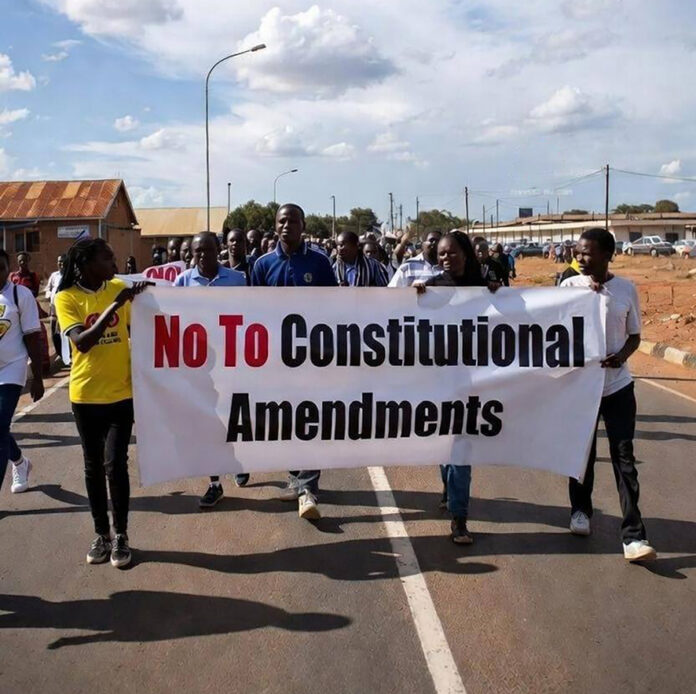
From the service-delivery and civil protests that periodically shake South Africa’s municipalities to Botswana’s ongoing debates about public accountability and governance standards to Zimbabwe’s own intensely contested constitutional moment, Southern Africa is being compelled to confront a difficult but necessary question:
What ultimately sustains a nation?
Is it its laws? Its leaders? Its institutions? Its mineral endowment? Or is it the character of its people?
At a time when public trust in institutions is under immense strain across the region, one uncomfortable truth confronts us: nations rarely rise or fall because of leaders alone. More often, they rise and fall on the character of their citizens.
It is easy, often justified, to blame politicians, governments, and state institutions for national decline. Across our region, we witness recurring stories of corruption, failing service delivery, collapsing infrastructure, and public resources disappearing into private hands.
Yet, a nation is not an abstract concept. A nation is its people.
It is the sum of our values, our habits, our sense of duty, and our willingness to defend what is right even when no one is watching, at every level of existence.
In Zimbabwe, this question has become particularly urgent as the country debates the proposed Constitutional Amendment No 3 Bill. Supporters argue that it seeks to strengthen governance structures and promote long-term policy continuity, while critics have raised concerns about timing, transparent public participation, institutional balance, and its wider political implications.
Whatever one’s position on the amendment itself, the debate has exposed something deeper than legal clauses and parliamentary procedure.
It has forced us to ask what kind of society we are becoming.
A constitution can define institutions. It can allocate powers. It can set terms and procedures. But it cannot manufacture integrity. No amendment, however elegantly drafted, can compensate for a society that has normalised dishonesty, opportunism, and public apathy.
Before corruption enters parliament, it often first enters daily life. It begins when we celebrate shortcuts over hard work.
When we admire wealth without questioning its source. When we use connections instead of competence. When we offer a “little something” to move a file,
secure a licence, or avoid responsibility.
These small compromises do not remain small. They become culture. And culture eventually becomes governance.
This is why the moral health of a society matters just as much as its political leadership. Leaders do not descend from another planet. They emerge from the values we tolerate, reward, and reproduce.
A society that normalises dishonesty in ordinary life should not be shocked when dishonesty occupies high office. Likewise, a people that tolerate incompetence in the classroom, in the workplace, and in civic life should not be surprised when the same mediocrity shapes national institutions.
The crisis we face in many of our countries is therefore not only political. It is civic. It is moral. It is cultural.
The question is not only what kind of leaders do we have?
The deeper and more uncomfortable question is, what kind of citizens are we becoming?
Do we still honour integrity?
Do we still respect truth?
Do we still value merit?
Do we still believe that public office is for service rather than enrichment?
Do we still teach and show our children that character matters more than status?
These are not philosophical luxuries. They are questions of national survival.
The erosion of public trust does not happen overnight. It happens when citizens begin to believe that dishonesty is the only way to survive and that ethics are for fools.
Once that mindset takes root, institutions become hollow, and patriotism is reduced to slogans.
But patriotism is not loud rhetoric. It is responsibility and vigilance. It is refusing to participate in corruption even when it benefits us. It is holding leaders accountable without exempting ourselves from the same standard.
A strong nation requires more than strong laws. It requires strong and morally upright citizens.
History teaches us that constitutions, courts and parliaments matter immensely, but they cannot permanently save a people who have surrendered their moral compass.
The future of any nation is not decided only in cabinet rooms or election rallies.
It is decided in homes, schools, churches, businesses, and on the streets – in the daily choices of ordinary citizens.
For in the end, nations do not merely inherit their destiny. They become what their people are.
- Tshuma is an author and sociopolitical commentator
- From the service-delivery and civil protests that periodically shake South Africa’s municipalities to Botswana’s ongoing debates about public accountability and governance standards to Zimbabwe’s own intensely contested constitutional moment, Southern Africa is being compelled to confront a difficult but necessary question: What ultimately sustains a nation.
- Is it its laws.
- Its leaders.
- Its institutions.
- Its mineral endowment.