


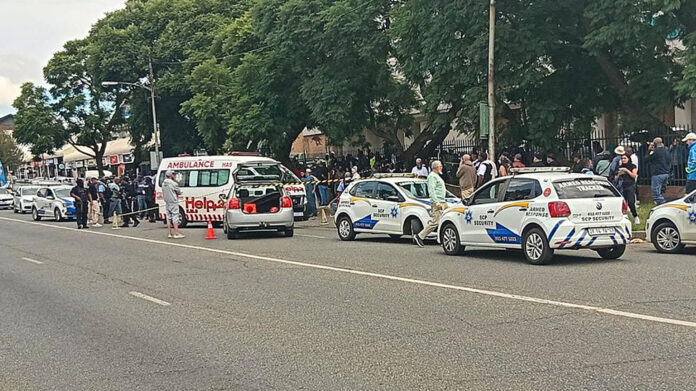
The NPA has declined to prosecute – for now – the man who shot and killed Faisal ul Rehman (48), a husband and father described as “a very good man”, in a road-rage incident in Emmarentia last weekend.
The decision follows a self-defence claim submitted by the shooter, which will remain in place pending further investigation. The case is complicated by allegations that Tehseen, Faisal’s wife, retrieved a firearm from their car during the confrontation – a claim the family strongly contests. Tehseen was also shot in the incident and was critically injured.
This incident has brought to the fore the culture of violence and anger, which shows itself in road rage and a rise in domestic violence among South African families. Our drivers are not known for their patience. They are notorious for aggression behind the wheel, which is part of why our roads are so deadly.
Witnesses say the altercation started with a fender-bender. The use of guns could have been avoided completely had the two men walked away rather than confront each other. Instead, after swearing and a fistfight failed to resolve anything, both reached for weapons – in full view of Faisal and Tehseen’s children, who watched their father die and their mother fall wounded in the street.
Whatever the truth of what happened, two young children watched their parents being shot on a Johannesburg street. Every gun owner knows – or should know – that a firearm in a heated confrontation can kill anyone nearby, including a child. That knowledge apparently counted for nothing.
Most parents would protect their children from violence. They would hold back when provoked. They would only consider using a firearm if their lives or their children’s lives were in real danger. Reports on this incident suggest that was not the case here – which is part of why the NPA has not yet proceeded with prosecution.
My deepest condolences go to Faisal’s family and his children, who were traumatised by what they witnessed. They did not deserve any of this.
What is it about gun ownership that makes people reckless?
Does owning a gun make someone feel untouchable?
A case in point is Paralympian Oscar Pistorius, who shot and killed Reeva Steenkamp after claiming he thought a burglar had locked himself in his toilet. He used a Taurus PT 917 CS 9mm semi-automatic pistol – not a military weapon or anything out of the ordinary, but a standard, legally licensed handgun of the kind found in countless South African homes.
What made it so lethal that night was the ammunition: expanding rounds, a type once banned in South Africa in the 1990s under the name “Black Talon,” which has re-entered the market. He fired four of them through a closed toilet door, making no attempt to first check whether there was actually a burglar on the other side.
A legal gun, in a home, killed Reeva Steenkamp.
People acquire guns for many reasons – protection, status and a sense of power. But whatever the reason, too many treat them like toys, with a casualness completely at odds with what they actually are: instruments capable of ending a life in seconds.
That gap between how guns are held and how they should be held is what gets people killed.
Once that trigger is pulled, there is no going back. All gun owners know this – or should.
The question is why so many still pull the trigger when they are not in any real danger. I am not saying people should be defenceless. But we have too many deaths in this country where guns were not used in self-defence – they were used as instruments of aggression.
We cannot run away from the fact that we live in a society where people are highly stressed, while others are just downright violent and impatient. This shows up in road-rage incidents, domestic violence, and what the SAPS crime statistics confirm quarter after quarter: the single biggest cause of murder in South Africa is not crime but arguments, misunderstandings and provocation – often between people who know each other.
New research into gun use in domestic violence in South Africa shows how often guns are used to coerce, threaten and intimidate in the home. The victims are almost always women and girls. The perpetrators are men – most often intimate partners, but also other family members – fathers, and sons.
The latest femicide research in South Africa confirms that guns are the leading weapon used to murder women. According to Gun Free SA, with 15 women killed every day, guns are the leading weapon used in femicide – and women are most at risk of being killed with a legally owned firearm. Firearm licence applications have increased by 58% since 2016.
It is troubling that applications for legal guns keep rising. The reasons are not hard to understand – most people who apply for a firearm do so because they feel unsafe. But the evidence tells a different story: a gun in the home is far more likely to be used against a family member than against an intruder.
A violent society like ours – shaped by apartheid, land dispossession and the brutal repression of an entire population – does not handle easy access to guns well. Before anything else, we need to find a way to confront our anger.
- Botha is a gun violence survivor and a secretariat member of the Global Coalition for WHO Action on Gun Violence. His father was shot and killed by police in the Sharpeville massacre. Twenty-six years later he was shot in the head by police during a protest march in Sharpeville, resulting in permanent paralysis.
- The NPA has currently declined to prosecute the man who fatally shot Faisal ul Rehman in a road-rage incident.
- Faisal ul Rehman, aged 48, was described as a “very good man,” husband, and father.
- The shooting occurred last weekend in Emmarentia.
- No immediate charges have been filed against the shooter.
- Further details are available in the e-edition of Sunday World.


