


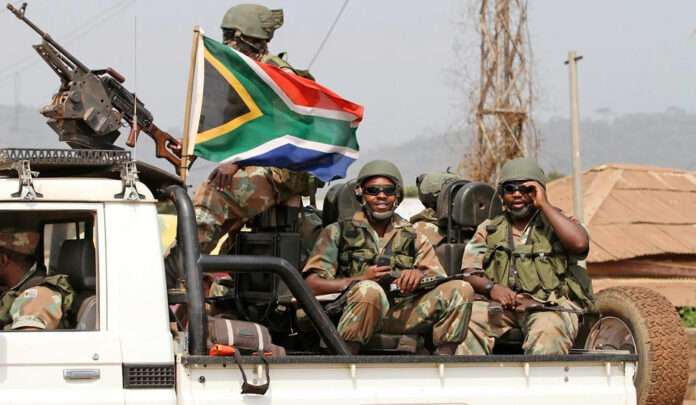
South Africa’s withdrawal of troops from the UN Stabilisation Mission in the DRC has been interpreted, in some circles, as a sign of our country’s retreat from Africa’s peace and security agenda. This is an incorrect interpretation.
As President Cyril Ramaphosa said, South Africa’s withdrawal from Monusco was influenced by the need to consolidate and realign our resources following nearly three decades of participation in UN peacekeeping efforts in the DRC.
Our country remains committed to peace and stability on the continent, even as geopolitical shifts introduce a new layer of complexity.
Our National Interest Framework is clear: there can be no development without peace and no peace without development. Continental security and stability are indispensable to South Africa’s own stability. For that reason, Africa’s security concerns and interests must shape South Africa’s policy choices, including in our international engagements. At the recent AU 39th Summit in Addis Ababa, we took practical steps to give effect to this commitment.
From South Africa’s perspective, the summit produced key positive outcomes, particularly on peace and security matters.
Four are worth noting.
First, together with Lesotho, South Africa was elected to serve a two-year term on the AU Peace and Security Council. The overwhelming support for our country from AU member states is a clear testament to the continent’s appreciation of, and confidence in, South
Africa’s track record in addressing Africa’s peace and security challenges.
The 15-member peace and security body will no doubt be seized with the burning challenges facing the continent.
These include the resurgence of unconstitutional changes of government, the scourge of terrorism and violent extremism and the illicit trade in small arms and light weapons, as well as the grave crises in Sudan and elsewhere.
In keeping with our Ubuntu diplomacy, we will promote dialogue and diplomatic solutions in conflict hotspots. For our continent to realise its full development potential, we must spare no effort to ensure that guns are silenced throughout Africa.
Second, at the ministerial level, South Africa now chairs the Agenda 2063 committee, the AU’s long-term plan for inclusive and sustainable development that aims to position Africa as an influential player in global affairs.
Thirdly, the summit also adopted the memorandum of understanding between the AU and regional economic communities. This move, which some states sought to frustrate for years, finally operationalises the African Standby Force. This is a breakthrough for the continent.
In keeping with UN Security Council Resolution 2719, we can now pursue sustainable financing for AU-led peace operations. This ensures that when African lives are at stake, African troops, backed by stable, assessed contributions, are among the first on the ground.
Pan-Africanism requires active, frank and often difficult mediation. Chairing the AU High-Level Ad Hoc Committee on South Sudan (C5) Plus Summit allows us to pursue inclusive political processes ahead of their December elections.
Similarly, as the next chair of the regional oversight mechanism for the DRC, South Africa will prioritise the restoration of sovereignty and territorial integrity in the Great Lakes region.
Finally, in a strong demonstration of a unified front and commitment to harmonise African positions on the world stage, the AU also endorsed South Africa for a non-permanent seat at the UN Security Council for 2031 to 2032.
This dovetails with the AU’s endorsement of the G20 Johannesburg Leaders’ Declaration, which tackles Africa’s debt burden, the need to democratise the work of credit ratings agencies, measures to reduce inequality within states and between regions of the world, especially between the global North and global South, as well as ethical and sustainable AI development, regulation and governance.
The assembly also resolved to establish a mechanism, led by the AU Commission, to follow up on progress in implementing the G20 Johannesburg Declaration and sent a clear message that South Africa’s participation in the G20 is not a favour.
As we engage the AU on continental issues, especially peace and security, we will be guided by the country’s foreign policy positions of promoting peace and stability on the continent, peaceful resolution of conflicts and inclusive dialogue by all parties.
Former president Nelson Mandela reminded us that peace is the greatest weapon for development any people can have. We will spare no effort to help build a peaceful, democratic, united and prosperous Africa.
- Lamola is the international relations and cooperation minister.


