


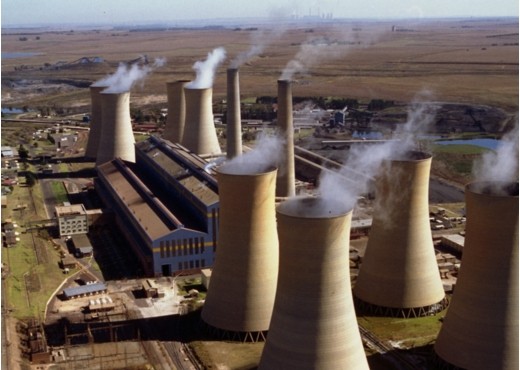
The small town of Komati in Mpumalanga has become the epicenter of a grand, high-stakes experiment: South Africa’s Just Energy Transition (JET). The decommissioning of the Komati Power Station in 2022 was heralded as a necessary, progressive step towards a low-carbon future. It was intended to be the blueprint – a pilot project demonstrating how a community dependent on coal could pivot towards
sustainable, green economic activity without being sacrificed on the altar of climate action.
The Just Energy Transition (JET) was indeed jet setting as bureaucrats hopped from capital to capital in preparation for a series of COPs that would follow. At the heart of the plot was the burial of the corpse of Komati. From Komati was expected a resurrection of tidings as discussions went on in airconditioned buildings across the world, whilst South Africa, with foolish distinction, stayed hellbent to please the world and sign and swallow the $8-billion bait hook, line and sinker.
Two years on, the narrative of a “just” transition is rapidly unravelling. The lived reality for the residents of Komati is not one of opportunity and renewal, but of profound economic anxiety and institutional abandonment.
The Lehohla Ledger traces the transition of disruption from a relatively good life in Komati that suddenly got disrupted by the JET, which left families destitute.
The Lehohla Ledger, utilising a rigorous, instrument-based diagnostic matrix that maps geo-spatial data against socio-economic indicators, has been tracking the pulse of Komati. My findings present a stark challenge to the official optimism when we model this for the region as the ghost of Komati reverberate and wails throughout the region and South Africa.
The transition in Komati is failing its primary procedural and substantive tests, generating two catastrophic indices that demand immediate national attention: a rapid Labour Disappearance Index (D-Index) and a nascent Democracy Collapse Index (C-Index).
The results affirm that South Africa is not poor because it lacks resources, but it is systematically impoverished by poverty of economic thought that has been replaced by a teller mentality who sits at the till and has a mandate to determine mission critical pathways. What a disgrace? Komati tells it all about a nation that has been crept by greed and devastating ignorance and to this end has lost economic morality all round.
The velocity of labour disappearance
We turn attention to the Mpumalanga region as a whole if the incorrigible JET lunatics have their way in replicating and unleashing their unrestrained Komati vile on Mpumalanga as a whole. The core promise of the JET is that new green economy jobs – in solar, wind, and battery storage – will not only replace the livelihoods lost in the coal sector but will catalyse a broader regional re-industrialisation.
Our data tells a different story. The Labour Disappearance Index (D-Index) measures the velocity at which formal, stable livelihoods are evaporating and being replaced by precarious, informal, or entirely absent economic activity. In Komati, the D-Index spiked brutally following the October 2022 shutdown.
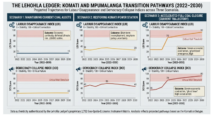
The closure did not eliminate just the 700 direct Eskom jobs. It triggered a systemic collapse of the local contracting and service ecosystem. The Lehohla Ledger captured the multiplier effect in reverse. As the anchor employer vanished, the local service economy—catering, transport, maintenance, retail—contracted with speed and ferocity. The unemployment rate within the immediate Komati residential area has soared, far exceeding the already high provincial averages.
Crucially, the D-Index also tracks the absorption rate of the proposed “repowering”; solutions. While the site is slated for a 150MW solar, 70MW wind, and 150MW storage microgrid, the immediate labour absorption capacity of these projects is a fraction of the jobs lost. Construction jobs are temporary and often sourced from outside the region. The permanent operations and maintenance jobs are minimal.
The D-Index reveals a “transition lag”; that is not merely a statistical blip but a lived economic catastrophe for hundreds of households. For these families, the “Just Transition”; is experienced as a one-way transition from formal employment to indigence. The green economy has not yet arrived at the scale required to offset the old.
The democracy collapse index
Even more insidious than the economic fallout is the erosion of community agency and trust. The Lehohla Ledger’s Democracy Collapse Index (C-Index) does not measure national electoral integrity; it tracks the procedural justice and substantive participation of the community in decisions that fundamentally reshape their lives.
The C-Index for Komati is currently flashing a critical red warning. The decommissioning process was largely perceived by the community as a top-down, technocratic decision, negotiated by national and international stakeholders in Pretoria and Glasgow, far removed from the realities of Komati. The promise of “procedural justice” — which requires meaningful, transparent consultation and shared
decision-making — was not met.
Residents, many of whom dedicated their working lives to powering the nation, report feeling marginalised, ignored, and treated as collateral damage in a larger geopolitical narrative. Their requests for credible reskilling programmes, local procurement guarantees, and psychosocial support during the transition were met with generic responses or bureaucratic silence.
The C-Index tracks this widening chasm between the state’s rhetoric of a “people-centered transition” and the lived reality of a community that feels acted upon, rather than included. When local priorities are consistently subordinated to macro-policy imperatives, the social contract fractures. This institutional disconnect is what the C-Index quantifies. The collapse of trust in this pilot project threatens the legitimacy of the entire national JET framework.
A transition that ignores the democratic imperative for community buy-in and ownership is not “just” it is simply economic displacement
repackaged with a green ribbon.
The urgency of a course correction
The Komati experience serves as a harrowing warning for the impending decommissioning of other major power stations, such as Hendrina, Camden, and Grootvlei. The “Just Transition” cannot succeed if it relies solely on energy-sector accounting (megawatts replaced by megawatts). It must prioritise the socio-economic and democratic resilience of the affected communities.
To reverse the alarming trends identified in the D-Index and C-Index, an urgent course correction is required:
Localisation of economic value chains: The repowering of Komati and other stations must be aggressively leveraged for local economic development. This requires hard mandates for local procurement, training, and employment in the construction and operation of new renewable facilities. The “green multiplier” must benefit Komati, not distant economic centers.
Meaningful reskilling, not tokenism: A robust, transparent social compact is needed to provide direct support and demand-driven reskilling for displaced workers and their families. Training must be initiated before decommissioning occurs, aligned with genuine job opportunities, and guarantee placement.
Deepening procedural justice: The democratic deficit must be addressed through the establishment of participatory governance structures with real decision-making power for affected communities. The community must be recognised as a primary stakeholder, not just a beneficiary awaiting directives.
The story of Komati is still being written. It can either be the graveyard of South Africa’s just transition aspirations or the catalyst for a necessary, people-centered course correction. If we fail to heed the warnings from Komati’s rapid labour disappearance and democracy collapse indices, the ghost of Komati will haunt the entire country’s socio-economic stability for decades to come. The choice is ours, but
the window to act is rapidly closing.
- Dr Pali Lehohla is a professor of practice at the University of Johannesburg, a research associate at Oxford University, and a distinguished alumnus of the University of Ghana. He is the former statistician-general of South Africa.
- The closure of Komati Power Station in 2022, a pilot for South Africa's Just Energy Transition (JET), has led to severe economic decline and increased unemployment in the local community, contrary to promises of green economic renewal.
- The Labour Disappearance Index (D-Index) shows a rapid loss of formal jobs and local economic collapse, with green energy projects failing to replace lost coal sector employment at a comparable scale.
- The Democracy Collapse Index (C-Index) highlights growing community distrust and marginalization due to a lack of meaningful consultation and participation in transition decisions.
- The JET's failure in Komati risks replicating similar social and economic crises in other Mpumalanga coal-dependent regions, threatening the overall legitimacy of South Africa’s green transition framework.
- Urgent corrective measures include local economic development mandates, genuine reskilling initiatives, and stronger community governance to ensure a just, people-centered energy transition.


