


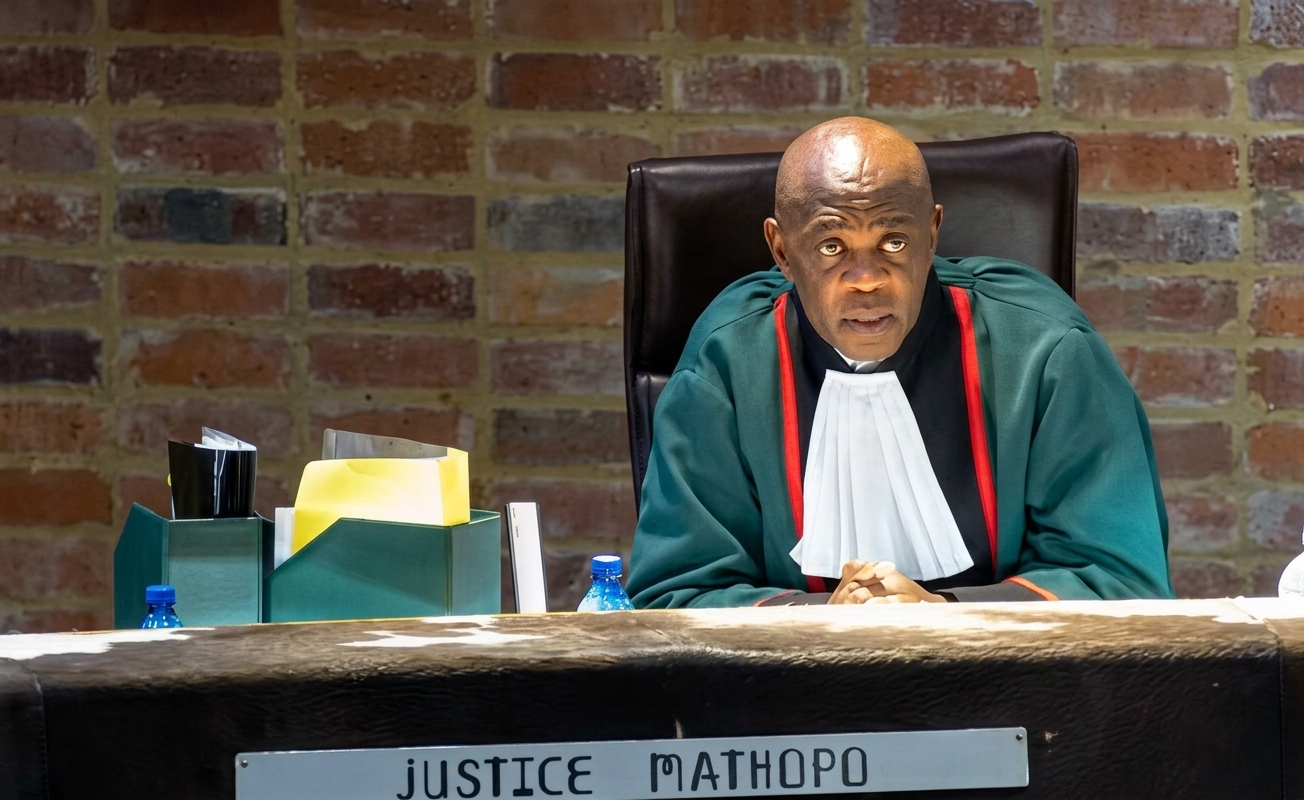
The social media outrage directed at Constitutional Court Justice Rammaka Mathopo for questioning the foundational legal instruments underpinning the Electoral Commission of South Africa’s (IEC) final submission button exposes an uncomfortable contradiction in South Africa’s democratic discourse.
We demand constitutional accountability from politicians, yet some appear offended when a constitutional judge interrogates whether administrative procedures hold the unfortunate potential to undermine voters’ rights.
Since when did asking difficult constitutional questions become an act of political betrayal?
READ MORE: ANC argues IEC submission requirement threatens constitutional rights
Mathopo’s questioning during Monday’s hearing over the ANC’s excluded municipal candidates was not a declaration of support for the governing party. It concerned something infinitely bigger: whether voters should suffer the consequences of an administrator’s failure to click a computer button.
The ANC may have been negligent. That is a legitimate argument. But intellectual dishonesty begins when political hostility towards the ANC prevents us from examining whose constitutional rights might ultimately be sacrificed.
Such selective constitutional outrage risks reducing a serious democratic question to a partisan shouting contest.
Mathopo put his concern plainly:
“It looks to me that it’s something very drastic, far-reaching, that impacts upon the rights of the voters.”
Interestingly, he was not the first prominent voice to raise this concern.
On September 18, Afrika Mayibuye Movement president Floyd Shivambu wrote to the IEC warning against technical requirements disenfranchising communities.
Shivambu may have been accused of many blunders, but where he speaks the truth, he must be given his flowers.
His letter cited 2 274 prospective candidates from 45 political parties whose details were captured electronically but not finally submitted.
He wrote: “An administrator’s genuine mistake should not, wherever lawful correction is possible, become a community’s lost political choice.”
That brings us to our imaginary Exhibit A in this marauding court of public opinion: Thabo Thiba Thabang of Majembeni, Bushbuckridge.
Imagine Thabo Thiba Thabang participating in community consultations to identify a councillor capable of ending years of unreliable water supplies, deteriorating roads and municipal neglect.
His community selects its preferred candidate. Documents are completed, and the candidate’s information is uploaded electronically. But somebody fails to click the final submission button.
Suddenly, a seemingly mundane administrative omission threatens to become a monumental democratic disappointment.
Should Thabo Thiba Thabang lose his preferred candidate because of a bureaucratic blunder he neither committed nor could prevent?
Consider ten constitutional arguments.
1. Democracy belongs to voters
Section 1(d) establishes universal adult suffrage and multiparty democracy. Electoral administration serves citizens, not the other way around.
2. Political choice is fundamental
Section 19(1) protects freedom to make political choices. Thabo Thiba Thabang’s preference deserves consideration even when his chosen party bungles paperwork.
3. Elections must be fair
Section 19(2) guarantees free and fair elections. Fairness demands both enforceable rules and meaningful political participation.
4. Voting must have substance
Section 19(3)(a) protects voting rights. Thabo Thiba Thabang may retain his ballot while losing the opportunity to support his preferred candidate.
5. Candidates possess rights
Section 19(3)(b) protects the right to stand for public office. Candidates may suffer exclusion through mistakes committed by administrators.
6. Political association matters
Section 18 protects freedom of association. Community political organisation deserves constitutional consideration beyond election-day voting.
7. Administration must be lawful
Section 33 protects lawful, reasonable and procedurally fair administrative action. Where applicable, exclusion decisions must withstand these standards.
8. Rights limitations require justification
Section 36 requires constitutionally justifiable limitations. Restrictions affecting political rights demand legal authority and consideration of lawful alternatives.
9. Equality cannot be selective
Section 9 guarantees equality before the law. Any corrective mechanism must apply consistently, whether the affected organisation is the ANC, Mayibuye or an independent contestant.
10. Constitutional interpretation is paramount
Section 39(2) requires legislation to be interpreted in a manner promoting the Bill of Rights. Electoral procedures must be understood within that constitutional framework.
Shivambu captured the democratic dilemma:
“Those voters may retain the formal right to cast a ballot. But removing the option they wished to support substantially diminishes the choice that gives that ballot meaning.”
Of course, the IEC has a legitimate obligation to enforce deadlines, maintain accurate nominations and protect electoral certainty. Uploading documents does not necessarily amount to legally completing a nomination.
READ MORE: ANC can’t pick and choose IEC rules, advocate Motau tells ConCourt
But the central question remains whether the disputed requirement possesses the legal authority to justify exclusion.
Mathopo asked:”And is an innovation something that can acquire the force of the law?” That question demands rigorous legal reasoning, not reflexive political outrage.
Shivambu’s appeal was equally compelling: “Correct what can lawfully be corrected. Allow qualifying candidates to face the judgment of the voters.”
The Constitutional Court must determine what the law permits, not rescue political parties from every administrative blunder.
But returning to Thabo Thiba Thabang, what is the point of holding an election if the community’s preferred candidate is excluded through an omission that the law might permit to be corrected?
Surely, our hard-won constitutional democracy deserves better than allowing an avoidable technological technicality to eclipse the very people it was designed to empower.
The ballot belongs to the voter. The button belongs to the administrator. Confusing the two risks making democracy answerable to machinery rather than the people.
RELATED
Troubled pasts cast shadow over ANC’s mayoral picks
- Constitutional Court Justice Rammaka Mathopo questioned whether the IEC's final submission button requirement could undermine voters' rights amid ANC's excluded municipal candidates controversy.
- Afrika Mayibuye Movement president Floyd Shivambu warned the IEC about technical requirements potentially disenfranchising over 2,274 prospective candidates from 45 political parties.
- The article outlines ten constitutional arguments emphasizing voters' rights, fair elections, lawful administration, and consistent equality concerning candidate exclusions due to administrative errors.
- The IEC must enforce deadlines and maintain electoral certainty, but the central legal issue is whether the final submission button requirement has the lawful authority to justify candidate exclusion.
- The Constitutional Court is tasked with determining the legality of administrative requirements without political bias, emphasizing that elections should not be undermined by avoidable technical mistakes.


