


“Who ya gonna call?” was an easy question in Ghostbusters.
In the movie, if there was something strange in the neighbourhood, you knew exactly who to call, and even more importantly, somebody would answer and respond.
In South Africa, considerably less supernatural problems can be much harder to navigate.
Who do you call when you spot a fire in the veld? Who is accountable for the derelict park? Who is accountable when a government programme exists on paper but does not appear to function where people live?
My response to my staff was always “Google will set you free” until someone challenged me with: “How will it?”
Websites of public entities profile the political leadership and senior management, but always have a generic info@ email address. Bottom line, we have become remarkably accustomed to not knowing who to call.
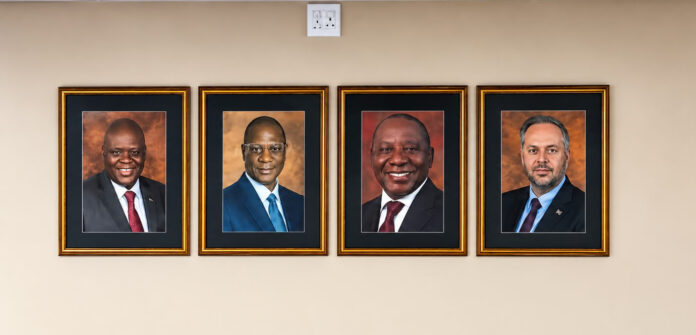
During a recent visit to China, one noticeable difference kept surfacing irrespective of what city I visited, what building I went into and often even the street corner I was standing at. You did not see any photographs of politicians in public buildings. What you did see were photographs of the people who were accountable.
In a museum, at a public facility, even around something as ordinary as a public toilet, there would be the name and photograph of the responsible person, together with clear instructions on where to complain in both Mandarin and English.
Even the local police officer responsible for an area had his picture and a complaints number. The message was clear and simple: this the person responsible.
There are many things about China’s system of government that are very different from ours, and this is not an article about political systems. It is an observation about something much more basic. There is a need for accountability and responsibility to have a human address.
You often hear complaints about decisions made by faceless bureaucrats. This must change, we deserve to know “where the buck stops”, “who is accountable”, and “how do I get hold of them”.
I have been thinking about this increasingly while preparing for the upcoming Safety 2026 conference in Cape Town.
Safety is perhaps the ultimate test of whether the government can work across boundaries. Violence, road injuries, child safety, unsafe schools, gender-based violence, dangerous public spaces and emerging digital harms do not belong neatly inside one government department.
Preventing them requires health, policing, justice, education, transport, social development, local government and others to work together.
As a build-up to the conference we have been working on several consensus documents designed to promote a whole-of-society, whole-of-government approach.
Early in the year we attempted to identify the appropriate people in provincial and national government who should be part of these conversations.
This required us to step outside our comfort zone of health and reach out to departments where we do not have an extensive contact network.
The experience has been instructive, and sadly, not in a good way. Except for one province, simply trying to discover who is the responsible official was an exercise in frustration, if not futility.
If you are lucky enough to track down the responsible person’s e-mail, you had to be extremely patient. In a few cases, we received responses months after they were sent; in most cases we never heard back.
Many were deleted without being read (someone needs to explain to senior public servants that there is a “confirm delivery option” in Outlook that tells you when an email is deleted without being read). The owners of the info@ or enquiries@ e-mail addresses presumably have passed on.
Switchboards ask you what the extension is of the person you are looking for. Clearly, internal phone books do not exist. If you eventually find someone, they will refer you to another, who suggests somebody in another department. Sometimes, months later, somebody responds.
What this exercise exposed is a serious weakness in the machinery of accountability.
One of our focus areas is gender-based violence and femicide (GBVF). There is no question that here, our priorities and those of government align. In November 2025, GBVF was formally classified as a national disaster under the Disaster Management Act.
In his February 2026 State of the Nation Address, President Cyril Ramaphosa said the classification should enable government to better coordinate its response and direct efforts towards interventions with the greatest impact.
That necessarily requires multiple departments, spheres of government and institutions to work together. So, here is my question, probably an uncomfortable question. If something is important enough to be classified as a national disaster, should it not be easy to identify and contact the people responsible for responding to this disaster?
We tried and we failed. So, if an organisation like us, working nationally, and with established networks and institutional resources, struggles to identify and reach the appropriate officials, what chance does a citizen stand?
Accountability cannot exist in abstract, the basics of any implementation plan in business is what, where, when and most importantly who. The who must be a person, not an abstract designation on an organogram. The who must also be easily accessible to the average citizens.
This matters because visible and functional accountability is preventative.
A manager who knows that performance is visible, that they are obliged to respond to correspondence, that clearing your inbox by deleting unread emails is not acceptable, that outcomes will be measured, and that failure requires explanation, behaves in a very different system from one in which responsibility can disappear into a departmental maze.
There is a much simpler test that any citizen should be able to apply for every major public service, programme or priority:
• Who is responsible?
• How do I contact them?
• When should I expect an answer?
• And who do I contact if I do not get one?
Imagine if every government website, clinic, police station, school and municipal facility answered those four questions clearly. Imagine if the person accountable for an outcome was as visible as the politicians in the foyers of every public building.
•Dr Wolvaardt is the founder of the Foundation for Professional Development, and has recently stepped down as MD.
- In South Africa, it is often difficult to identify and contact the responsible officials for public services and programmes, with generic email addresses and slow or no responses common.
- In contrast, in China, public buildings display photographs and contact details of accountable individuals, providing clear instructions for complaints in multiple languages.
- The article highlights the challenge of accountability in South African government departments, especially when coordination across multiple sectors is required, such as in addressing gender-based violence and femicide (GBVF).
- GBVF was declared a national disaster in South Africa in November 2025, aimed at improving government coordination and intervention efforts, but identifying and reaching responsible officials remains problematic.
- The author argues for the necessity of visible and functional accountability, suggesting government entities should clearly indicate who is responsible, how to contact them, expected response times, and escalation contacts.


