


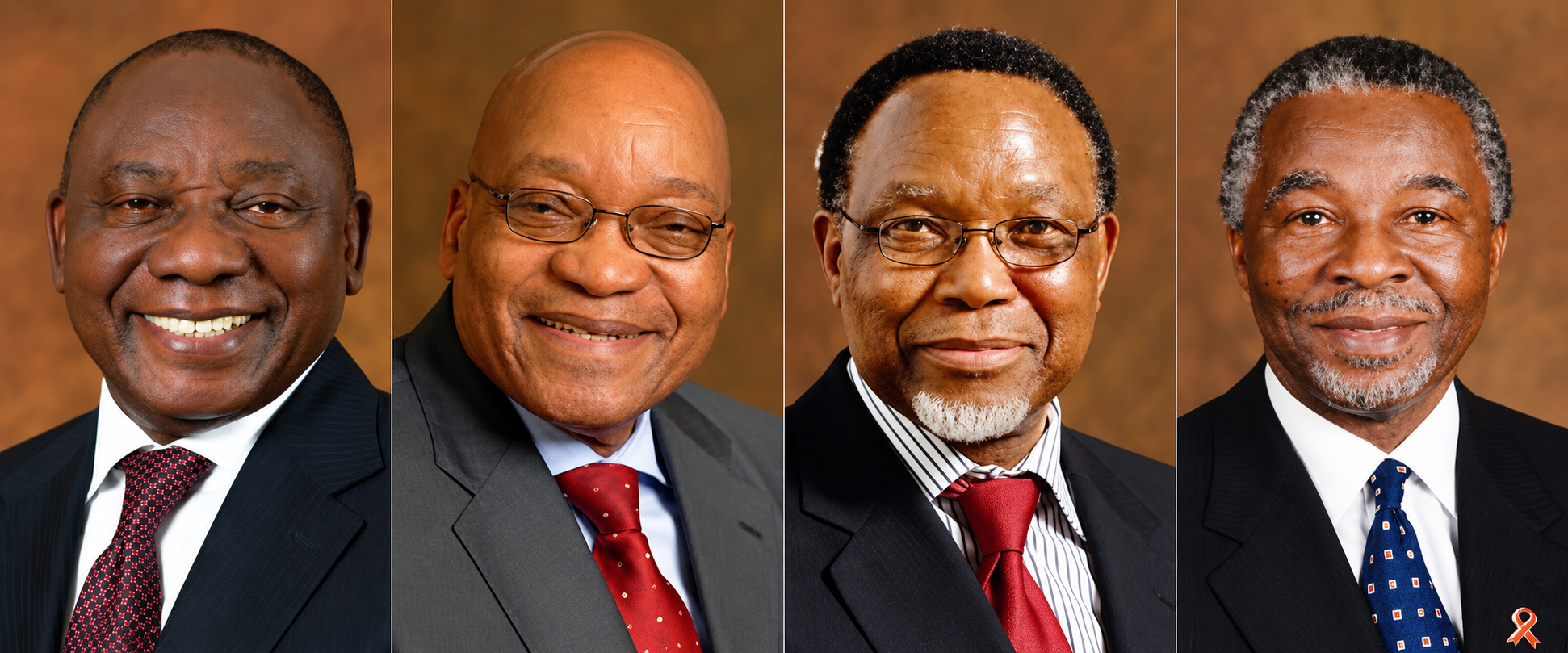
The Constitutional Court has delivered a damning judgment against South Africa’s Presidency, finding that four successive presidents violated their constitutional obligations by allowing two innocent men to wait 24 years for presidential pardons.
In a unanimous judgment delivered on Wednesday, the apex court found that former presidents Thabo Mbeki, Kgalema Motlanthe and Jacob Zuma, together with President Cyril Ramaphosa in his official capacity, failed to ensure that a joint pardon application was decided diligently and without delay.
The extraordinary ruling follows a decades-long struggle by Fusi Simon Mofokeng and Tshokolo Joseph Mokoena, who spent 19 years behind bars for crimes the court found they had not committed.
Mokoena died before his name could be cleared. His widow, Xoliswa Percival Mokoena, continued the legal battle on behalf of his estate.
Justice Narandran Kollapen, writing for a unanimous bench of nine judges, ruled that the applicants were entitled to constitutional damages, with the amount to be determined after further submissions.
The court found that the presidential failures extended across successive administrations, although liability attached to the office of the Presidency rather than the former presidents personally.
Innocent men imprisoned for 19 years
The case originated from a deadly shoot-out between an ANC self-defence unit and police officers in Bethlehem, Free State, on April 2, 1992.
One police officer was killed and another seriously injured.
Mofokeng and Mokoena were convicted of conspiracy to commit robbery, attempted murder and murder, despite neither having participated in the shoot-out nor belonging to the self-defence unit.
Their convictions rested on the doctrine of common purpose and the evidence of a single unreliable state witness.
They were sentenced to life imprisonment plus another 18 years.
During Truth and Reconciliation Commission proceedings, three members of the self-defence unit confirmed that the convicted men had no involvement in the attack and were complete strangers to them.
READ MORE: “We reveal: How Walus spent his 28 years in jail”
Four actual participants received amnesty.
Mofokeng and Mokoena, however, refused to admit guilt for crimes they maintained they had not committed, leaving them unable to obtain amnesty through the same process.
They eventually secured parole in April 2011 after spending 19 years in prison.
Presidential pardon application disappeared
The two men submitted their joint presidential pardon application in November 2001.
But the application remained unresolved through successive presidencies.
The court heard that the Presidency could not explain why the original application had never reached the president’s office, despite having been processed by the Department of Justice.
The government argued that the original application had effectively been overtaken by subsequent legal processes and that a fresh application was submitted in 2021.
The Constitutional Court rejected this explanation.
Kollapen found that the original application remained valid and that the government could not escape responsibility by claiming the documents had never reached the presidents themselves.
The judgment stated:
“The only way in which a 24-year delay could have occurred is through wilful neglect or gross negligence.”
The court rejected the government’s explanation that the department responsible for processing pardons was understaffed.
It also dismissed the argument that the delay should be calculated from 2021 rather than 2001.
Court condemns government’s callousness
The judgment was especially critical of the government’s treatment of Mokoena during his final days.
Officials had been informed that he was in poor health and wanted his pardon application decided before his death.
Two weeks later, the department was notified that he had died.
There was no response.
Kollapen described the government’s conduct as shocking, saying the men had spent decades pleading for decisions while enduring the stigma of convictions for crimes they had not committed.
The court also criticised the government’s attempt to argue that Mokoena’s death prevented his estate from pursuing constitutional damages.
“This is untenable and smacks of an uncaring attitude,” Kollapen wrote.
He said the government’s conduct was considerably worse than the president’s description of the circumstances as deeply regrettable.
The court found that the Presidency’s failures could not be excused by administrative problems or the fact that the pardons were eventually granted.
Ramaphosa pardoned men in December
The litigation was launched in the Constitutional Court in August 2025.
After the case was instituted, Ramaphosa undertook to decide the pardon application by January 31, 2026.
He eventually granted both men full presidential pardons on December 19, 2025, including a posthumous pardon for Mokoena.
However, the court ruled that granting the pardons did not erase the constitutional violations committed over the preceding 24 years.
It found that the right to have a pardon application considered diligently and without delay was distinct from the president’s discretion to grant or refuse a pardon.
The judgment also established that the president remained constitutionally accountable for failures within the administrative machinery handling pardon applications.
Constitutional damages ordered
In a significant development for constitutional law, the court ruled that monetary compensation was the most appropriate remedy for the prolonged failure to fulfil presidential obligations.
It found that forcing the applicants into another lengthy damages lawsuit would be manifestly unjust after their decades-long struggle.
READ MORE: “Former President Jacob Zuma released on medical parole”
The applicants must submit written arguments on the amount of constitutional damages by November 11, while the respondents have until November 25.
The court also left open the possibility of separate delictual damages proceedings in the High Court, subject to safeguards against double compensation.
Ramaphosa, in his official capacity, was ordered to pay the applicants’ legal costs.
Although the court declined to order a structural overhaul of the pardon system, it expressed an expectation that the Presidency would review its processes and prevent similar failures.
Kollapen concluded that the men had fallen between the cracks of the TRC and the criminal justice system, where those who admitted involvement in politically motivated crimes received amnesty while innocent people remained imprisoned.
“They were failed, and callously so,” he wrote.
- The Constitutional Court ruled that four successive South African presidents violated constitutional duties by delaying presidential pardons for two innocent men for 24 years.
- Fusi Simon Mofokeng and Tshokolo Joseph Mokoena were wrongly convicted and imprisoned for 19 years for crimes they did not commit, with Mokoena dying before his name was cleared.
- The joint pardon application submitted in 2001 went unresolved as it did not reach the president's office due to negligence, and the court rejected government's claims of understaffing or subsequent applications nullifying the original.
- President Cyril Ramaphosa granted full presidential pardons, including posthumously for Mokoena, in December 2025 following constitutional court litigation started in August 2025.
- The court ordered constitutional damages to be paid to the applicants, with submissions on the amount due by November 11, and mandated Ramaphosa to cover legal costs while urging a review of pardon processes.


