


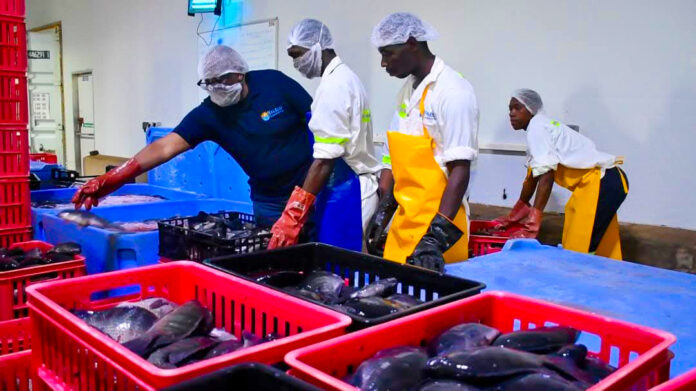
More and more Zambians are finding their fortune not at the copper mines, but in the water.
Sibongile Sonile Nthani is among those trying their hand at fish farming, benefitting from the experience of multinational Zambian players already in the market and government support.
“I never imagined I’d become a fish farmer,” said the 27-year-old Nthani with a laugh. “But when I saw how much fish we were importing, I knew there was an opportunity.”
She scattered feed across her fish ponds as the sun rose over the small town of Kafue, just outside Lusaka.
Across Zambia, people like Nthani are transforming fish farming from a small, rural practice into a profitable agribusiness that is reshaping how the country feeds itself.
A growing blue economy
Zambia consumes more than 170 000 metric tons of fish every year, yet nearly a third is imported.
To bridge that gap, the government has identified aquaculture as a key growth sector to create jobs, reduce imports, and boost food security.
Through the Ministry of Fisheries and Livestock, initiatives like the Aquaculture Seed Fund and the Citizens Economic Empowerment Commission offer low-interest loans to youth and women.
According to ministry director Evans Mutanuka, almost 20,000 small-scale farmers have benefited in the past five years.
“Our goal is to make aquaculture a sustainable business, especially for women and young people,” Mutanuka explained.
“We’re also partnering with private companies to improve hatcheries and feed production so that farmers have access to quality inputs locally.”
Private innovation and export growth
“In the past, fish farming was something older rural men did with a small backyard pond,” said Fisho Mwale, a pioneer whose company Yalelo now produces more than 18 000 metric tons of fish each year, supplying markets in Zambia and across southern, east, and central Africa.
“Now we’re seeing a new generation that’s educated, tech-savvy, and business-minded,” he added.
Mwale’s team runs workshops teaching farmers how to manage feed, monitor water quality, and connect with buyers through digital platforms.
For women like Sibongile, this shift has been life-changing. “I wanted something I could own and grow,” she said.
“It’s not easy. Pond construction is expensive, but with perseverance, training and small grants, it’s possible.”
In his recent 2026 national budget address, Zambia’s Finance Minister, Dr. Situmbeko Musokotwane, described aquaculture as one of the country’s fastest-growing industries, producing over 89 000 metric tons of fish in 2024—the highest in southern Africa.
Experts say Zambia’s rise mirrors a continental trend. The African Union’s Inter-African Bureau for Animal Resources notes in its Africa Blue Economy Strategy (2023) that aquaculture is expanding by over 5% annually across the continent, helping nations reduce imports and strengthen intra-African trade.
Zambia’s success, they say, could serve as a model for other African countries seeking to diversify beyond traditional agriculture and mining.
Zambia is one of the top 20 African countries whose economy heavily relies on exports of mining resources.
Challenges and opportunities
Despite strong growth, challenges persist. Feed costs remain high, accounting for nearly 60% of production expenses, while climate change affects pond water levels. Local producers also face competition from cheaper imported fish.
“I sometimes struggle to find consistent buyers,” said John Phiri, a fish trader at Lusaka’s Lilanda Market.
“People prefer imported fish because it looks bigger and cheaper. But when I explain that local fish is fresher and supports our farmers, more are willing to buy.”
Still, optimism runs high. With improved feed manufacturing, stronger value chains, and increased investment, Zambia’s aquaculture sector is well-positioned to meet domestic demand and export more across Africa.
A new generation rising
Dr Kunda Ndashe, an aquatic animal health researcher at the University of Zambia, said that sustained growth will depend on innovation and investment.
“To achieve our targets, we need affordable and sustainable feed production, good-quality fingerlings, and stronger biosecurity and fish health systems. We must also expand research into climate-smart aquaculture.”
As the sun set, Sibongile checked her ponds one last time. The fish have grown steadily over the past few months, and she’s preparing to harvest her biggest order yet. It’s a supply for a local hotel chain.
“When I started, people laughed and said fish farming was for men,” she recalled with a smile. “Now, they ask how to start their own ponds.”
Her story reflects a broader transformation, which has seen a generation of younger Zambians prove that the next wave of economic growth may not come from the copper mines, but from the waters.
In ponds across the country, Zambia’s fish farmers are telling a new story of resilience, innovation and self-reliance that echoes across Africa’s Blue Economy.
bird story agency
Visit SW YouTube Channel for our video content
- More and more Zambians are finding their fortune not at the copper mines, but in the water.
- Sibongile Sonile Nthani is among those trying their hand at fish farming, benefitting from the experience of multinational Zambian players already in the market and government support.
- “I never imagined I’d become a fish farmer,” said the 27-year-old Nthani with a laugh.
- “But when I saw how much fish we were importing, I knew there was an opportunity.” She scattered feed across her fish ponds as the sun rose over the small town of Kafue, just outside Lusaka.
- Across Zambia, people like Nthani are transforming fish farming from a small, rural practice into a profitable agribusiness that is reshaping how the country feeds itself.


