


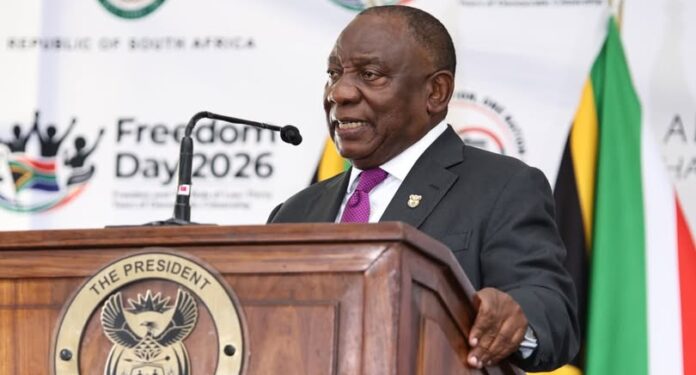
President Cyril Ramaphosa has underlined the government’s determination to confront organised crime and rebuild trust in the state while acknowledging the challenges still faced under South African democracy.
As the country remembers the end of apartheid and the first democratic elections in 1994, Ramaphosa said in his Freedom Day speech in Bloemfontein that work was being done to strengthen institutions that had been weakened by corruption and criminal networks.
“We are reforming and strengthening the criminal justice system, rooting out corruption, and building a police service and a prosecuting authority in which people can have trust and confidence,” Ramaphosa said.
He emphasised that tackling organised crime and corruption requires a collective effort and urged citizens to play an active role in improving safety and accountability.
In an effort to tackle crime and corruption, the South African National Defence Force (SANDF) has been deployed to assist police fight organised crime, illegal mining, and gang violence, while a Judicial Commission of Inquiry into Criminality, Political Interference, and Corruption in the Criminal Justice System is also underway.
Renewal of democratic promise
Ramaphosa framed the fight against crime as part of a broader renewal of the country’s democratic promise.
“Today we take the opportunity to reflect, renew, and reaffirm our commitment to the social contract we entered into 32 years ago.
“This is a compact that demands active citizenship, democratic oversight, and a state that delivers justice, services, opportunity, and dignity in return for public trust.
“This is a solemn agreement that must be renewed in every interaction between the state and the people to whom it is accountable, in every service delivered, and in every life improved,” he told hundreds of people.
He said the government of national unity is focused on inclusive growth and job creation, while also addressing the structural weaknesses that have allowed crime and corruption to take root.
The president noted the failing infrastructure and weak local governance as factors that not only harm daily life but also create opportunities for corruption and criminal activity.
“Failing water infrastructure, collapsing municipalities, and deteriorating services are not mere inconveniences.
“They directly affect the quality of daily life, and they constrain the growth of businesses and the creation of jobs.
“Our resolve to strengthen local government provides an opportunity to transform municipalities, making them better run, more efficient, and more responsive to the needs of our people,” he said.
Government’s economic plans
He added that the success of democracy must ultimately be measured by improvements in people’s living conditions.
“This is important because the truest test of our democracy is whether freedom translates into material change in people’s lives.
“Dignity starts with the most basic things: a roof over one’s head, clean running water, and reliable electricity.
Freedom means being able to go to a clinic when sick, have a school for one’s children, and be provided for in old age.
“Advancing human dignity is the promise of our constitution and the fundamental value from which all other human rights flow.”
He linked this vision to the government’s economic plans, including infrastructure investment and reforms aimed at boosting growth and reducing inequality.
- President Ramaphosa reaffirmed the government's commitment to fight organised crime, corruption, and rebuild trust in South Africa’s institutions, particularly the criminal justice system.
- The South African National Defence Force (SANDF) has been deployed to support police in combating organised crime, illegal mining, and gang violence, alongside an ongoing Judicial Commission of Inquiry into criminality and political interference.
- Ramaphosa framed the anti-crime efforts as part of renewing the country's democratic promise, emphasizing active citizenship, democratic oversight, and accountable governance.
- He highlighted failing infrastructure and weak local governance as key factors enabling corruption and crime, pledging to strengthen municipalities for better service delivery and economic growth.
- The president linked democracy’s success to tangible improvements in citizens’ living conditions, focusing on dignity through access to basic services and economic reforms aimed at boosting growth and reducing inequality.


