


A clash within the board of the National Student Financial Aid Scheme over the appointment of a chief executive officer triggered a string of resignations this week that left the board with just seven members, and at risk of being dissolved.
At the same time, the remaining members have written back to Higher Education Minister Buti Manamela, insisting the board is still functional despite the exits, and that the scheme, with an annual budget of R60-billion, should not be placed under administration.
At the centre of the clash is a recommendation of the board’s Human Resource and Organisational Development (HROD) committee on who should be appointed CEO of NSFAS. Sharp differences emerged at a meeting held on April 14, which deliberated on the decisions of a panel that interviewed three candidates for the R3.5 million per annum role.
The panel – made up of individuals within NSFAS, also included two deputy directors-general from the department of higher education and training, and the CEO of Universities South Africa. It recommended the appointment of the former head of the National School of Government, Busani Ngcaweni, whose aggregate score was slightly higher than that of current acting NSFAS acting CEO Waseem Carrim. Another shortlisted candidate, Lindiwe Kwele, was ranked lowest in the aggregate scores.
Carrim was, however, ranked higher in the psychometric assessment, which deemed him an “acceptable fit” for the role, while Ngcaweni, who has joined the University of Johannesburg as director of its Centre for Public Policy and African Studies, was deemed a “moderate fit”. Kwele was assessed as a “limited fit”.
However, when the board’s HROD Committee met to deliberate on the CEO recruitment, its chair, Karabo Mohale, supported the panel’s recommendation of Ngcaweni, while four other members – Siyanda Mngadi, Lavan Gopaul, Portia Loyilane and Johanna Maphutha – rejected this recommendation, and indicated they preferred Carrim for the role.
Loyilane told the committee she considered the psychometric assessment outcomes stronger than aggregate scores, saying Carrim had demonstrated strong strategic capability, strategic thinking and leadership attributes.
Mngadi supported Loyilane’s view, describing the differences in the scores between the leading candidates as “minimal and mathematically insignificant”. He is also said to have favoured continuity in the role.
Maphutha, in motivating for Carrim’s appointment, told the committee that the differences in the aggregate scores were minimal and not materially significant to determine suitability.
Gopaul submitted to the committee that although Ngcaweni was academically accomplished, he did not meet the specified criteria.
He expressed the view that the role of CEO required strong practical leadership in managing a large and complex financial institution.
But Mohale voiced her preference for Ngcaweni, describing him as administratively strong, with extensive leadership experience in the public sector, citing his roles at the National School of Governance and the Presidency.
In its final recommendation to the board, the committee said it had resolved by majority view (with four members supporting and one dissenting) to recommend Carrim as the preferred candidate.
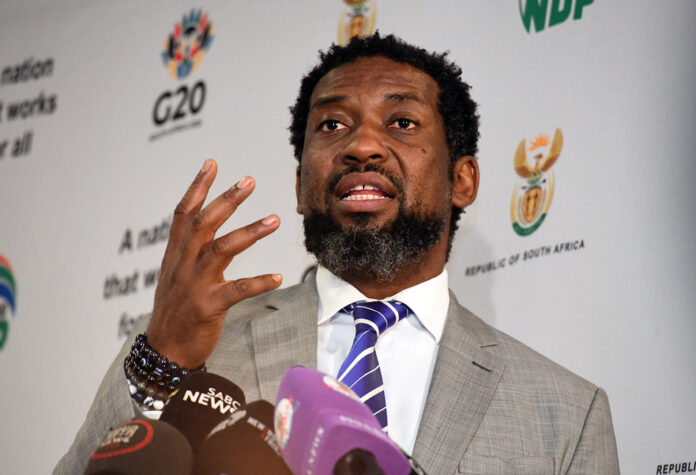
Manamela has now been placed at the centre of the row, with political insiders accusing him of trying to impose his favourite candidate on the board and of engineering a crisis by triggering this week’s resignations in order to place NSFAS under administration. Manamela has vehemently denied the allegations.
Acting NSFAS chair Mugwena Maluleke resigned alongside Mohale, citing personal and academic commitments as the reasons for his departure. It is alleged that Manamela tried to influence his preferred candidate by winning over Maluleke and Mohale.
Manamela is said to have called a meeting with board members in Johannesburg on April 13 where their mobile phones were allegedly confiscated. This was two days before the meeting of the HROD committee to finalise the CEO recruitment and recommend a successful candidate to the board.
Manamela is said to have told those who attended the meeting of the need to halt the recruitment process. An insider said the minister indicated he was consulting Luthuli House (ANC headquarters) to seek a political mandate on the matter.
EFF MP and member of the portfolio committee on higher education, Sihle Lonzi, has formally written to Manamela quizzing him about the alleged secret meeting.
“What is the nature and purpose of the ‘political consultations’ you indicated were necessary in relation to the CEO appointment?” Lonzi wrote.
On Wednesday, Manamela issued a media statement saying he had received and accepted a series of resignations from the NSFAS board, including those of Maluleke and Mohale.
“The cumulative effect of these and other resignations has significantly reduced the number of remaining voting members of the board, raising serious concerns regarding the Board’s ability to continue to constitute itself lawfully and to discharge its statutory and fiduciary responsibilities,” the statement read.
Manamela also sent letters to each of the remaining board members asking them to explain how it would function going forward. In a response to him, dated April 30, the remaining Board members were in a defiant mood, saying they don’t accept the minister’s characterisation that the board “is no longer capable of constituting itself in a manner that enables lawful and effective decision-making”.
They said in terms of the Board charter, the majority of the members will constitute a quorum provided that three members of the executive leadership of NSFAS are present in meetings.
“The present composition satisfies these requirements when all seven remaining members are present. The board is therefore able to convene, deliberate, and take binding decisions.”
The board further requested undertakings from the minister that he would not place NSFAS under administration and will take immediate steps to fill the existing vacancies.
Manamela’s spokesperson, Matshepo Seedat, rejected claims of interference with the board, saying the decisions by individual members to resign had nothing to do with him.
“Any suggestion that the Minister orchestrated or influenced the resignation of board members is entirely false and without basis”.
She said the minister does from time to time meet with Boards of entities that fall under his department in the “ordinary course of governance and oversight”.
“Allegations that the Minister sought to improperly influence board processes are denied,” Seedat said.
Responding to Sunday World through his lawyers, Maluleke said he had made the reasons for his resignation public.
“When Dr Maluleke assumed the position of interim chairperson, it was understood this would be for a short period.
“The appointment of a (CEO) is the prerogative of the Board and does not depend on any individual board member’s preference,” his lawyers said.
Mohale said the recruitment process had been conducted within an established governance framework, guided by applicable legislation and policy.”
“As with any process of this nature, there were robust engagements and differing professional views, which are not unusual in board settings.”
Mohale said her resignation from the Board was a “considered personal and professional decision”. She refused to comment on what transpired in the meeting of the HROD Committee as the deliberations were confidential.
Ngcaweni said he could not provide details on the process he undertook as the headhunting firm that initially contacted him had not provided any information in over a month.
“I will reach out to them upon returning to South Africa and gather more details since they have been my sole channel of communication.”
Carrim confirmed he had applied for the role, participated in interviews, done a psychometric assessment, and subjected himself to criminal, credit and qualification checks.
“I have not had any outcome of the above process communicated to me,” he added.
- Additional reporting by Queenin Masuabi.
Visit SW YouTube Channel for our video content
- A dispute over the CEO appointment at NSFAS caused multiple board resignations, leaving only seven members and risking board dissolution.
- The conflict centers on choosing between Busani Ngcaweni, favored by the panel and HROD chair, and acting CEO Waseem Carrim, preferred by a majority of the HROD committee.
- Higher Education Minister Buti Manamela is accused of trying to impose a preferred candidate and interfering in the recruitment, allegations he denies.
- Remaining board members insist they are still functional per their charter and oppose placing NSFAS under administration.
- Resigning chair Mugwena Maluleke and HROD chair Karabo Mohale cited personal reasons, while debates continued over the recruitment process transparency and political influence.


