


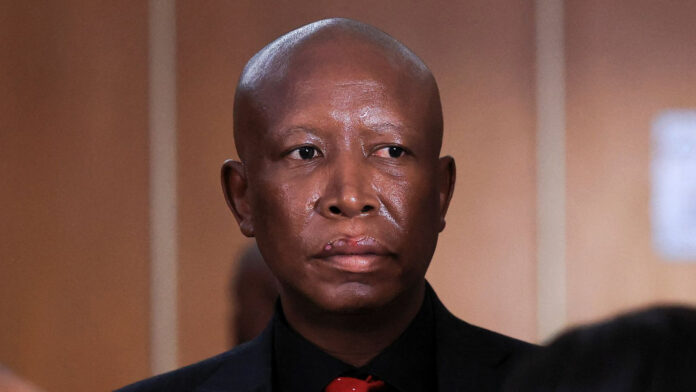
Economic Freedom Fighters (EFF) leader Julius Malema has defended the party’s controversial “Kill the Boer, Kill the Farmer” chant, arguing that it should not be interpreted as an instruction to kill farmers, as the slogan continues to feature in tensions between South Africa and the US.
He was speaking at the EFF’s Tshela Thupa rally at Orlando Stadium in Soweto on Saturday, ahead of the November 4 elections. Malema said the chant belonged to the country’s liberation history but insisted that violence against farmers and farm workers had to end.
“The chant ‘Kill The Boer, Kill The Farmer’ was never meant in a literal sense. The killings in the farms and of farmers must stop and must stop now,” he said.
Malema’s comments followed the attack on North West farmer Donovan Marx in the Ventersdorp area, where he was shot and stabbed before his attackers allegedly mutilated him by cutting off his ears.
The EFF leader condemned the brutality of the attack and questioned how anyone could inflict such violence on another person.
READ: Malema headed for another legal fight with AfriForum over rape comments
He called on the police to identify and arrest those responsible, but added that the EFF wanted the suspects brought to the party.
“Police must find those people who committed those acts of criminality and bring them to us; the EFF will teach them a lesson,” he said.
Malema also rejected claims that white South Africans were facing genocide, arguing that farm killings were being used to advance a narrative that damaged the country’s international standing.
He said the continued attacks on farming communities were giving credibility to claims of a racial campaign against white people, which he dismissed as false.
The EFF leader turned his criticism towards the government of national unity, accusing it of failing to protect people living and working in rural areas.
He argued that the controversy surrounding the liberation chant should not distract from the state’s responsibility to ensure the safety of farmers and farm workers.
“We must never allow a historical liberation chant to be used as a scapegoat for the failure to protect farmers and farm workers,” he said.
The remarks come against the backdrop of an ongoing diplomatic disagreement between South Africa and the US over the chant and how it is viewed by the Trump administration.
READ: EFF’s Maotwe takes on patriarchy during Tshwane mayoral debate
The issue gained international attention during President Cyril Ramaphosa’s visit to the White House in May 2025, when US President Donald Trump played footage of Malema singing the chant and challenged Ramaphosa over its use.
Ramaphosa rejected the suggestion that white South Africans were being persecuted, maintaining that the actions and statements of individual political leaders should not be confused with government policy.
The chant has remained a point of contention in the relationship, with Washington raising concerns about political rhetoric and what it regards as incitement against racial minorities.
In September, US Secretary of State Marco Rubio announced visa restrictions targeting foreign nationals accused of enabling certain forms of racial discrimination, land seizures or incitement to violence. The announcement also referred to what Washington described as dehumanising chants and slogans.
The measures did not identify specific South African politicians as targets.
- Economic Freedom Fighters (EFF) leader Julius Malema has defended the party’s controversial “Kill the Boer, Kill the Farmer” chant, arguing that it should not be interpreted as an instruction to kill farmers, as the slogan continues to feature in tensions between South Africa and the US.
- He was speaking at the EFF’s Tshela Thupa rally at Orlando Stadium in Soweto on Saturday, ahead of the November 4 elections.
- Malema said the chant belonged to the country’s liberation history but insisted that violence against farmers and farm workers had to end.
- The killings in the farms and of farmers must stop and must stop now,” he said.


