


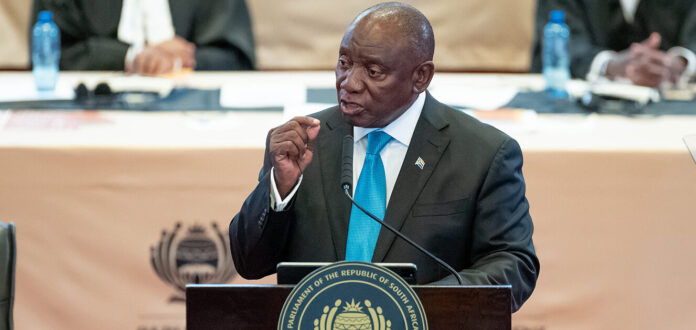
President Cyril Ramaphosa has thrown down the gauntlet to Parliament’s critics of black economic empowerment, insisting that transformation remains central to fixing apartheid-era injustice. And announced a review of the empowerment framework to make it “more effective”.
Replying to the debate on his State of the Nation Address on Wednesday, Ramaphosa said it “cannot be acceptable” that African, coloured and Indian people remain poorer with fewer opportunities than white people. Or that women earn less, own less and run fewer businesses than men.
MPs spreading falsehoods about BEE
He attacked MPs who argued that empowerment measures should be scrapped. And he accused them of spreading falsehoods about BEE.
“They say we must get rid of broad-based black economic empowerment. Falsely claiming that it benefits only a few, falsely claiming that it inhibits economic growth. And falsely claiming that it enables corruption,” he said.
Ramaphosa backed his defence with statistics. He used them to show that empowerment laws have shifted economic outcomes over time. He said that between 2006 and 2023, black African households experienced real income growth of 46%, coloured households 29% and Indian households 19%.
Ramaphosa said poverty levels in the black African population fell from 67% in 2006 to 44% in 2023. While poverty among coloured South Africans fell from 43% to 25% over the same period.
Despite that progress, Ramaphosa conceded that the income gap remains vast. He said the average income of white households is still nearly five times higher than that of black African households.
“This is the gulf we must close through deliberate and sustained efforts to expand opportunity,” he said.
BEE a constitutional and economic imperative
The president framed BEE as a constitutional and economic imperative rather than a discretionary policy choice. He said the country cannot redress injustice without transforming the economy.
He argued that empowerment should be viewed as growth-enhancing rather than growth-restricting.
“We must see broad-based Black economic empowerment not as a cost to the economy, but as an investment in the sustainable growth of our economy,” Ramaphosa said.
The government will review the BBBEE framework to ensure it promotes “greater transformation and inclusive growth”. A step that may increase political tensions within the GNU. This is where coalition partners differ on empowerment rules, procurement, and how transformation relates to investment.
The review signals a possible shift toward tightening outcomes and enforcement as the government tries to balance transformation goals with promises to reduce regulatory burdens and boost growth.
Ramaphosa invoked the Freedom Charter to frame empowerment as a long-term national project. He urged parties in the coalition and the opposition to treat transformation as a shared responsibility.
“Now is not the time to abandon BEE,” he said. “Now is the time to make it more effective.”
- President Cyril Ramaphosa has thrown down the gauntlet to Parliament’s critics of black economic empowerment, insisting that transformation remains central to fixing apartheid-era injustice.
- And announced a review of the empowerment framework to make it “more effective”.
- Replying to the debate on his State of the Nation Address on Wednesday, Ramaphosa said it “cannot be acceptable” that African, coloured and Indian people remain poorer with fewer opportunities than white people.
- Or that women earn less, own less and run fewer businesses than men.
- MPs spreading falsehoods about BEE He attacked MPs who argued that empowerment measures should be scrapped.


