


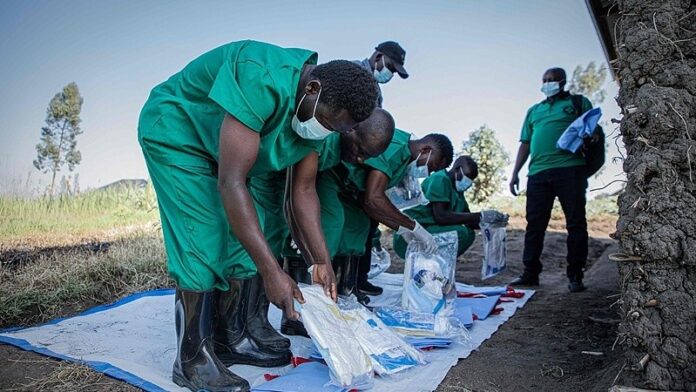
The Ebola outbreak in Congo has not yet stabilised and is still expanding, with transmission fuelled by population movement, a World Health Organisation official said on Tuesday.
The Democratic Republic of Congo has confirmed 1,561 cases, including 506 deaths, in the worst-ever outbreak of the rare Bundibugyo species of Ebola for which there is no proven treatment or cure.
“It is still in the expansion phase, unfortunately. We would like to say it is stabilising, but frankly we cannot say it yet,” Dr Anne Ancia, WHO representative in the country, told reporters by video link from Bunia, at the epicentre of the epidemic.
‘Population movements complicate efforts’
She said that major challenges remained, such as the near-saturation of some Ebola treatment centres with occupancy levels around 90%.
Another difficulty is that workers falling ill in the mining town of Mongbwalu are not seeking treatment locally, but instead travelling and spreading the disease to new regions, she said.
“Population movements, persistent insecurity and the fragility of the health system continue to complicate efforts to bring the outbreak under control,” she said.
ALSO READ: Second batch of Chinese experts arrives in DRC to reinforce Ebola response
- The Ebola outbreak in the Democratic Republic of Congo is still expanding and has not yet stabilized, according to WHO.
- There have been 1,561 confirmed cases and 506 deaths in the outbreak, caused by the rare Bundibugyo species of Ebola, which has no proven treatment.
- Challenges include nearly full Ebola treatment centers, with occupancy around 90%.
- Movement of infected workers, especially from the mining town Mongbwalu, is spreading the disease to new areas.
- Ongoing population movements, insecurity, and a fragile health system complicate efforts to control the outbreak.


