


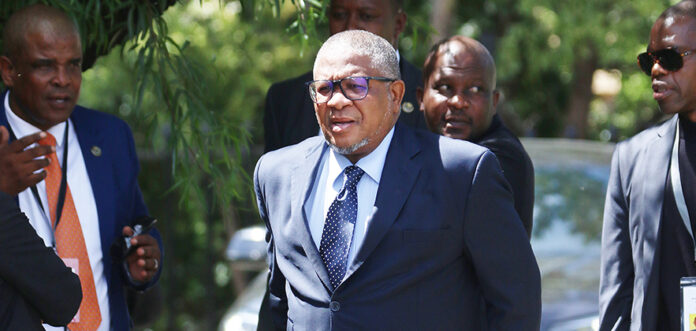
ANC secretary-general Fikile Mbalula’s abrupt dissolution and reconfiguration of the ANC national dispute resolution committee (NDRC) appeal committee have received mixed reactions from senior party members.
This comes after Mbalula last week issued a communique that took many by surprise, announcing the sweeping changes to the NEC subcommittee, retaining only one member, namely Alvin Botes.
The likes of veteran politician and former minister Thandi Modise, Ronald Lamola and Faith Muthambi were chucked out in favour of Cassel Mathale, Mmamoloko Kubayi and Joy Maimela. Mathale replaced Modise as chairperson of the committee.
Some have described the move as a defining moment in the organisation’s current trajectory, one that raises profound questions about constitutional order, institutional integrity, and the concentration of power.
Some believe this came as no surprise given the new responsibilities given to Modise and Muthambi, who are headed out of the country as ambassadors, while Lamola is said to be inundated by international trips in his government responsibility as minister of international relations and cooperation.
Mbalula’s stated reason for the reshuffle, in a letter to NEC members that Sunday World has seen, aligns with the latter viewpoint.
“Following a number of considerations to strengthen the capacity of the dispute resolution committees, this serves to advise you of the reconfiguration of the NDRC appeal committee,” wrote Mbalula in the letter dated March 19.
“The redeployment of some members to take up other responsibilities has depleted the committee.”
But critics within the NEC insist that what has been presented as a routine administrative adjustment to address “capacity constraints” is, in fact, a structural intervention into the most sensitive and consequential organ of internal democracy, the final arbiter of disputes whose decisions shape leadership legitimacy across branches, regions, and provinces.
The significance of this cannot be overstated, they added, because the NDRC appeals committee is not a peripheral structure, but it is the last line of defence in the ANC’s internal governance architecture.
They charged that the structure’s authority lies in its perceived independence, consistency, and insulation from political pressure that must be guarded jealously from political manoeuvres by those with political ambition.
Historically composed of seasoned leaders with institutional weight and credibility, the NDRC appeals committee has functioned as the body of last resort, where disputes are settled and organisational order is restored.
“All the removed members were shocked because they received letters informing them that they were gone,” said an NEC member who requested anonymity.
“This matter did not even go to the NWC (national working committee), let alone the NEC. This is even though the NDRC appeals committee is a subcommittee of the NEC, not a subcommittee of the SG (secretary-general office).
“But then again, that is what he (Mbalula) always does. He does what he wishes, and nobody has the balls to confront him because everyone fears the man.”
Another NEC insider said Mbalula was losing control of the NDRC appeals committee, which had “indifferent” seasoned people like Modise who do not take instructions from him.
The leader said what deepens the concern is the manner and timing of the intervention.
They said it was evident that the dissolved committee was actively engaged in adjudicating appeals linked to highly contested regional conferences across the country, conferences whose legitimacy has already come under scrutiny due to disputes over membership, processes, and the sequencing of appeals.
“The SG had to put people aligned to him and his political ambition because the dissolved NDRC was slipping away from his grip.
‘There were indifferent people there like Sis’Thandi (Modise) who does not just allow nonsense to fly because of political considerations,” said the mole.
“Then there was Faith (Muthambi), who really does not care about what the SG tells her. Mbaks (Mbalula) has, in fact, once approached Faith to work with him, but she declined.”
But those sympathetic to Mbalula said there was nothing to read from the reshuffle, saying maybe the only fault was the way it was done, but saying it was coming anyway given the redeployment of Muthambi and Modise and Lamola’s busy schedule outside the country.
ANC spokesperson Mahlengi Bhengu said: “Strengthening NEC subcommittees remains a normal internal process aimed at realising operational efficiency.”
- ANC secretary-general Fikile Mbalula’s abrupt dissolution and reconfiguration of the ANC national dispute resolution committee (NDRC) appeal committee have received mixed reactions from senior party members.
- This comes after Mbalula last week issued a communique that took many by surprise, announcing the sweeping changes to the NEC subcommittee, retaining only one member, namely Alvin Botes.
- The likes of veteran politician and former minister Thandi Modise, Ronald Lamola and Faith Muthambi were chucked out in favour of Cassel Mathale, Mmamoloko Kubayi and Joy Maimela.
- Mathale replaced Modise as chairperson of the committee.
- Some have described the move as a defining moment in the organisation’s current trajectory, one that raises profound questions about constitutional order, institutional integrity, and the concentration of power.


