


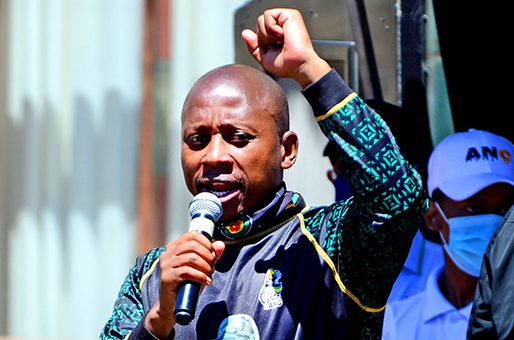
The Johannesburg High Court has declared the removal of Andile Lungisa from the party’s Nelson Mandela Bay proportional representation candidate list unconstitutional and unlawful.
The political irony of the judgment could hardly be more devastating as secretary-general Fikile Mbalula, charged with safeguarding organisational discipline, has found himself on the receiving end of this precedent-setting judgement by Judge Nelisa Mali.
This was no ordinary internal disagreement but a full-blown confrontation over the limits of the secretary-general’s political authority, the sanctity of collective decision-making and whether the ANC’s own rules apply equally to those entrusted with enforcing them.
READ: Lungisa, Mbalula fight over list removal intensifies
Judge Mali delivered a scathing judgment that stripped away the legal foundation of Lungisa’s removal. The court ordered the ANC to restore his name to its relevant internal list with immediate effect. It also ordered Mbalula, the ANC and its national executive committee (NEC) to pay the applicant’s legal costs.
Lungisa must be put back on ANC list
“The removal of the [Lungisa’s] name from the proportional representation list of candidates for the ANC in Nelson Mandela Bay is declared to be unconstitutional, unlawful, invalid and of no force or effect,” ruled Judge Mali.
“The first to third respondents (Mbalula, ANC and ANC NEC) are directed to take steps to ensure that the name of the applicant is reinstated to the internal list of the second respondent referred to above with immediate effect.
“To the extent that the Chief Electoral Officer of the fifth respondent affords the African National Congress to supplement its list under Item 17(1) of Schedule 1 to the Local Government: Municipal Structures Act 117 of 1998, it is, directed that the name of the applicant shall be submitted as part of the supplementary list provided under this provision.”
Lungisa had approached the court claiming that his name was unilaterally removed without due process by the former liberation movement.
The court agreed with him and granted urgency on the basis that delaying the matter to after elections would serve little to no value as the aggrieved party would have been prejudiced.
READ: Ngcukayitobi bombshell: Claims he heard Mbalula order Andile Lungisa’s list removal
For the ANC, the political embarrassment lies in what the court exposed about the decision-making process, particularly about the running of its administration office.
The secretary-general’s office is not an ordinary administrator, his office is the institutional nerve centre of the organisation, responsible for ensuring that its constitution, rules and collective decisions are faithfully implemented.
ANC found wanting
Yet the judgment found that the respondents had failed to establish the authority under which Lungisa’s name was unilaterally removed.
“The applicant’s explanation that he had progressed beyond the relevant stage of the vetting process is, on the evidence before the court, consistent with the undisputed processes followed up to 28 August 2026,” the judgement reads.
“The significance of this provision is that the internal rules themselves prescribe a defined decision-making structure. The Secretary-General’s function is not thereby converted into an unrestricted discretion to amend the final list.
“The respondents assert that the applicant failed to attend vetting. Yet the answering affidavit does not adequately explain: precisely what the vetting process entailed; which component of that process the applicant allegedly failed to complete; when the applicant was required to complete it; who was authorised to make the final vetting determination; whether a final disqualification decision was in fact made before the applicant’s name was removed; and what provision of the governing guidelines authorised the [Mbalula] personally to remove the [Lungisa’s] name at that stage.”
That finding goes to the heart of organisational credibility. The ANC had argued that Lungisa failed to complete mandatory vetting procedures.
READ: Lungisa accuses Mbalula of ordering his removal from ANC list
But the court identified glaring deficiencies in that explanation.
These were not peripheral technicalities. They were the essential questions upon which the lawfulness of the decision depended. The respondents failed dismally to answer them, the judgement notes.
Even more damaging was the court’s examination of the ANC’s own candidate-selection guidelines. Those rules established a structured process of nomination, vetting, collective approval and finalisation.
They did not confer an unrestricted power on the secretary-general to rewrite the outcome.
The court did not abolish the ANC’s right to vet candidates. Nor did it pronounce Lungisa automatically entitled to municipal office. It held that political parties must follow their own rules when exercising their powers.
Lungisa’s victory is also narrower than some political celebrations may suggest. The court carefully preserved the Electoral Commission’s statutory powers.
His name must be restored internally, but submission to the IEC depends on whether electoral legislation lawfully permits supplementation of the party list.
- The Johannesburg High Court ruled that Andile Lungisa's removal from the ANC's Nelson Mandela Bay proportional representation candidate list was unconstitutional and unlawful.
- The court ordered the ANC to immediately reinstate Lungisa's name on the internal candidate list and directed Mbalula, the ANC, and its NEC to pay Lungisa's legal costs.
- Judge Nelisa Mali found that the secretary-general and the ANC failed to establish legal authority for Lungisa’s unilateral removal from the list.
- The court emphasized that ANC's internal rules prescribe a defined decision-making structure, and the secretary-general does not have unrestricted power to amend the final candidate list.
- While Lungisa's name must be restored internally, the court upheld that submission to the Electoral Commission depends on lawful electoral legislation permitting list supplementation.


