


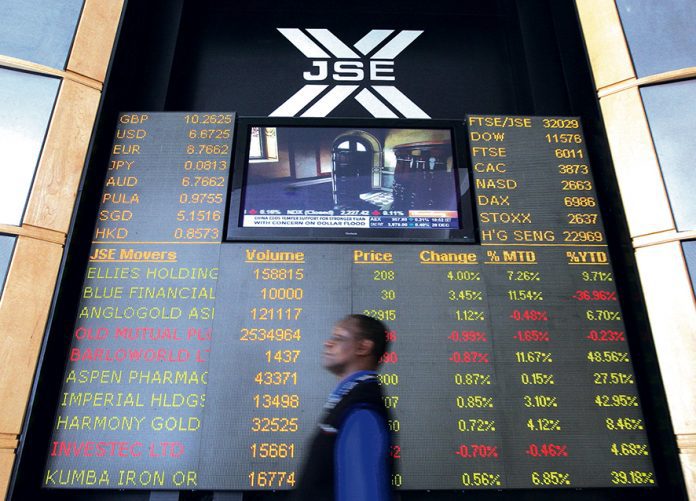
Black ownership of South Africa’s largest listed companies remains strikingly low, despite decades of Black Economic Empowerment (BEE) transactions.
The Black Ownership on the Johannesburg Stock Exchange (JSE) report presented on Monday shows that black ownership accounts for just 1.5% of the market capitalisation of the top 60 companies on the JSE. In rand terms, this amounts to about R255-billion, equivalent to 6.9% of South African assets.
Effectiveness of BEE policies in question
The findings have raised concerns over the effectiveness of BEE policies in fundamentally shifting ownership patterns in the country’s economy.
Of this total, listed black ownership accounts for R200.7-billion, while unlisted holdings contribute R54.5-billion.
The data also highlights a significant concentration of black ownership in just two sectors, including mining and financial services, which together account for 77% of black ownership on the JSE.
According to the report, the financial sector shows stronger participation, with companies such as FirstRand, Sanlam and Capitec reflecting notable BEE stakes. In mining, firms like Exxaro and African Rainbow Minerals stand out for higher levels of black ownership.
The presentation also challenged widely-cited claims about the scale of BEE deals, including the assertion that R1-trillion had been transferred to black investors.
Economist, Duma Gqubule said such figures are often overstated due to the way transactions are measured.
In some cases, transactions fail to deliver any net value, while others are later reversed, further reducing long-term ownership.
A significant portion of black ownership comes from broad-based initiatives, including employee share-ownership plans (ESOPs) and community trusts.
These schemes now account for at least two-thirds of black ownership on the JSE, with notable examples including public retail investment programmes that have paid out billions in dividends over time.
State-backed institutions such as the Public Investment Corporation (PIC) and the Industrial Development Corporation (IDC) have played a role in financing BEE deals, but their impact appears limited.
Read more:
Measure B-BBEE outcomes to ensure inclusive economic growth
VAT increase aimed at keeping blacks economically marginalised
- Black ownership in South Africa’s top 60 Johannesburg Stock Exchange (JSE) companies remains low at 1.5% of market capitalization, around R255 billion or 6.9% of national assets.
- Ownership is heavily concentrated in mining and financial services, which together represent 77% of black ownership on the JSE.
- The report challenges claims that R1 trillion has been transferred to black investors through BEE, noting many deals are overstated, reversed, or deliver no net value.
- Two-thirds of black ownership stems from broad-based initiatives like employee share-ownership plans and community trusts, which have paid out substantial dividends.
- While state-backed institutions such as the PIC and IDC have financed BEE deals, their overall impact on increasing black ownership is limited.


