


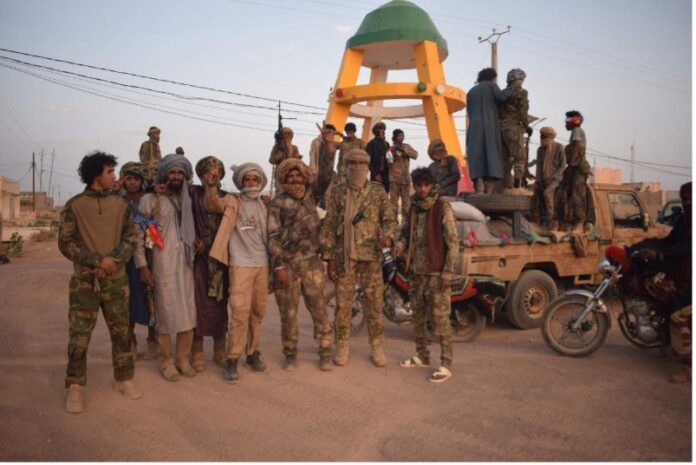
Since coordinated attacks launched on April 25, Mali’s security situation has remained highly volatile, with armed groups intensifying assaults on military positions and key infrastructure across several regions.
The violence escalated further following the killing of Malian Defence Minister Sadio Camara in an attack on his residence in the town of Kati, near the capital Bamako. The attacks, attributed mainly to the terrorist group Jama’at Nusrat al-Islam wal-Muslimin (JNIM) and the Azawad Liberation Front (FLA), exposed ongoing weaknesses in state control despite continued military operations.
As violence spreads from northern Mali towards central and southern regions, concerns are growing over civilian safety, regional stability, and the government’s ability to contain the insurgency.
As regional security experts examine how the two groups came together, more urgent questions are emerging: what are the risks if Mali fails to contain the insurgency, and what kind of political, military, and regional strategy could realistically pave the way towards lasting peace in the Sahel?
Major actors in question
Analysts have warned that the alliance of separatist Tuareg movements and terrorists could mark a dangerous new phase in the conflict. “Before it was almost unthinkable for rebels and extremists to fight together,” said Fidel Amakye Owusu, a geopolitical analyst based in Ghana.
Founded in 2024, the FLA is a Tuareg-led separatist movement seeking greater autonomy or independence for Mali’s Azawad region. JNIM, an al-Qaeda affiliate, aims to overthrow regional governments and impose its version of Islamic rule.
Journalist and researcher Paul Melly, a longtime observer of West Africa and the Sahel, described Bamako’s decision in January 2024 to scrap the 2015 peace agreement with Tuareg rebels as a turning point that “really changed the picture.” Since resuming offensives against both Tuareg groups and JNIM, the Malian army and its allies have become “overstretched,” fighting what Melly called “a war on several fronts.”
However, Malian journalist Moussa Sayon Camara noted that cooperation between such groups is not new. In 2012, armed factions, including predecessors linked to today’s FLA and JNIM, also formed alliances against the Malian state. Despite their differing objectives, both FLA and JNIM are classified as terrorist groups by Mali’s military government.
“Over time, differences may emerge between these groups as they gain territory and influence. However, for now, we are witnessing a dangerous trend in which extremist groups appear to be gaining the upper hand,” said Fidel.
A long history of military interventions
Mali has hosted some of the world’s largest international military operations, from French forces to the UN peacekeeping mission, yet none succeeded in bringing lasting stability.
Melly attributed the failure to a mix of factors, including Mali’s vast geography, socioeconomic challenges, herder-farmer tensions, cross-border trafficking, and weak governance. “These grievances could not all be solved through military force,” he said.
Geopolitical analyst Fidel Amakye Owusu also noted that repeated coups across the region further complicated international interventions. After seizing power, Mali’s military authorities expelled French troops and ended the UN mission, arguing the operations had failed. Bamako instead turned to Russian mercenaries from the Wagner Group, now Africa Corps, to fight the insurgency. But recent security setbacks have exposed the limits of relying mainly on military solutions.
“It means that we still have to go back to the drawing board and find constructive solutions to this crisis,” said Fidel.
A test for the new alliance
Mali, Burkina Faso, and Niger formed the Alliance of Sahel States (AES) in September 2023, a mutual defense pact centered on sovereignty and collective security. Having all experienced coups in recent years and withdrawn from the Economic Community of West African States (ECOWAS), the three Sahel countries pledged to support one another against armed rebellions and external threats, later launching a unified force and joint military operations in December 2025.
Following the April 25 attacks in Mali, Burkina Faso Defense Minister Celestin Simpore speaking on behalf of AES, vowed to “hunt down” the “assassins” of Mali’s defence minister.
Moussa pointed out that there is a level of coordination among the AES countries and they don’t need to go through lengthy procedures or diplomatic protocols. But “it is possible that assistance (to Mali) was provided in less visible ways, not openly enough for the public to fully appreciate it.”
“If you look at the context in which the alliance was created, it was more reactionary in nature. As a result, the level of cooperation needed to effectively fight terrorism is still not mature.” said Fidel, adding that international forces and regional cooperation remain essential to stabilize such a large territory.
Melly also stressed that all three AES countries face serious security challenges themselves, highlighting the need for wider regional coordination. “There is actually quite a long history of troops from the rest of the region helping in Mali,” he said. “With coordination, they could help again.”
Regional spillover feared
Mali borders seven countries, while extremist groups continue expanding their influence toward coastal West Africa. “If these extremists gain ground, no one will be safe,” Fidel warned.
To prevent the spillover of violence, coastal states have strengthened their intelligence and security systems. Still, experts say closer cooperation between coastal countries and the AES states is essential.
“One solution is to ease tensions between Mali and its neighbors,” Moussa said. He stressed that Mali, Niger, and Burkina Faso “cannot fight extremist groups alone” and will need stronger coordination, regional cooperation, and international support to effectively address the crisis.
Melly shared a similar view from an economic perspective. “There are deep family, social, and economic ties between Mali and the coastal West African states,” he said, arguing that such connections are essential for Mali’s long-term economic development.
Military or political approach?
After 14 years of turmoil, Mali remains desperate for a lasting solution.
Moussa argues that one possible path forward is an inclusive political dialogue among Malians to determine what can realistically be achieved together. “If there is no peaceful political environment, then the security situation will also struggle to improve, because the two go hand in hand,” he said.
He noted that many armed groups are led by Malians, some with past links to state institutions or political structures, suggesting dialogue could help define what compromises may be possible.
Melly also called for a broader rethink of Mali’s approach. “There needs to be a real refocusing, not only on military issues, but also on development challenges and internal political questions,” he said, emphasizing that Malians themselves must determine the country’s future path.
At the same time Paul highlighted economic development as key to long-term stability, arguing that “security and development have to go alongside each other.” The challenge, he added, is creating enough security for economic activity to take root.
- Since April 25, Mali has experienced intensified attacks by armed groups, notably JNIM and the FLA, targeting military and key infrastructure amid a volatile security situation.
- The killing of Malian Defence Minister Sadio Camara in Kati escalated violence, highlighting weaknesses in Mali's state control despite ongoing military efforts.
- The FLA, a Tuareg-led separatist group founded in 2024, and JNIM, an al-Qaeda affiliate, have formed an alliance, marking a dangerous new phase in the conflict according to analysts.
- Mali, Burkina Faso, and Niger created the Alliance of Sahel States (AES) in 2023 to coordinate defense against armed groups, but cooperation is still developing and regional security challenges persist.
- Experts emphasize that political dialogue, regional cooperation, and economic development are essential alongside military efforts for Mali's long-term stability and peace.


