


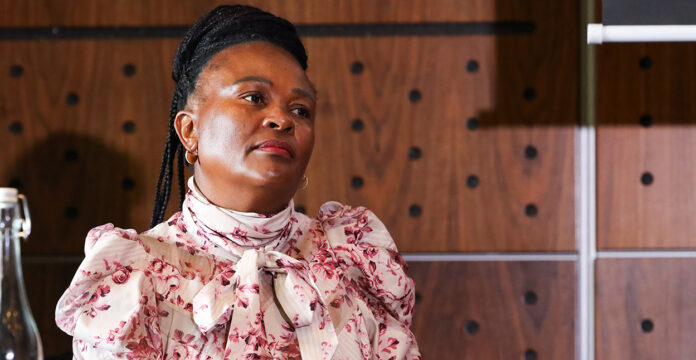
Former Public Protector Busisiwe Mkhwebane recalls sitting quietly inside a nail salon, watching the television screen flicker as one of South Africa’s most politically charged sagas unfolded yet again.
Outside, she says, life moved ordinarily. Phones rang. Nail dryers hummed. Conversations drifted casually across the room.
But for her, the moment carried the emotional weight of years.
The nail technician, she notes, sat beside her – unknowingly sharing space with someone reliving battles that had consumed her public life, fractured her reputation and, she says, scarred her family.
At first, she did not trust what she was seeing. “Seeing the body language, I was sceptical.”
For years, Mkhwebane says, she had learnt to read courtrooms carefully – the pauses, the facial expressions, and the shifting moods before judgements were spoken aloud. Too often, she says, those moments preceded humiliation.
Then the judgments started coming. One after another.
Slowly, her anxiety gave way to something else.
Hope.
“When all three judgments were delivered, I regained hope,” she says. “I was elated when the final judgment was delivered.”
As the proceedings unfolded, she says memories rushed back with painful clarity. Not just legal battles, but the loneliness that accompanied them.
“I remembered how I was ridiculed by the media,” she says.
The names roll off her tongue like fragments from a political war diary: the ANC, the DA, FF Plus, and ACDP. Judges she believed had turned against her. Senior political figures. Public critics. Parliamentary adversaries.
To many South Africans, she acknowledges, the Phala Phala scandal became a constitutional drama involving President Cyril Ramaphosa, state institutions and questions of accountability.
But for her, it became deeply personal. “Standing for the truth cost me dearly,” she says quietly.
The cost, she insists, was not abstract. “It affected my family’s health until death.”
There were financial consequences too, she says, as well as lingering bitterness over what she describes as the refusal to pay her gratuity after leaving office.
In that nail salon, surrounded by ordinary rituals of daily life, she says the political suddenly became intimate again. Not triumphant in a grand cinematic sense. Just deeply human.
For Mkhwebane, the judgments did not erase the past. They did not undo the ridicule, the isolation or the damage she believes she suffered.
But for a brief moment, she allowed herself to feel something she says had long been denied to her: vindication.
- Former Public Protector Busisiwe Mkhwebane reflects on the emotional impact of multiple court judgments related to her politically charged legal battles.
- Mkhwebane describes the loneliness, media ridicule, and personal toll including family health issues and financial hardships from the controversies.
- She recalls skepticism turning into hope and eventual elation as the final judgments were delivered.
- The Phala Phala scandal, widely seen as a political and constitutional issue, became a deeply personal struggle for her.
- Despite feeling vindicated by the court rulings, Mkhwebane acknowledges the judgments do not erase the harm or isolation she endured.


