


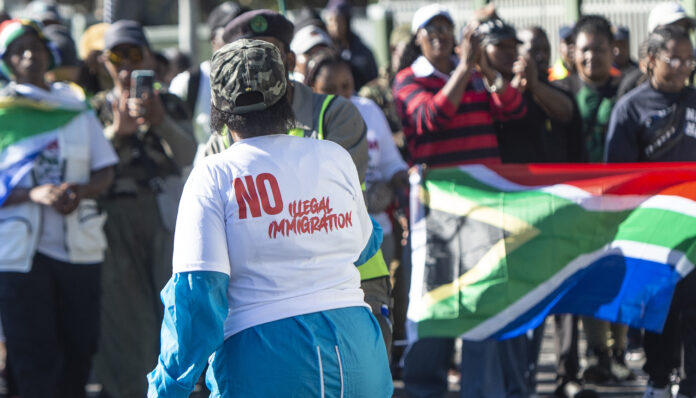
The security cluster is monitoring possible risks linked to the June 30 deadline set by anti-illegal immigration campaigners for undocumented migrants to leave South Africa. A highly placed government insider has told Sunday World that an inter-ministerial committee tasked with monitoring the situation as the deadline set by the protestors looms is receiving regular intelligence reports on “potential dangers”.
The ANC is also moving to contain the fallout from the anti-illegal immigration sentiment gripping the country. Its international relations subcommittee has been having discussions on the matter and also met with the High Commissioner of Mozambique to South Africa, Maria Gustava, as it sought to open political channels with foreign governments and other key stakeholders.
Security cluster insiders said the state was managing the matter through different structures, including voluntary repatriations, stakeholder engagements, law enforcement planning and intelligence reports.
The source said the government could not simply ban protests linked to the deadline, but law enforcement agencies would have to make sure that any protest action did not turn violent.
“We cannot just say people should not protest, because they can take us to court. It is unconstitutional. But law enforcement must be there so that people do not do wrong things.”
March on March, a civic pressure group campaigning for tougher immigration laws and the removal of undocumented migrants, has been campaigning alongside organisations with similar goals. They have given undocumented migrants until June 30 to leave the country, although it is not clear what action will ensue should their ultimatum be ignored.
The campaign has caused fear in immigrant communities in Durban, Cape Town, Johannesburg and other major cities, and triggered concern among African governments.
Efforts were underway yesterday to document and transport up to 4 000 Malawians who have been camped at Sherwood Park in Durban, the hotbed of protest action.
Two weeks ago, Ghana arranged a flight that repatriated 297 citizens from OR Tambo International Airport. The government of Mozambique provided buses that transported over 500 citizens to the Ressano Garcia border post. President Bola Ahmed Tinubu of Nigeria approved five flights to repatriate anxious Nigerians, with the scale of the operation said to airlift as many as 4 000 people.
The South African government has said the June 30 deadline was not issued by the state, and President Cyril Ramaphosa has warned that only authorised officials may enforce immigration law.
But the security cluster insider said the government had noticed a shift in the public language of some activists after engagements with stakeholders. Nonetheless, the state was still preparing for possible risks.
“Their language has changed. They are trying to say there should not be violence, but we still have to ensure that law enforcement is there.”
The source said the matter was being handled by the inter-ministerial committee, but some issues had been left to the security cluster because they involved operational decisions.
“The IMC is getting intelligence reports about potential dangers. There are various teams that work on what needs to be done. But some things are operational matters of the security cluster. The IMC deals with strategy, and the security cluster deals with operations,” the insider added.
The source said ministers and officials could agree on the broad approach, but police would be responsible for implementation. “You can agree on the principle, and then the operational teams must act. They must also be held accountable for what has been agreed,” the source said.
The government insider said migration remained an emotional issue and warned that anyone who promised a quick solution would be misleading the public. “It is a process. We have to engage and appeal to people so that we solve it.”
The state’s preparations come as Ramaphosa announced a tougher government response, including dedicated immigration courts to speed up deportations. Ramaphosa has also said police, the home affairs, employment and labour departments will increase inspections targeting companies employing undocumented foreign nationals.
He said the labour department had started the phased recruitment of 10 000 inspectors.
The government source said the security response was not only about policing protests but also about keeping public order.
“We cannot enter every operational matter, but the security cluster must deal with the operations,” the source said. “We are [also] engaging stakeholders to educate the public.”
Ramaphosa has acknowledged public concern about illegal migration but warned that citizens may not take the law into their own hands. He has said foreign nationals must obey South African laws, but South Africans must also respect the law when raising concerns.
“Only authorised government officials should act against violations of the country’s laws, including violations of immigration laws. Anyone taking the law into their own hands must be brought to book. Actions that destabilise the country through incitement of lawlessness and violence must never be tolerated,” the president said in a June 7 address to the nation.
While the president promised to send envoys around the continent to explain the government’s stance on immigration, details around these planned deployments are still unclear.
International Relations department spokesperson Chrispin Phiri told Sunday World, “All communication channels remain open for discussions with affected countries,” he said.
Phiri said the deployment of envoys was still being handled on the government side. “It remains a work in progress.”
- South Africa's inter-ministerial committee and security cluster are actively monitoring risks related to the June 30 deadline set by anti-illegal immigration groups for undocumented migrants to leave, receiving regular intelligence on potential dangers.
- The ANC has engaged with foreign governments, including Mozambique, to manage diplomatic fallout and open political channels amid rising anti-immigration sentiment.
- The government is handling the situation through voluntary repatriations, law enforcement planning, stakeholder engagement, and intelligence, while ensuring protests remain non-violent and respecting constitutional rights.
- Several African countries, including Ghana, Mozambique, and Nigeria, have organized repatriation flights and transport for their citizens amidst protests and fears in immigrant communities.
- President Ramaphosa has emphasized that only authorized officials can enforce immigration laws, announced tougher measures including dedicated immigration courts and recruitment of inspectors, and warned against vigilantism and violence.


