


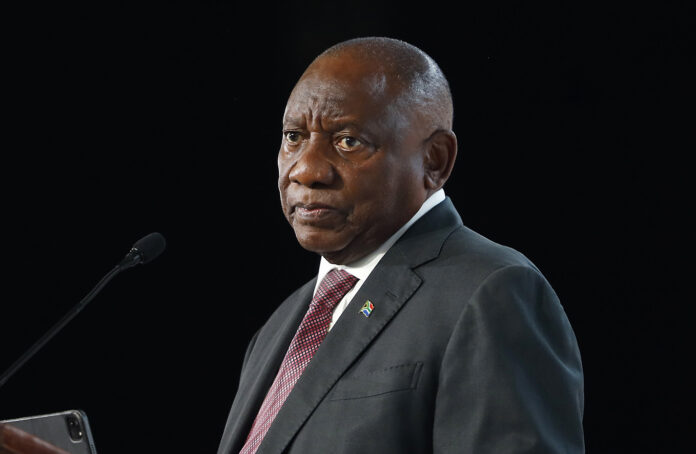
MPs have demanded that Parliament name President Cyril Ramaphosa directly over the apparent failure to act on a top police general’s protected disclosure, accusing the committee’s draft report of hiding presidential accountability behind the vague phrase “the state”.
Ramaphosa faces fresh questions over what happened to an explosive police dossier addressed directly to him after MPs accused Parliament’s draft report of shielding him from personal accountability.
The dispute erupted during deliberations on the preliminary report of Parliament’s ad hoc committee investigating alleged criminal infiltration and political interference in the criminal justice system.
Protected disclosure ‘directed to Ramaphosa’
At issue is a protected disclosure submitted in July 2022 by then deputy national police commissioner Francinah Vuma, who alleged that she was being targeted for removal after resisting unlawful instructions and investigating politically sensitive contracts.
The draft report reportedly says the evidence did not prove every allegation in Vuma’s disclosure but found that “the state” had failed to demonstrate a coordinated, properly documented and complete response.
EFF MP Leigh-Ann Mathys said that wording concealed the central fact: Ramaphosa was one of the disclosure’s principal recipients.
“There was no evidence in the committee to say that her disclosure was acted on,” Mathys said.
Push to replace ‘state’ with Ramaphosa
“But it’s not the state. In particular, we must put in there President Ramaphosa. That disclosure was addressed directly. He was the first person that this was directed to.”
Mathys said the reference to “the state” should be replaced with Ramaphosa and the other officials who received the disclosure.
Her intervention went beyond a disagreement over drafting. It raised the question of whether Parliament’s final report will identify the political office that received the warning or spread responsibility across the government until no individual is answerable.
The strongest inference from the debate is that MPs believe the draft’s cautious language removes Ramaphosa from the chain of accountability.
Ramaphosa ‘failed to act’
Mathys wanted the report to find that there was no evidence the president dealt with a warning from one of the country’s most senior police officers, despite the disclosure containing serious allegations against senior SAPS officials and then police minister Bheki Cele.
“There’s no evidence before the committee that President Ramaphosa dealt with the protected disclosure that was addressed to him by a high-ranking official,” Mathys said.
She said it contained “very serious allegations against senior officials and also the minister of that time” and argued that the failure to process it contributed to Vuma’s prolonged paid suspension until her retirement.
The disclosure, signed by Vuma on July 6, 2022, confirms that Ramaphosa was listed first among its recipients.
It was also directed to the chairperson of Parliament’s police committee, Hawks head Godfrey Lebeya, Independent Directorate head Andrea Johnson, IPID head Dikeledi Ntlatseng and State Security Agency head Thembisile Majola. National police commissioner Fannie Masemola was copied.
Vuma feared for her life
Vuma alleged that she feared for her life and livelihood and that people inside and outside SAPS were pushing for her suspension or transfer.
Her claims included alleged pressure involving PPE suppliers, an urgent R8-million payment to the Special Investigating Unit, a R120-million interception-equipment purchase and investigations into contracts worth billions.
Those were allegations requiring investigation. But the disclosure establishes that the Presidency and senior law-enforcement authorities were formally alerted to them.
It also made clear that Vuma believed her removal was connected to investigations she was conducting and her refusal to approve decisions she considered unlawful.
The Ramaphosa dispute formed part of a broader revolt by MPs who said the preliminary report had been stripped of findings supported by months of oral testimony and documentary evidence.
‘Draft watered down’
ActionSA MP Dereleen James said the draft had been “materially watered down”, softened the evidence and omitted findings that the record plainly supported.
“In several respects it reads as a summary of proceedings rather than a determination on the facts placed before this committee,” James said.
She warned that where oral and documentary evidence pointed to a clear conclusion, the draft retreated into neutral language that did not commit the committee to a finding.
“The effect is that the report will not withstand scrutiny and will not produce the accountability this process was established to deliver,” she said.
‘Everyone is exonerated here’
MK Party MP David Skosana was blunter.
“In fact, everyone here is exonerated, Chair. Let me put it like that. This report, everyone is exonerated here,” he said.
Skosana argued that the committee had already spent months deliberating over named officials and disputed relationships, only for the draft to return many of those matters to the realm of unresolved assessment.
“I don’t know which deliberation we’ve deliberated on, unless you are going to start afresh,” he said.
Committee chairperson Soviet Lekganyane assured MPs that the report had not yet been adopted and that their objections would be incorporated before a revised draft was sent to affected parties.
“You are going to satisfy yourselves first before it goes out that it is essentially what you have impressed upon,” Lekganyane said.
- MPs criticized the draft report of Parliament’s ad hoc committee for not holding President Cyril Ramaphosa personally accountable for failing to act on a protected disclosure by police deputy national commissioner Francinah Vuma.
- Vuma alleged in a July 2022 disclosure that she was being targeted for resisting unlawful instructions and investigating politically sensitive contracts; Ramaphosa was the primary addressee of this disclosure.
- The draft report uses vague language attributing failures to "the state," which MPs say conceals Ramaphosa’s individual responsibility in not addressing serious allegations involving senior police officials and the former police minister.
- Several MPs accused the draft report of being watered down—removing clear findings supported by evidence and weakening accountability by exonerating key figures.
- Committee chairperson Soviet Lekganyane promised to incorporate MPs’ objections into the revised report before final adoption to ensure accountability is properly addressed.


