


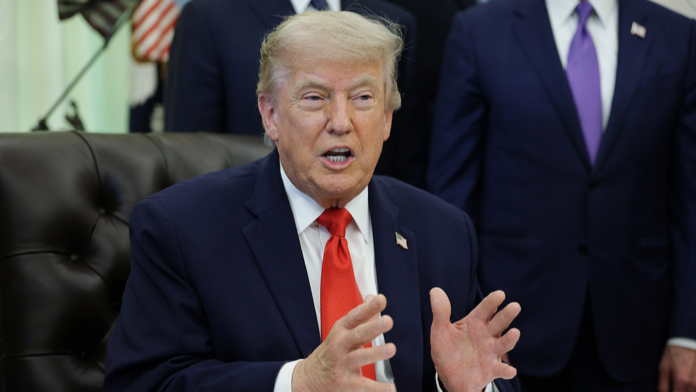
US President Donald Trump withdrew his threat of further strikes against Iran on Thursday and said a deal with Tehran to end the war could be signed in coming days.
Claiming that talks with Iran had been “brought to the highest level of Iranian leadership and approved”, Trump said he had “cancelled the scheduled strikes and bombings against Iran this evening”.
He said the finer points of the arrangement had been approved by the US and its allies in the region, including Israel, with which Washington jointly launched the war in February.
Deal to be sealed ‘pretty quickly’
Trump also told reporters at the White House that the documents were in “final shape” and that the deal would be completed “pretty quickly”.
Asked if Iran’s Supreme Leader Mojtaba Khamenei had agreed to the deal, Trump said: “I understand the answer is yes.”
He further noted that he expected a signing ceremony, attended by Vice-President JD Vance, to be held in Europe over the weekend.
‘Trump had been saying deal is imminent’
The Tasnim news agency noted that Trump had announced a deal was imminent 38 times in the previous two months.
“Until Iran announces the matter of a potential understanding, any news from Trump on this subject should be regarded the same as his previous messaging,” it said.
Iranian Foreign Ministry spokesman Esmaeil Baghaei said on Thursday that to date, Iran has not reached a final conclusion on the agreement and that all the issues raised in the Iran-US agreement were speculation.
According to Israeli media report, a senior Israeli official stated on Thursday that Israel has not received any notification that the US-Iran agreement has been finalised.
Prime Minister Benjamin Netanyahu’s office said the Israeli leader spoke to Trump, who vowed any memorandum of understanding would include the removal of Tehran’s enriched nuclear material as well as dismantling of missile infrastructure.
Expanding economic impacts of the war
The World Bank earlier in the day revised down its global growth forecast to a level not seen since the coronavirus pandemic, warning of the expanding economic impacts of the war.
The war – which began on February 28 with a wave of US-Israeli strikes on Iran that killed supreme leader Ayatollah Ali Khamenei – paused under an April truce. But efforts to hammer out a permanent end to the fighting appeared stalled.
Tehran’s mayor said on Thursday that the former supreme leader’s funeral would be delayed to the end of June or start of July.
With US threats escalating, Iranian General Ali Abdollahi warned earlier in the day that if the US attacked, “it will receive a harsher response than before, and the flames of war, in addition to creating insecurity in the region, will become more widespread and far-reaching”.
Meanwhile, Iran has renewed its warnings over the Strait of Hormuz, a vital waterway for oil and gas transport that it has essentially closed since early in the war, roiling global energy markets. Iran’s new body overseeing the strait said it “will be closed until further notice”.
- US President Donald Trump canceled planned strikes against Iran and announced a near-final deal to end the war, expected to be signed soon in Europe.
- Trump claimed talks were approved by Iran’s top leadership and allies including Israel, but Iran and Israeli officials indicated no final agreement or notification had been confirmed.
- Iran's Foreign Ministry dismissed details of the deal as speculation, and a senior Israeli official said they had not been formally informed of any finalized agreement.
- The ongoing conflict, which started with US-Israeli attacks in February including the killing of Iran's supreme leader, has paused under a truce but remains unresolved, with heightened tensions and warnings of severe retaliation from Iran.
- The war has had broad economic impacts, prompting the World Bank to lower global growth forecasts, while Iran has intensified disruptions in the strategic Strait of Hormuz, affecting global energy markets.


