


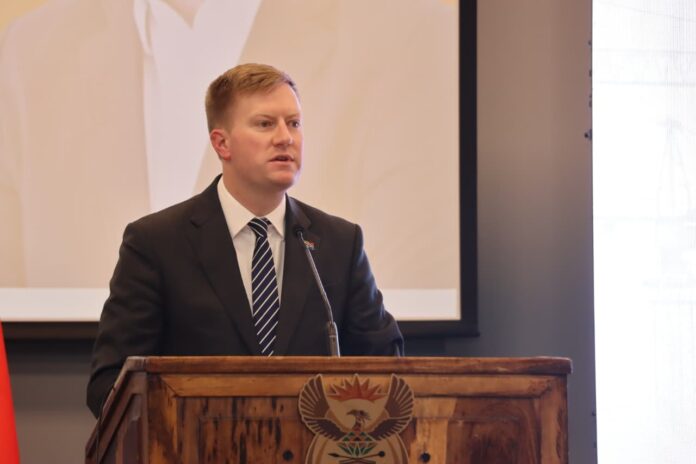
The department of public works and infrastructure under the political leadership of minister Dean Macpherson has launched the National Built Environment and Construction Safety Framework.
The launch took place on Friday in Modderfontein, Ekurhuleni, at the annual Public and Infrastructure Summit, in which the department is focusing on strengthening public and building safety, asset management and infrastructure delivery.
Speaking at the summit, Macpherson said the framework aimed to improve accountability and to help prevent future building collapses across South Africa, where many people have died during construction projects, notably in George, Western Cape, in 2024 and recently in Ormonde in Gauteng and Redcliffe in KwaZulu-Natal.
Macpherson said that his ministry will gazette Council for the Built Environment (CBE) public interest and safety regulations, focusing on structural and dolomitic occurrences, improved compliance in the erection of buildings, and certification requirements aligned to South African National Standards (SANS) 17024.
Public Infrastructure Confidence Index
He also launched the Public Infrastructure Confidence Index to provide a periodic measure of stakeholder confidence in the performance, readiness, capability and credibility of South Africa’s public infrastructure system.
Through the theme, “From Collapse to Confidence”, Macpherson said that his department is not simply about buildings, budgets, tenders or technical drawings, stating that it is also about dignity to let the people access services safely from court building functions, secured police stations and public offices that are fit for purpose, including border posts works.
Urgency, capability and purpose
“This past week, I saw exactly what public works can do when urgency, capability and purpose come together. I have twice visited the Beitbridge Border Post and the repatriation centre near South Africa’s border with Zimbabwe alongside the Inter-Ministerial Committee on Migration.
“We engaged with officials, law enforcement agencies and the teams responsible for managing a sensitive and important operation to ensure that people leaving South Africa could do so safely, humanely and in an orderly manner. What we saw there was impressive. On Sunday, the repatriation centre did not exist and was a barren piece of overgrown vegetation.
“Within 96 hours, officials from the Department of Public Works and Infrastructure had built it. It was not a mega-project or a ribbon-cutting ceremony years in the making. But it was public works at its best [to be] practical, urgent, humane and focused on solving a real problem,” said Macpherson.
He added: We meet today after a number of building collapses that have shaken South Africa and forced difficult questions about construction quality, regulatory oversight, professional accountability, enforcement and state capability. We remember George. We remember Redcliffe. We remember Ormonde. The George building collapse remains one of the most painful construction disasters in South Africa’s recent history. It claimed 34 lives and injured 28 people. Since assuming office, I have visited George and met with affected families to communicate the outcomes of an investigation into the engineer responsible for signing off on the building plans.
Accountability on building collapses
Machperson said accountability must follow the Redcliffe and Ormonde building collapses, stressing that no engineer, developer, official or any other person should be above the law if negligence contributed to a disaster. He noted that one engineer had already been found guilty of five legal contraventions and suspended, while he had urged the National Prosecuting Authority (NPA) to act on the findings of a SAPS investigation.
He said investigations into the Redcliffe collapse raised concerns about possible construction failures, including substandard materials, poor-quality workmanship and a lack of approved building plans, permits and occupation certificates. Similar concerns emerged from investigations into the Ormonde collapse, prompting a broader technical, governance and regulatory probe. The outcomes of both investigations have been completed and will be released soon.
Machperson stressed that the findings must lead to meaningful reforms rather than simply becoming reports, warning that gaps in oversight and accountability continue to exist because responsibilities are spread across municipalities, government departments and professional bodies. He called for stronger coordination, tougher enforcement and clearer accountability across the built environment sector.
He said the summit aimed to address the causes of building collapses and drive improvements in safety standards, compliance and public asset management. He added that the lessons from George, Redcliffe and Ormonde should serve as a catalyst for urgent reform to prevent future tragedies and restore confidence in South Africa’s built environment.
- The Department of Public Works and Infrastructure, led by Minister Dean Macpherson, launched the National Built Environment and Construction Safety Framework to improve accountability and prevent building collapses in South Africa.
- The launch took place at the Public and Infrastructure Summit in Modderfontein, focusing on public and building safety, asset management, and infrastructure delivery.
- The department also introduced the Public Infrastructure Confidence Index to gauge stakeholder confidence in South Africa’s public infrastructure system.
- Following recent deadly building collapses in George, Redcliffe, and Ormonde, investigations revealed issues like substandard materials, poor workmanship, and lack of proper permits, leading to calls for stronger enforcement, oversight, and accountability.
- Minister Macpherson emphasized the importance of urgent reforms, coordination, and legal accountability in the construction sector to ensure safer, fit-for-purpose public infrastructure and restore public confidence.


