


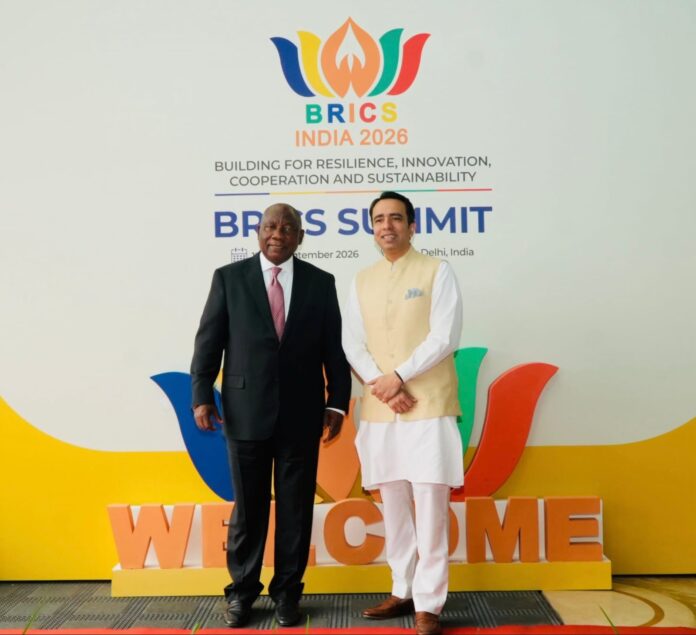
With President Cyril Ramaphosa arriving in New Delhi on Friday morning, the stage is set for India to host the 18th Brics Summit.
Over the past two decades, the grouping, which began as a geo-economic construct, has expanded both its membership and outreach around three pillars: political security, economy and finance, and cultural and people-to-people exchanges.
When the leaders sit down for a formal Summit meeting on Sunday, the Brics forum now stands expanded beyond the 2009 founding members – Brazil, Russia, India, and China – with South Africa joining two years later to complete the acronym. Today, the platform has grown to represent 11 members and 10 partner countries who collectively account for a shade under half of the global population, with a share of 40% of GDP and 26% of trade.
READ: Dr. Diaa Helmy | BRICS, a path toward a more equitable, multipolar world
The focus of the September 12-13 meeting is on trade, digital innovation, ensuring energy security, with an emphasis on reforming institutions of global governance. In keeping with the ever-changing world and its own character, the theme for the New Delhi Summit is ‘Building for Resilience, Innovation, Cooperation and Sustainability’.
The footprint of the platform has expanded with the inclusion of Egypt, Ethiopia, Iran, Saudi Arabia and UAE as full members from January 2024 and Indonesia in January 2025, while during the year, Belarus, Bolivia, Kazakhstan, Cuba, Malaysia, Nigeria, Thailand, Uganda, Uzbekistan and Vietnam joined as partner countries.
Challenges ahead
The summit comes amid the backdrop of the ongoing conflict in West Asia and casts a shadow on the competing interests of member nations such as Iran and the UAE. All eyes are on whether New Delhi will be able to forge a consensus and come out with a declaration, just as it was successful in bringing out a document at the 2023 G20 Summit.
This aspect is watched closely since consensus eluded the Foreign Ministers’ meeting during May this year. As per reports, diplomats are working towards a resolution since there is consensus on an overwhelming majority of the text.
The sharp increase in membership and the forum attracting countries of the Global South led to an impression that Brics could shape itself into anti-West amid intermittent mention of de-dollarisation. However, India steadfastly worked to debunk such characterisation, stressing that the platform stands for cooperation among the emerging economies and taking along those from the global south while working towards an arrangement to settle trade in local currencies.
India’s thrust
Working towards a multi-polar world, India professed inclusive alternatives and constructive advocacy in areas such as economic and trade cooperation; digital innovation; energy and sustainability; and reforms in global governance institutions.
Besides building resilience supply chains, in the field of economy and finance, New Delhi showcases its digital public infrastructure, a stack of 18 digital platforms for governance, including the United Payments Interface (UPI) that allows seamless transfer of funds and biometric-based Aadhaar authentication. While 23 countries have signed memoranda of understanding for Digital Public Infrastructur cooperation, eight countries – UAE, Singapore, Bhutan, Nepal, Sri Lanka, France, Mauritius and Qatar – have live UPI.
The effort is to work around it instead of a unified currency being advocated by a few members.
Climate and energy priorities
With climate change occupying centre stage as countries push towards development, India’s thrust has been on green energy, climate adaptation and security of critical minerals. The stress remains that developed economies must assist developing access to inexpensive finance and technology to combat climate change instead of imposing green tariffs. While oil-producing countries such as Russia and Saudi Arabia prioritise fossil fuels, Brazil and India stand behind renewable energy and climate resilience.
The Brics considers that there has to be immediacy in reforming global governance institutions such as the United Nations Security Council, the World Bank, and the International Monetary Fund, which have been functioning since the middle of last century without any change.
At the Brics Finance Ministers and Central Bank Governors meeting on September 10, the joint statement observed that the global economy faces significant headwinds.
“Risks to the global economic outlook remain elevated, reflecting persistent geopolitical tensions, trade fragmentation and protectionism, policy uncertainty, fiscal and inflationary pressures, growing debt and financial vulnerabilities. We continue to have serious concerns with the unilateral imposition of trade and finance-related actions, including the raising of tariffs and non-tariff measures, which distort trade and are inconsistent with World Trade Organisation rules. These pressures weigh most heavily on emerging markets and developing economies… we reiterate our support for an open, transparent, inclusive, non-discriminatory, and rules-based multilateral trading system with the WTO at its core.”
The role of the New Development Bank
The establishment of the New Development Bank by Brics, which became operational in 2015, mobilises resources for infrastructure and sustainable development projects in emerging markets and developing countries. Till June this year, the NDB has committed US $44 billion to finance 141 projects across BRICS founding members and new members Bangladesh, UAE, Egypt, and Uruguay.
These projects are identified by the beneficiary countries and cover areas like clean energy and energy efficiency, environmental protection, transport infrastructure, sanitation and water, and social and digital. However, challenges remain over slow implementation due to delays in disbursement, and even though 30%of the funds are released in local currency, exchange rate fluctuations remain a risk.
Business and innovation agenda
Meanwhile, ahead of the summit addressing the Brics Business Forum in New Delhi today, India’s External Affairs Minister Subramanyam Jaishankar underscored that resilience has become a key component of the Brics community, with the Brics Business Council and Brics Women’s Business Alliance playing an important role in bringing industry, entrepreneurs and business leaders into the Brics process.
Supply chain connectivity and trade facilitation have emerged as crucial, alongside services, agriculture and agri-technology, digital delivery, MSMEs, startups and women-led enterprises. He stressed the need for greater self-reliance while remaining connected and competitive through genuine market practices, dependable logistics, a predictable business environment, diversified commercial relationships and transparent trade and investment. He also highlighted digital public infrastructure, artificial intelligence, fintech and advanced manufacturing as major opportunities, while noting questions of access, standards, security and trust.
South Africa and its expectations
On his part, High Commissioner Anil Sooklal provided an overview of how South Africa is approaching the Summit. In an interaction with the Centre for Global India Insights, Prof Sooklal stated that New Delhi hosts the Summit at a critical time on geopolitical security, economic, and financial fronts, and all three pillars are receiving attention during India’s chair.
As for the situation in West Asia, he felt Brics should remain engaged, and the forum that is steeped in multilateralism has an opportunity, especially when the world is lacking in global leadership.
- Prasad is a senior journalist in Delhi and reporting for Sunday World.
- The 18th Brics Summit is being hosted in New Delhi with 11 full members and 10 partner countries, collectively representing nearly half of the global population and 40% of global GDP.
- New members joining as full Brics members from January 2024 include Egypt, Ethiopia, Iran, Saudi Arabia, and UAE, with Indonesia set to join in January 2025.
- The summit focuses on trade, digital innovation, energy security, and reform of global governance institutions, under the theme "Building for Resilience, Innovation, Cooperation and Sustainability."
- The New Development Bank has committed $44 billion to 141 projects supporting infrastructure and sustainable development, with 30% of funds released in local currencies despite implementation challenges.
- Key agenda items for business and innovation include supply chain connectivity, digital public infrastructure, AI, fintech, and support for MSMEs and women-led enterprises.


