


The Competition Commission has warned it may investigate potential price gouging after finding that public and private sector pricing practices are keeping living costs high despite easing input prices.
Its latest Cost of Living Report 2026, released on Friday, found that essential goods and services remain at record highs even where producer costs have fallen. The commission said the first half of 2026 was marked by sharp fuel price increases driven by geopolitical tension, supply chain disruptions and exchange-rate pressures.
It said businesses may be using higher fuel costs to justify price increases that are not fully cost-reflective, a pattern it described as “rocket and feather” pricing: prices rise quickly when costs increase but are slow to fall when input costs decline.
The trend is particularly evident in food consumed by lower-income households. The retail price of canned pilchards, a key source of protein for many South Africans, climbed to R29.15 per 400g can in June 2026, despite significant producer-price declines.
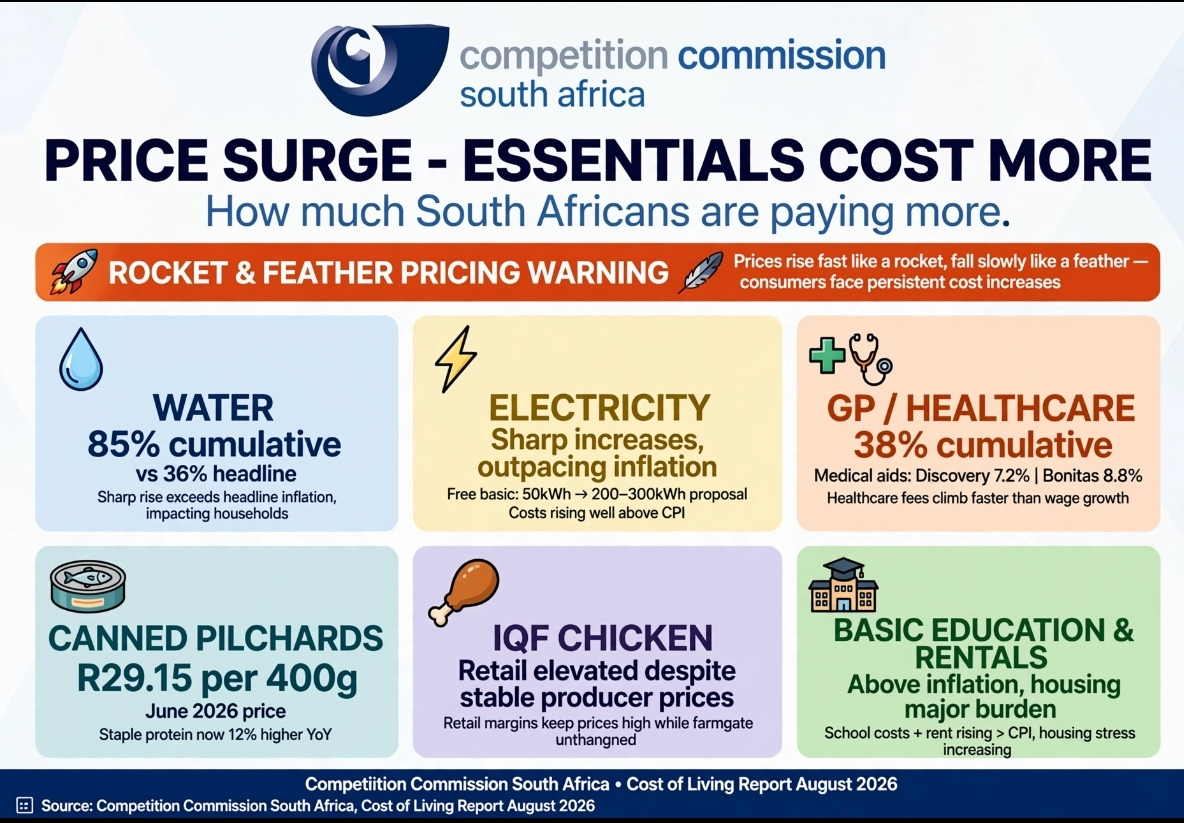
Similar trends were identified in staples such as eggs, individually quick frozen chicken, bread, sunflower oil and maize meal, where retail prices have remained elevated despite stable or declining producer costs and stronger harvests.
The commission warned that households face mounting financial pressure as food, transport, utilities and healthcare costs rise faster than incomes.
“Although inflation eased during parts of 2025, inflationary pressures strengthened again in 2026, driven largely by increases in transport costs due to higher fuel prices. As a result, many households continue to experience rising living costs,” the commission said.
Statistics South Africa data cited in the report shows that households in the lowest income decile spend 40.71% of their budgets on food and non-alcoholic beverages and 26.1% on housing and utilities.
Data, public transport and insurance add about 5%, pushing basic necessities to roughly 80% of household expenditure.
Non-food essentials have also risen sharply. Water inflation reached about 85% cumulatively by July 2026 after successive municipal tariff hikes, while electricity prices continued to outpace inflation.
Healthcare costs have climbed too. General practitioner consultation fees recorded cumulative inflation of 38% by July 2026, while Discovery raised medical scheme premiums by 7.2% and Bonitas by 8.8% on average.
At the report’s release, Competition Commission chief economist James Hodge said falling commodity prices had not translated into lower consumer prices. “On the food front, we have considerable concerns. When the fuel price increased, we issued a warning that it should not be exploited.
“But what we are seeing in food is that we are having historically high margins for staple foodstuffs. Those … are either taking place at the producer level, those who process grains into products or at the retail level.
“But we have not seen declining prices for products that come out of that, such as brown bread, maize meal and cooking oil. If we look at the history of margins and the spreads between commodity prices and producer prices, that spread is at record highs … and those are staple foods.
“This is something we have to monitor. If the warnings in this report are not heeded, this is something the commissioner may have to investigate … based on price-gouging concerns.”
Hodge said the commission was also concerned about retail pricing of protein products.
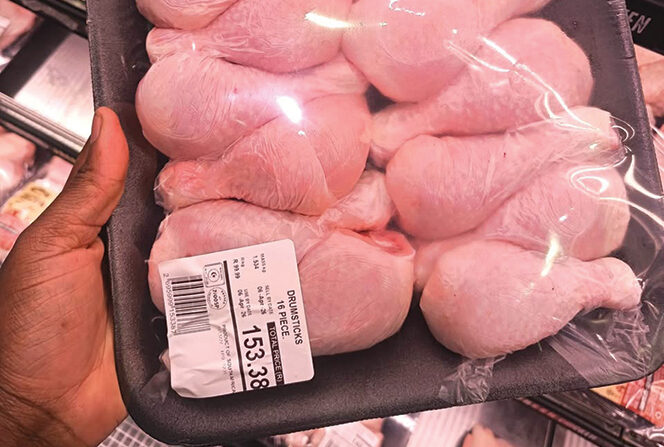
“Most of the increases … in individually quick frozen chicken have been on the retail side, not on the producer side. There have been big increases in margins at retail level. The same applies to tinned pilchards. Expansion of the total allowable catch has meant that production costs have come down quite significantly but the retail price has not come down at all. This means retailers are enjoying historically high margins,” he said.
“We are very concerned that fuel price increases are being used as an excuse to increase margins by retailers or producers, and we may be forced to act if things do not change.
“For non-food items, July 1 introduced increases of 8.1% for electricity and 10.1% for water, which is almost double last year’s inflation rate of 4.3%. When we look at the long-term trend, electricity tariffs are increasing at three times the rate of inflation,” he said.
“There has been a release of spectrum into the market … If the increase in data prices becomes a trend, that is a concern because data accounts for about 5% of household expenditure.”
Debt Rescue CEO Neil Roets said the cumulative impact was forcing many consumers into impossible financial decisions.
“The relentless hikes in fuel, electricity, food and municipal tariffs have a cumulative impact on household budgets. Every additional rand absorbed by fuel, transport, electricity or debt repayments is a rand that is no longer available for groceries and other household necessities.
“This is pushing people into a situation where they must make impossible choices, like keeping the lights on or buying food to feed their families. It is deeply concerning that authorities are simply ignoring this ticking time bomb,” says Roets.
- The Competition Commission's Cost of Living Report 2026 found essential goods and services remain at record high prices despite falling producer costs, raising concerns of potential price gouging.
- The report highlights "rocket and feather" pricing, where fuel costs inflate prices quickly but those prices drop slowly or not at all when input costs decline, especially in staple foods like pilchards, eggs, bread, and maize meal.
- Households in the lowest income decile spend around 80% of their budgets on essentials including food, housing, utilities, public transport, and insurance, with sharp inflation seen in water (85%) and electricity prices.
- Healthcare costs have increased significantly, with general practitioner fees up 38% and major medical scheme premiums rising between 7.2% and 8.8% as of July 2026.
- Competition Commission chief economist James Hodge warned that if high retail margins and pricing practices are not addressed, the commission may investigate for price gouging due to artificially inflated prices not justified by producer costs.


