


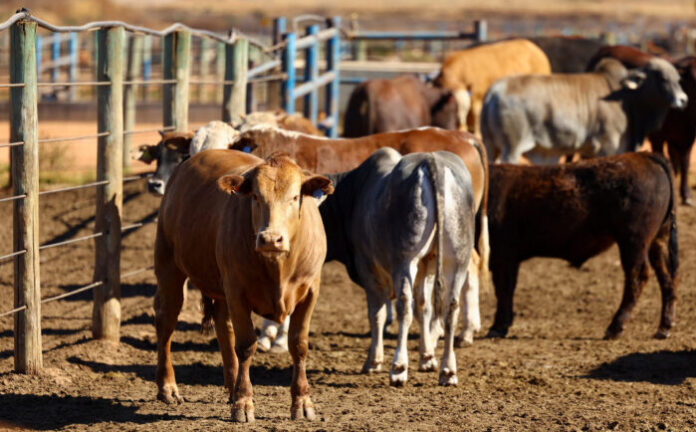
South Africa’s beef industry could face supply pressures and rising cattle prices if foot-and-mouth disease (FMD) restrictions in Namibia disrupt the flow of weaners into local feedlots, agricultural economists have warned.
While consumers are unlikely to see an immediate surge in beef prices, experts say a prolonged interruption to cross-border livestock trade could tighten supplies and push costs through the value chain over the coming months.
Feedlot sector heavily reliant on Namibian cattle
University of Pretoria agricultural economist Dr Danie Jordaan said the key issue would be how Namibia manages livestock movements following the outbreak.
READ: Food inflation likely to soften in 2026 though foot and mouth disease remains challenge
South Africa relies heavily on Namibian weaners, with large numbers of cattle crossing the border to supply local feedlots, he said. Any restrictions on those exports could reduce animal availability and place upward pressure on prices.
Jordaan said South Africa’s feedlot industry depends on imported cattle because domestic producers do not generate enough calves suitable for feedlotting to meet demand. He added that Namibia remains an important source of competitively priced weaners, helping to fill a supply gap in the local market.
Restrictions triggered by contingency plan
His comments come after Namibia activated its national FMD contingency plan following the detection of the disease in the country’s internationally recognised FMD-free zone.
The outbreak was identified on a commercial farm in the Karasburg State Veterinary District in the ||Kharas Region after laboratory tests confirmed positive cases in cattle showing symptoms consistent with the disease.
Authorities responded by suspending the movement, marketing, import and export of cloven-hoofed animals and their raw products nationwide. Slaughtering at export and local abattoirs has also been halted, while surveillance operations and roadblocks have been deployed to contain the spread of the disease.
The measures are expected to have significant implications for Namibia’s livestock sector, a major contributor to agricultural production and export earnings, while also affecting regional trade with South Africa.
Exporters assess fallout
Namibian processor Savanna Beef Processors said the restrictions were expected to materially disrupt its slaughtering, processing and export activities.
The company is assessing the impact on slaughter bookings, products already in transit, cash flow, financing arrangements and staffing, while working with veterinary authorities and industry stakeholders to contain the outbreak and restore market access.
It has also urged shareholders and holders of slaughter rights to exercise caution until there is greater clarity on the duration and impact of the restrictions.
Direct beef imports are relatively small
According to Dr Simphiwe Madikizela of the Unisa School of Business Leadership argued that the bigger concern is Namibia’s role as a supplier of live cattle rather than boxed beef.
South Africa imported more than 717,000 cattle in 2024, with about 81% sourced from Namibia. Much of this trade consists of weaners destined for South African feedlots before entering the local beef market.
Madikizela said the immediate impact on South African beef prices is likely to be limited because direct beef imports from Namibia account for only a small share of local consumption.
South Africa imported about 3,407 tonnes of fresh and frozen beef from Namibia in 2024, representing roughly 0.46% of annual domestic beef consumption.
“The suspension of Namibian beef exports following the confirmation of foot-and-mouth disease needs to be viewed in the context of Namibia’s broader role in the South African beef value chain,” said Madikizela.
He said existing inventories, domestic supply and alternative import sources should help cushion the market from any immediate shock.
Live cattle trade poses greater threat
“This is why I would not describe Namibia as supplying only 0.5% of the South African beef market. That figure applies specifically to direct fresh and frozen beef imports. The country’s contribution through live cattle is considerably more significant,” he said.
Madikizela warned that prolonged restrictions on cattle movements could tighten feedlot supplies, increase competition for locally available livestock and ultimately drive up costs throughout the supply chain.
Higher procurement costs at feedlot level would likely filter through to slaughter prices, wholesale beef prices and, eventually, retail prices.
READ: Provinces must quicken foot and mouth vaccinations – minister John Steenhuisen
Price pressures may emerge later
Although consumers are unlikely to experience a major price shock in the coming weeks, Madikizela said the next one to three months will be crucial.
If restrictions remain in place and Namibian cattle are unable to enter South Africa, feedlots could begin struggling to replace animals, putting upward pressure on producer and wholesale prices.
“If the FMD restrictions substantially disrupt this trade for an extended period, the impact could become much more significant,” he said.
He added that the risk becomes more pronounced over a three-to-six-month period as reduced cattle availability works its way through the production cycle.
Despite the threat, Madikizela said South Africa’s sizeable domestic cattle industry means the suspension of Namibian exports does not automatically translate into a beef shortage. The eventual impact will depend on how long restrictions remain in place, domestic slaughter levels, feedlot inventories and the availability of alternative supply sources.
Inflation concerns remain muted
Agricultural economist Wandile Sihlobo described the outbreak as concerning given the importance of livestock to Namibia’s agricultural economy but said there was some comfort in the fact that Namibia could draw lessons from South Africa’s experience in managing FMD outbreaks through expanded vaccination programmes.
Sihlobo said he does not expect the outbreak to create significant inflationary pressure in either Namibia or South Africa.
He noted that restrictions on exports could increase meat availability within Namibia, helping to keep local prices under control. In South Africa, a relatively healthy cattle herd should help absorb any short-term disruption.
While acknowledging Namibia’s importance to the regional livestock value chain, Sihlobo said the outbreak is unlikely to introduce a new risk to meat supply or food inflation.
“We don’t see this introducing new risk on the meat supply or inflation. We are actually in a year where food inflation in this country has been at the lowest in 16 years,” he said.
- South Africa's beef industry may face supply pressures and rising cattle prices if foot-and-mouth disease restrictions in Namibia disrupt the flow of weaners into local feedlots.
- Namibia has suspended movement, marketing, import, and export of cloven-hoofed animals nationwide following an FMD outbreak in the Karasburg State Veterinary District.
- South Africa imported over 717,000 cattle in 2024, with about 81% sourced from Namibia, mostly as live cattle for feedlots rather than boxed beef.
- The immediate impact on South African beef prices is expected to be limited, as direct beef imports from Namibia account for only about 0.46% of domestic consumption.
- Prolonged restrictions on Namibian cattle exports could tighten feedlot supplies and increase prices over a three-to-six-month period, though South Africa's large domestic herd may mitigate a major shortage.


