


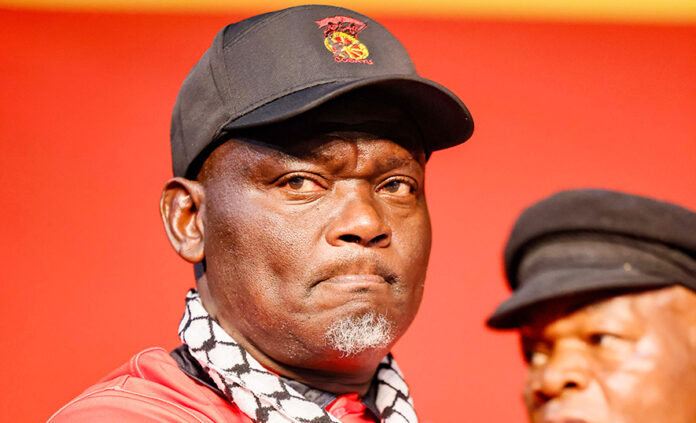
The Labour Court has dismissed Congress of South African Trade Unions (Cosatu) first deputy president Mike Shingange’s appeal against his disciplinary hearing, on the basis that the hearing does not essentially impact his standing at Cosatu as he will still be allowed to contest its elections.
This comes after the National Education, Health and Allied Workers’ Union (Nehawu) slapped him with a disciplinary hearing, due to start on Friday, as he stands for elections for presidency at Cosatu 15th National Congress.
READ: Court clears Shingange for Cosatu leadership contest after congress collapse
Hearing feared to threaten Cosatu status
Shingange, through his legal representative Tubatse Moloi, argued on Wednesday that the disciplinary hearing should be halted, as he believes that it threatens his standing in the union and may have implications for his position at Cosatu.
“We are here two days before the hearing. We do not seek to interdict congress; we seek to interdict an unlawful, irregular disciplinary hearing which starts in two days. It cannot be said that it’s self-created urgency,” said Moloi.
This case follows an earlier matter in which he successfully challenged his precautionary suspension.
Shingange’s internal disciplinary processes were not set aside, but it was found that it does not stop him from participating, as he has not been charged with misconduct.
The congress eventually collapsed as affiliates demanded clarity on his status before they would proceed with elections.
READ: Why Cosatu congress collapsed
Disciplinary stems from last year’s investigation
Moloi further argued that the disciplinary process had not been properly constituted and that the union’s central executive committee (CEC) should have dealt with the matter.
Shingange was placed on precautionary suspension by Nehawu just two days before the congress was due to begin.
At present he has not been formally charged with misconduct by his union, though the precautionary suspension is said to be related to alleged constitutional breaches.
In the arguments presented in court, the CEC had decided that an NEC task team should investigate the allegations and make a recommendation. Moloi argued that the matter was then not properly returned to the CEC before disciplinary action was pursued.
He said Shingange wanted access to the task team’s report, saying he had been provided with other documents but not the report on which the disciplinary process was based.
“This court is informed that this is a normal disciplinary hearing. No. It is not. There was a task team set up; Mr Shingange [was] suspended two days before the congress based on the strength of the finalised report. He is then charged after requesting the said report. That is not normal. You must look at the timing and everything that the first respondent has done,” said Moloi.
He also questioned why the allegations, which date back about 15 months, were only being pursued through the current disciplinary process. Shingange’s side further argued that the consequences of the disciplinary proceedings could extend beyond Nehawu.
He noted that if Shingange were to lose his position as a Nehawu shop steward, this could affect his ability to participate in Cosatu structures, as participation requires him to be a member in good standing and must have been nominated by two or more affiliates.
Nehawu insists disciplinary does not relate to Cosatu matters
Garth Hulley, Nehawu’s legal representative, told the court that the union had consistently maintained, both in earlier proceedings and in the current case, that it was not seeking to determine whether Shingange was eligible to contest the Cosatu elections.
Hulley told the court that Shingange’s suspension or disciplinary proceedings within Nehawu could not, in themselves, establish that he was ineligible to contest the federation’s position.
He also disputed the suggestion that the timing of the disciplinary process demonstrated an attempt to interfere with the Cosatu election. Hulley argued that the investigation had already been under way before the congress, and that Shingange was aware of the investigation.
Hulley told the court that once the investigation had been completed, Shingange was charged and that the timing did not support the inference that Nehawu was using the disciplinary proceedings to interfere with the Cosatu contest.
- The Labour Court dismissed Mike Shingange’s appeal against his disciplinary hearing, allowing him to contest the Cosatu elections.
- Nehawu initiated the disciplinary hearing against Shingange due to alleged constitutional breaches from an investigation started about 15 months ago.
- Shingange's legal representative argued that the disciplinary process was irregular and had not been properly constituted by the union’s central executive committee (CEC).
- Nehawu stated the disciplinary proceedings do not concern Shingange’s eligibility for the Cosatu presidency or interfere with the federation’s elections.
- The disciplinary hearing was postponed but Shingange remains eligible to participate in Cosatu structures despite not being formally charged yet.


