


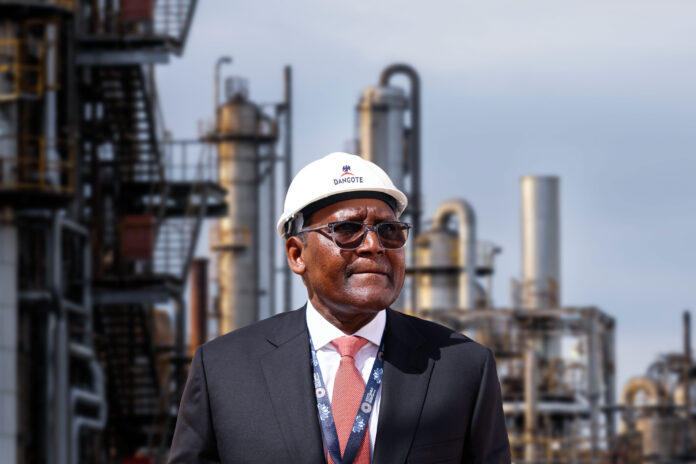
Nigerian billionaire Aliko Dangote’s US$1.6-billion (R26-billion) refinery IPO is turning one of Africa’s biggest industrial projects into a publicly investable asset, drawing retail and institutional investors into its ownership.
The early scramble for access, including efforts to bring investors from other African markets into the offer, is testing whether the continent’s fragmented capital markets can finance industrial growth at scale.
Kenya is now seeking a stake in that regional opportunity. Speaking to ARISE Xchange on the sidelines of the IPO launch in Lagos last week, Nairobi Securities Exchange CEO Frank Mwiti said a potential Nairobi cross-listing was “on the table”, with the NSE discussing the proposal with Dangote, the Nigerian Exchange and Nigeria’s capital-market regulator.
The IPO opened on September 14, offering 4.1 billion shares at about US$4 each and targeting US$1.6 billion, according to Dangote Refinery’s official offer documents. The minimum subscription is 10 shares. The offer closes on October 13, with trading on the Nigerian Exchange expected to begin in November.
READ: Nigerian billionaire Dangote launches oil refinery IPO, Africa’s biggest share sale
Investor demand overwhelms platforms
The offer is already testing the infrastructure needed to bring first-time investors into the market.
In an interview with BBC, Temi Popoola, Group Managing Director and CEO of Nigerian Exchange Group, said several distributor apps “halted and crashed” on the first day of the offer as demand exceeded expectations.
The disruption was also reported by Reuters, which said several Nigerian digital investment platforms experienced outages after a sharp surge in traffic following the IPO launch.
Africanews, citing the Associated Press, reported that Nigerians had begun scrambling to buy shares, with some describing the offer as an opportunity to participate in one of Africa’s most ambitious industrial projects.
One investor, dispatch rider Boluwatife Ogundairo, said he would invest for his future, his finances and Nigeria’s economy.
The retail response matters because Dangote has deliberately positioned the transaction as an ownership opportunity for ordinary Nigerians. The minimum investment of ₦5,250 makes the offer accessible to a much wider pool of investors than a conventional institutional transaction.
Popularity versus suitability
But the enthusiasm also puts the question of suitability alongside the question of access.
According to Odiri Oginni, CEO of United Capital Asset Management, the excitement around the IPO should not substitute for investor analysis.
“The most important question is not ‘Should my client buy the Dangote IPO?’” Oginni explained. “It is: ‘How do I help my client decide whether this investment is right for them?’”
Her warning is particularly relevant as retail investors respond to the Dangote name and the refinery’s recent financial performance.
A valuation built on profits
The refinery reported US$13.9 billion in revenue and US$1.82 billion in net profit in the first half of 2026, compared with a US$476 million loss in 2025, according to Reuters. The news agency said stronger refining margins following disruptions to Middle Eastern fuel supplies contributed to the sharp improvement.
The recent profits therefore raise a valuation question.
According to investment analyst Ibinabo Anabraba, investors should focus on the durability of those earnings.
“The H1 numbers are impressive, but refining profitability remains exposed to crude costs, product prices, crack spreads, foreign exchange and operating conditions,” Anabraba explains.
Her central question is whether the refinery’s recent performance represents “a new sustainable earnings base or, at least in part, a particularly favourable refining environment.”
At ₦525 (about US$4) a share, the offer values the refinery at roughly ₦63 trillion (about US$47.6 billion), according to Reuters. Breakingviews said the valuation implies around 8.3 times projected 2026 EBITDA and depends partly on future expansion and refining conditions.
Anabraba argues that investors should look beyond the size of the refinery and ask whether it can generate sufficient returns on the enormous capital invested.
“The more important question is whether DPRP can generate and sustain earnings large enough to make that valuation attractive,” she wrote.
Expansion brings new challenges
That question becomes harder as Dangote prepares to expand.
Reuters reports that the refinery plans to increase capacity from about 700,000 barrels per day to 1.4 million barrels per day by 2029. The company will need additional crude supplies, capital expenditure and operating capacity to support that expansion.
The crude question is already attracting scrutiny. Reuters reported in August that securing sufficiently competitively priced Nigerian crude was among the issues investors were watching as Dangote moved towards expansion.
A growing export powerhouse
The refinery’s significance also extends beyond Nigeria.
Reuters reported on September 15 that Dangote supplied about 80,000 barrels of jet fuel per day to Europe in the second quarter of 2026, making it Europe’s largest supplier of the fuel during a period of disrupted Middle Eastern exports.
The refinery also increased diesel and gasoil exports to West Africa and Europe.
That growing regional role strengthens the industrialisation argument behind the IPO.
Financing Africa with African capital
But Popoola sees the transaction as potentially larger than the opening of one Nigerian company to public ownership.
Asked whether investors from Kenya, South Africa and other African markets could participate, he said the answer was yes, although the regulatory requirements and modalities would differ between countries.
“Large African companies, frankly speaking, should be financed by Africans,” Popoola said. “We need to be able to mobilise capital across the continent and funnel it into businesses, in whatever countries they are, to drive our collective growth.”
READ: Dangote has ‘strong intent’ for South Africa listing after Nigeria IPO – JSE
The ambition is consistent with discussions already taking place among African exchanges. In April, the Nigerian Exchange brought together the Johannesburg Stock Exchange, Nairobi Securities Exchange, Ghana Stock Exchange, Ethiopian Securities Exchange and the BRVM for talks with Dangote and Nigerian market officials about cross-border investment.
Mwiti said at the time that “the plan is to structure a pan-African IPO”, according to Energy Connects.
Cross-border investing takes shape
The deal has since taken a more immediate form. The refinery is listed for subscription in Nigeria, while Kenyan investors can already access the offer through digital intermediaries.
Money254 reported on September 16 that MyStocks Africa was enabling eligible Kenyan investors to apply without opening a Nigerian bank account or individual CSCS account. The platform says the minimum 10-share purchase costs about KSh5,137 (about US$4), before fees and currency conversion charges.
The prospect of African investors owning companies listed outside their home markets points to a broader problem: the continent has capital, but its financial markets remain fragmented across currencies, regulations, settlement systems and national exchanges.
A test case for public markets
Popoola said the Dangote transaction is already generating interest from another group: founders and CEOs of privately held companies considering opening their ownership through public markets.
Before the offer, he said, the Nigerian Exchange already had what it considered a “decent enough pipeline” of potential transactions. The Dangote IPO, however, is demonstrating that large African companies can raise substantial amounts of capital through public markets.
That could give the transaction a significance beyond the US$1.6 billion being raised.
Willy Nsabiyumva, an African growth-stage business adviser, says the deeper issue is whether African companies can move from concentrated private ownership towards broader public ownership and larger pools of institutional capital.
“Africa has no shortage of entrepreneurs,” Nsabiyumva wrote in an August analysis. “What Africa has historically lacked is sufficient pools of large, patient and sophisticated capital capable of financing industrial assets that require billions of dollars before they generate meaningful returns.”
He sees the Dangote transaction as part of that transition, describing it as “a new mechanism through which African and international investors can participate in the ownership and expansion of African industrial infrastructure.”
Beyond the IPO
Africa’s capital markets have a long way to go to provide that financing at scale. The African Development Bank says the continent accounted for just 0.4% of global public-equity market capitalisation at the end of 2024, while its listed companies had a combined market value of US$561 billion.
The Dangote IPO puts those limitations into focus because the company is raising equity for one of Africa’s largest industrial projects through a domestic exchange while another African exchange is actively seeking a role for its own investors.
For Kenya, that role could eventually extend beyond Dangote Refinery.
Mwiti has also pointed to the proposed Dangote refinery in Kenya, renewable-energy projects, fuel storage and logistics businesses and large infrastructure such as the East African Crude Oil Pipeline as potential future users of deeper capital markets.
The long-term question
For first-time investors, however, the expansion of access does not remove the underlying risks.
Popoola’s advice is direct: capital markets are a long-term game, and an investment that appreciates can also depreciate. Investors, he said, need to assess the potential investment properly before committing their money.
Oginni’s warning is similarly simple: “Popularity is different from suitability.”
The longer-term question is therefore bigger than whether Dangote Refinery’s IPO succeeds.
If the transaction draws large numbers of retail investors, attracts capital from other African markets and encourages more private companies to consider public ownership, it could provide a working example of how African savings can be connected to African industrial growth.
- Nigerian billionaire Aliko Dangote launched a US$1.6-billion refinery IPO, offering 4.1 billion shares at around US$4 each, with a minimum subscription of 10 shares, targeting retail and institutional investors.
- The IPO opened on September 14 and closes on October 13, with trading on the Nigerian Exchange expected to begin in November, though several digital investment platforms experienced outages due to overwhelming demand.
- Nairobi Securities Exchange CEO Frank Mwiti confirmed that a potential cross-listing for the refinery IPO is being discussed with Dangote, the Nigerian Exchange, and Nigeria’s capital-market regulator, enabling Kenyan investors to access the offer.
- The refinery reported US$13.9 billion in revenue and US$1.82 billion in net profit in the first half of 2026, a significant improvement from a US$476 million loss in 2025, driven by stronger refining margins amid Middle Eastern fuel supply disruptions.
- The IPO aims to mobilize African capital for industrial growth, with Dangote planning to expand refinery capacity to 1.4 million barrels per day by 2029, while raising broader questions about the sustainability of earnings and the need for deeper, integrated African capital markets.


