


South Africa has a diverse agricultural sector, from grains and oilseeds to sugar cane, livestock and more. In appreciation of the sector’s diversity, we decided to place emphasis on the Karoo region.
Why is this important? Consider the distribution of South Africa’s agricultural land and its land potential. Commercial agriculture typically takes
place on freehold land. Freehold (private title deeds) farmland makes up 77.5 million hectares, roughly 63%, of South Africa’s surface area.
Of the farmland area, 44.5 million hectares (57%) are in the semi-arid Karoo and the Kalahari. It is here that extensive livestock production takes place (mutton, lamb, wool, mohair and cattle. For this reason, rainfall, the timing of rainfall and the quality of natural grazing are critical to the financial well-being of farmers.
Although the Karoo and Kalahari do get periods of good rainfall, the farmers cope with regular droughts and the resulting poor grazing, leading to financial hardship.
However, this year, as in much of South Africa, has brought favourable rainfall to the Kalahari, where the Kuruman River has begun to flow after being dry for many years.
In the Karoo region, we saw pictures of excessive rainfall in the Koup (Beaufort-West and Laingsburg), Graaff-Reinet and Middelburg regions. The upper Karoo, from Britstown to Carnarvon and Victoria-West, has also been blessed with record rainfall. Even the Western regions past Williston, to Brandvlei and Sutherland, did not miss out, although rainfall totals there are much lower.
But there is something special about this year’s rainfall beyond the record totals that most farmers have highlighted – the timing and frequency. Regular (weekly) rainfall of between 10mm and 25mm in March, April, May and June has a much bigger impact on grazing quality than 100mm in January or February when it is too warm, causing much of the moisture to disappear quickly. This is what happened this year – good regular rainfall from March to May and even into June.
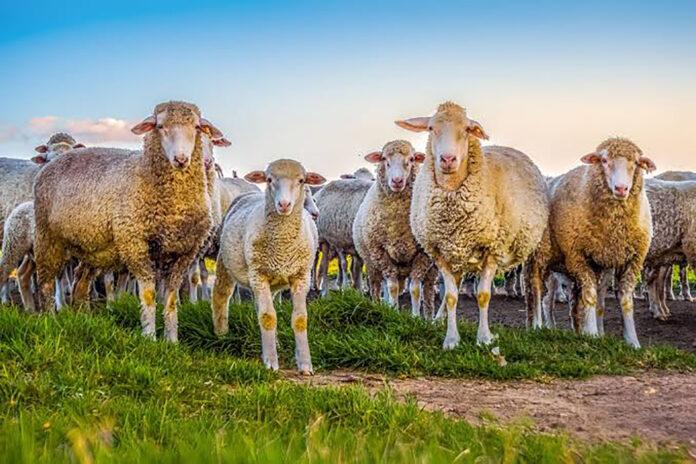
The benefits are clear in the sheep industry. The ewes are producing many lambs, the udders of the ewes are full and the lambs gain weight quickly.
The only other year in recent history with similar fantastic conditions was 1974/75, which remains the wettest on record.
On some farms, we see fountains, springs and rivers running for the first time in the lifetime of the farmers. This suggests that water tables and soil moisture have been replenished beyond previous levels.
If we experience an El Niño next year, the farmers in the Karoo should be in a good position for a while.
We have received a report from AridEco. The data used in its report covers the period from the beginning of May 2026 and consists of weather station data, reference farm data, satellite-derived NDVI data and supporting information.
The Normalised Difference Vegetation Index is the most used index in vegetation monitoring. It is a simple graphical indicator that can be used to analyse remote sensing measurements and provides an index of plant “greenness” or photosynthetic activity.
The biggest benefit of good vegetation conditions is that farmers do not have to buy feed. Considering the good wool and lamb prices, we expect farm profits in the Karoo to get a well-needed boost – something they really need after many years of suffering.
More importantly, all lambs produced and slaughtered in the Karoo will have natural Karoo veld vegetation this year.
Every lamb produced in 2026 should automatically have complied with the requirements for the Karoo Lamb Geographical Indication, provided the farm is in the Karoo region and registered with the Department of Agriculture and SA Meat Industry Company.
This is therefore an ideal time for abattoirs in the Karoo to capitalise on the good grazing conditions and make sure their lamb is marketed, sold and labelled as Karoo Lamb.
Overall, as with some fruits and field crops, 2026 is going to be a good year for Karoo farmers and Karoo lamb.
- Sihlobo is the presidential envoy on agriculture and land. He is the chief economist of the Agricultural Business Chamber of South Africa, and a senior research fellow in the Department of Agricultural Economics at Stellenbosch University.
- South Africa's agricultural sector is diverse, with commercial farming mainly on freehold land, 57% of which lies in the semi-arid Karoo and Kalahari regions, crucial for extensive livestock production (sheep, wool, mohair, cattle).
- The Karoo and Kalahari often face drought and poor grazing; however, 2026 has seen unusually favorable, well-timed, and frequent rainfall, significantly improving grazing quality and water availability.
- The beneficial rainfall pattern from March to June has led to increased lamb production, better ewe health, rapid lamb weight gain, and replenished water tables, comparable only to the historically wet year of 1974/75.
- Improved vegetation conditions mean farmers can avoid buying feed, potentially boosting profits amid good wool and lamb prices, with all lambs produced possibly qualifying for the Karoo Lamb Geographical Indication certification.
- 2026 presents an excellent opportunity for Karoo lamb producers and abattoirs to market and capitalize on high-quality lamb from natural Karoo veld grazing, marking a prosperous year for Karoo farmers.


