


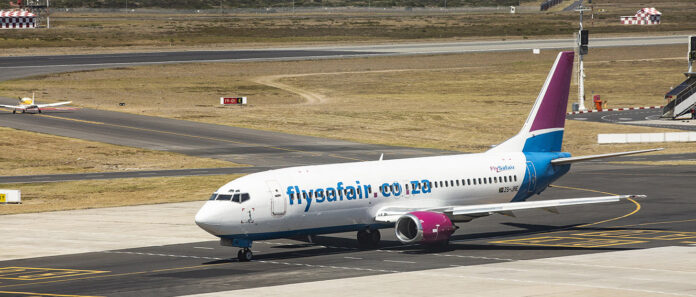
Low-cost domestic airline FlySafair has announced a cut to its dynamic fuel surcharge, dropping it to below the 40% peak reached in late March.
The surcharge was introduced in March at the height of the escalating Middle East war, which surged global oil prices to around $100 per barrel following the closure of the critical shipping routes, the Strait of Hormuz, where 20% of the world’s oil passes.
The combination of higher global prices and currency pressures led to a rapid increase in operating costs, prompting the airline to introduce a dynamic, route-based fuel surcharge rather than raise base fares.
Significant adjustment
Kirby Gordon, FlySafair chief marketing officer, said this week’s reduction comes as they mark significant adjustment since the surcharge was introduced.
“We’re encouraged to see some relief in jet fuel prices, and we’re pleased to be able to pass that benefit on to our customers.
“When we introduced the surcharge, we committed to reviewing it weekly and reducing it as soon as conditions allowed. This latest adjustment reflects that commitment to transparency and fairness,” said Gordon.
FlySafair had committed to applying the surcharge as a clearly itemised lie item, calculated according to route-specific fuel consumption and reviewed weekly in line with market conditions.
The surcharge was highest between April 14 and 21, where it was R832.60 for the Johannesburg to Cape Town route, R840.65 for the Cape Town to Durban route and R460 for the Johannesburg to Durban route. The prices have now dropped to R491.01, R495.69 and R271.23, respectively.
Market stability returns
This comes as market conditions have begun to stabilise in recent weeks. The airline said improved availability of Jet A1 fuel, alongside easing refining margins, has helped to drive prices lower.
Despite the recent decline, the airline cautioned that fuel prices remain closely tied to geopolitical developments and global oil markets. Ongoing instability in the Middle East continues to pose risks to supply chains, meaning further volatility cannot be ruled out.
He said FlySafair will continue to review the surcharge on a weekly basis and adjust it in line with underlying fuel costs, ensuring that any future changes are communicated clearly to customers.
- FlySafair has reduced its dynamic fuel surcharge from a peak of over 40% in late March to lower rates due to easing fuel prices.
- The surcharge was introduced in March amid rising global oil prices caused by the Middle East conflict and closure of the Strait of Hormuz.
- The airline uses a route-based surcharge model to manage rising costs without increasing base fares, with weekly reviews and transparent customer communication.
- Current surcharges for key routes like Johannesburg-Cape Town and Cape Town-Durban have dropped significantly from their April highs.
- While fuel prices have stabilized recently, FlySafair warns that ongoing Middle East instability may cause future fuel cost volatility and continues to monitor and adjust the surcharge accordingly.


