


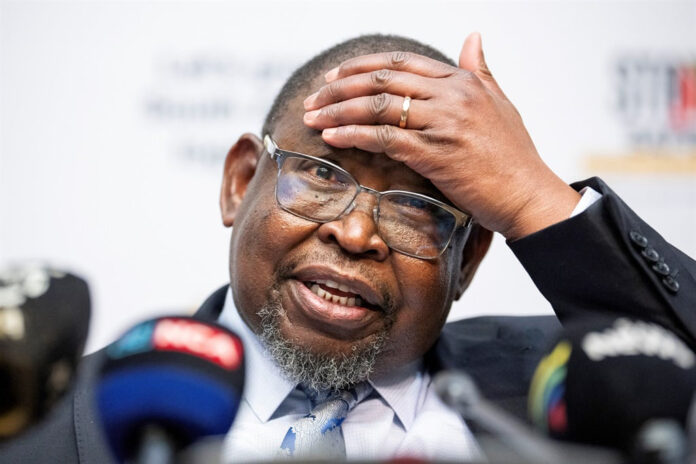
Finance Minister Enoch Godongwana has broken his silence following a Constitutional Court ruling setting aside the Public Procurement Act, 2024, saying he respects the ruling and will consult parliamentary leaders on the way forward after the landmark ruling declared the legislation unconstitutional.
Godongwana said this in a statement issued after the judgement, saying he had taken note of the court’s finding that the Act was adopted in a manner inconsistent with the Constitution and was therefore invalid.
The unanimous Constitutional Court ruling invalidated the Public Procurement Act before it could be brought into operation, finding that Parliament failed to facilitate public participation adequately during the legislative process.
The Act was intended to create a single national procurement framework, replacing a fragmented regime governed by multiple laws and regulations.
Treasury defends need for reform
Despite the setback, the Treasury signalled that procurement reform remains a priority, arguing that South Africa’s current procurement environment is failing to meet constitutional objectives and continues to be undermined by widespread governance weaknesses.
Godongwana said public procurement is a critical instrument for economic growth and development but that such goals cannot be achieved through a weak procurement system.
According to the statement, the existing framework remains plagued by corruption, fraud, financial losses, poor planning, weak institutional capacity, irregular expenditure and failures to sufficiently support domestic industries.
National Treasury argued that these shortcomings have been repeatedly highlighted in official reports, media investigations and commissions of inquiry into state governance and procurement practices.
Court leaves door open for new legislation
The Constitutional Court acknowledged that Parliament remains free to pursue new procurement legislation, provided it complies with constitutional requirements relating to public participation.
Citing paragraph 119 of the judgement, the minister pointed to the court’s observation that it would be inappropriate for judges to direct Parliament on how to remedy the defects in the legislative process. The court stated that lawmakers are free to proceed with enacting the Act or similar legislation, provided they follow a constitutionally compliant public participation process.
The ruling leaves open the possibility of a revised procurement bill being introduced after renewed consultation.
Consultations on way forward
Godongwana said he would first assess the implications of the judgement before engaging the Speaker of the National Assembly and the Chairperson of the National Council of Provinces on the appropriate response.
“Accordingly, after studying the implications of the judgement, the Minister of Finance will engage the Speaker of the National Assembly and the Chairperson of the National Council of Provinces on the way forward,” the statement said.
For businesses, suppliers and investors that operate in the public procurement market, the judgment preserves the status quo by keeping existing procurement legislation in force. However, it also delays the introduction of a unified procurement regime that the government had argued would strengthen oversight, improve efficiency and provide greater policy certainty.
The Treasury maintained that the need for procurement reform remains unchanged despite the legal defeat.
“It remains my commitment, with the support of the National Treasury, to advance the requisite public procurement legislative reforms as guided by the Constitutional Court judgement,” the minister said.
The judgement means government must now decide whether to restart the legislative process for a revised procurement law, a process that would require substantially broader public consultation to meet constitutional standards.
The Constitutional Court ruled that the Public Procurement Act of 2024 unconstitutional and invalid, delivering a major setback to the government’s effort to overhaul the country’s fragmented procurement system and creating fresh uncertainty around one of the most significant economic reform initiatives in recent years.
In the unanimous judgement delivered by Acting Justice Gcinikaya Nuku on Thursday, the court found that Parliament failed to meet its constitutional obligation to facilitate meaningful public participation before passing the legislation, which was intended to establish a single national framework for public procurement.
The ruling invalidates the entire Act before it could come into operation, leaving existing procurement laws in place and forcing the government to restart any legislative effort to create a replacement framework.
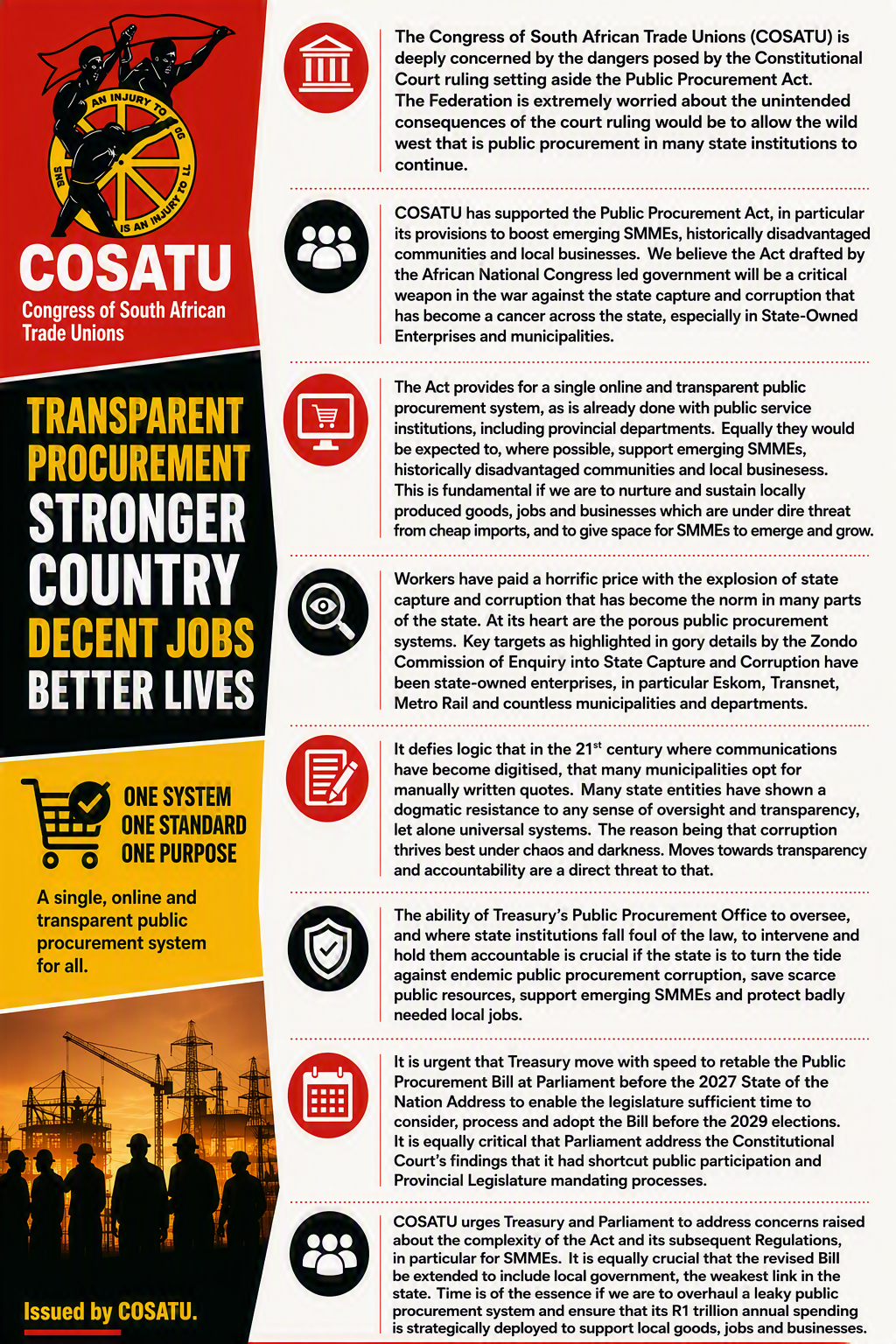
The case was brought by the Premier of the Western Cape, the City of Cape Town, investigative journalism organisation AmaBhungane and predominantly Afrikaner trade union Solidarity, who argued that Parliament rushed the bill through the legislative process and failed to consult the public adequately on substantial changes introduced during its passage.
Ambitious procurement reform programme
The government designed the Public Procurement Act as a cornerstone of its effort to modernise public purchasing rules. It sought to consolidate dozens of procurement-related laws and regulations while creating a new Public Procurement Office within National Treasury and an independent Public Procurement Tribunal to review tender disputes.
Critically, the law was also intended to provide a unified framework for preferential procurement policies aimed at advancing historically disadvantaged groups through state contracting.
Court faults public participation process
The court found that Parliament introduced major new provisions governing preferential procurement after the initial public consultation phase and failed to conduct a fresh round of public participation despite the scale of those changes.
According to the judgement, the original bill contained a relatively broad framework for preferential procurement, but later versions introduced extensive new mechanisms, including mandatory set-asides, prequalification requirements, subcontracting obligations and local-content rules.
The court said those amendments were material rather than merely technical and therefore required further public consultation.
READ: BBC welcomes cabinet approval of Public Procurement Bill
“The new Chapter 4 cannot be properly characterised as a mere elaboration or refinement,” the judgement stated, finding that the changes had significant constitutional, economic and practical consequences for businesses, government entities and potential state suppliers.
Concerns over handling of public submissions
The court was also critical of the way public submissions were handled. Evidence before the court showed that more than 100 stakeholders submitted comments on the bill, but only a portion received detailed consideration by National Treasury during the legislative process.
Judges concluded that Parliament’s failure to consider all submissions undermined the purpose of public participation and deprived stakeholders of a realistic opportunity to influence legislation.
The judgement further highlighted concerns about compressed consultation timelines. Stakeholders were reportedly given only four hours to review major amendments to the bill before a parliamentary meeting and were allocated just two minutes each to comment on the changes.
The court said the legislation was of such importance and potentially wide-ranging impact that it required a more robust consultation process.
Major implications for business
For business, the ruling removes what would have been the most sweeping overhaul of South African procurement law in decades.
The Act aimed to replace a patchwork of legislation, including provisions of the Public Finance Management Act, Municipal Finance Management Act and Preferential Procurement Policy Framework Act, creating a single national procurement regime applicable across government.
Business groups had closely watched the legislation because of its implications for tender eligibility, localisation requirements, empowerment policies and supplier development obligations.
What happens next?
The Constitutional Court, however, declined to suspend its declaration of invalidity, noting that the Act had not yet been brought into force and that existing procurement legislation remained operational. The court also declined to direct Parliament on how to repair the defects, effectively requiring lawmakers to decide whether and how to restart the legislative process.
The court ordered Parliament and several provincial legislatures opposing the challenge to pay the applicants’ legal costs, including the costs of two counsel.
- The Constitutional Court unanimously ruled the Public Procurement Act, 2024 unconstitutional and invalid for failing to allow adequate public participation during the legislative process.
- Finance Minister Enoch Godongwana stated he respects the ruling and will consult parliamentary leaders on the way forward following the judgement.
- The ruling leaves existing procurement laws in place and requires Parliament to restart the legislative process with broader public consultation to comply with constitutional standards.
- The Act was designed to unify South Africa's fragmented procurement framework and introduce mechanisms supporting historically disadvantaged groups through state contracting.
- The court criticized Parliament for introducing major changes after initial consultations without additional public engagement and for poor handling of public submissions.


