



With more than 14 years at the helm, Shameel Joosub has overseen one of the most significant transformations in African telecommunications, turning Vodacom from a South African mobile operator into a diversified technology and financial services powerhouse spanning the continent.
When he returned to South Africa from Spain in 2012 to take over as chief executive of Vodacom Group, the company looked very different.
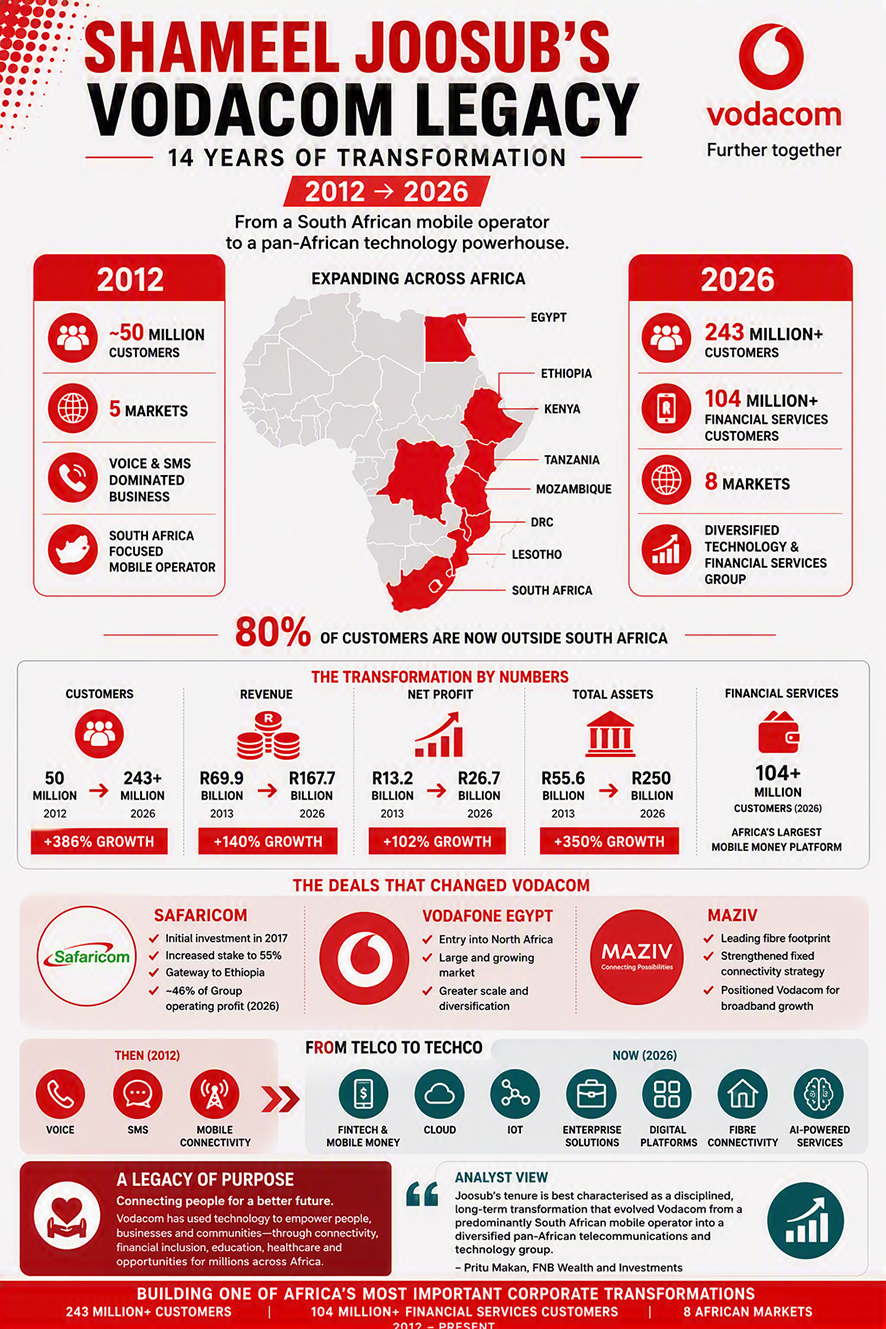
It operated in five countries, served about 50 million customers and remained reliant on voice and SMS revenues. South Africa dominated the business, while its operations in Tanzania, Mozambique, the Democratic Republic of Congo (DRC) and Lesotho provided valuable but comparatively small, growth opportunities.
Fourteen years later, Vodacom has become one of Africa’s most diversified telecommunications and technology companies.
It serves more than 243 million customers across eight markets, including Egypt in North Africa and Kenya and Ethiopia in East Africa through its strategic investment and acquisition of a controlling stake in Safaricom.
Joosub, who grew up in Laudium, a Pretoria township, acknowledged that the scale of the company’s evolution exceeded what management could have reasonably anticipated in 2012.
Today, around 80% of Vodacom’s customers are outside South Africa and the company’s growth is increasingly driven by financial services, digital platforms, fibre, cloud computing, enterprise technology and the Internet of Things (IoT) rather than traditional voice revenues.
Joosub says the company is entering a new chapter shaped by the consolidation of Safaricom and the ambitions of Vision 2030, which targets 275 million customers and 130 million financial services users.
Joosub, 55, says his focus remains on executing the next stage of Vodacom’s growth strategy and intends to continue leading the business as long as he retains the board’s confidence.
Succession questions typically intensify once executives pass the decade mark in office. In Joosub’s case, however, the company’s evolving structure arguably complicates the issue.
When quizzed about the Please Call Me dispute with Nkosana Makate, which became one of the longest-running legal battles in South African corporate history, spanning more than a decade and remaining a prominent issue throughout much of Joosub’s tenure, his position is that the key outcome was achieving finality, allowing all parties to move forward.
FNB Wealth and Investments analyst Pritu Makan said Joosub’s tenure ranked among the most significant leadership periods in African telecommunications. Rather than being defined by a dramatic turnaround, Joosub’s legacy was characterised by long-term transformation.
Joosub evolved Vodacom into a diversified pan-African technology and telecommunications group, expanding its customer base, digital capabilities, data revenues and geographic reach while navigating competitive and regulated markets.
One of his defining achievements was repositioning Vodacom away from its dependence on traditional voice services towards higher-growth opportunities such as data connectivity, fintech and digital services.
Today, the business spans mobile and fixed connectivity, fintech, cloud services, digital infrastructure, IoT solutions and one of Africa’s largest mobile financial services ecosystems. The group’s profits are diversified across South Africa, Egypt, Kenya, Tanzania, Mozambique, Lesotho and the DRC.
“As a result, Joosub leaves behind a business that is broader, more resilient and better positioned for long-term growth than the one he inherited,” Makan said.
Several landmark transactions helped define his era.
The first was Vodacom’s investment in Safaricom in 2017, which Joosub described as recognition of a high-quality business, strong management and the enormous potential of M-Pesa. Safaricom became one of Africa’s leading technology success stories and opened the door to Ethiopia through the Safaricom-led consortium. Vodacom later deepened the relationship through a $2.1 billion transaction that increased its stake in Safaricom to 55%.
Safaricom contributed about 46% of group operating profit during the 2026 financial year and strengthened Vodacom’s exposure to mobile financial services, one of the fastest-growing segments in African telecommunications.
The acquisitions of Vodafone Egypt and a significant stake in fibre operator Maziv gave Vodacom greater geographic diversification and positioning it to participate in the continent’s demand for broadband connectivity and digital infrastructure. The deals transformed Vodacom into a pan-African technology company.
The numbers provide a powerful illustration of the journey.
Group revenue increased by around 140%, rising from R69.9bn in 2013 to R167.7bn in the financial year ended March 2026. Total assets expanded by about 250%, from R55.6bn to R250bn, while net profit more than doubled to R26.7bn from R13.2bn.
Compared with developed-market telecom operators, Makan described Vodacom’s financial performance as healthy and consistent, driven by strong data growth and exposure to faster-growing African markets.
What distinguished the business, he said, was its resilience. Despite regulatory challenges, growing competition and difficult economic conditions, Vodacom maintained strong profitability, cash generation and an ability to reward shareholders. Its growth story was therefore defined less by aggressive risk-taking and more by disciplined execution, Makan said.
Perhaps Joosub’s most enduring contribution was recognising early that connectivity alone would not be enough.
As smartphones became central to daily life, Vodacom broadened its focus from simply connecting customers to enabling digital lifestyles and financial inclusion. The company now serves well over 104 million financial-services customers and operates Africa’s largest mobile money platform. Through payments, lending, insurance and digital services, Vodacom has become embedded in the daily lives of millions across the continent.
Joosub believes the mission represents technology at its most meaningful, as it helps entrepreneurs reach customers, connects students to educational resources, enabling access to healthcare and brings millions of people into the formal financial system.
A hallmark of his leadership has been the purpose-driven approach, centring on building strong management teams and empowering leaders across the organisation.
That might ultimately prove to be one of Joosub’s most important achievements.
- Shameel Joosub has led Vodacom for more than 14 years, transforming it from a South African mobile operator into a diversified pan-African technology and financial services company.
- Vodacom now serves over 243 million customers in eight markets across Africa, with around 80% of customers outside South Africa.
- The company’s growth focus has shifted from traditional voice and SMS to financial services, digital platforms, fibre, cloud computing, enterprise technology, and IoT.
- Major transactions under Joosub's leadership include acquiring a controlling stake in Safaricom, Vodafone Egypt, and a stake in fibre operator Maziv, expanding Vodacom’s geographic reach and service offerings.
- Vodacom’s revenue rose from R69.9 billion in 2013 to R167.7 billion in 2026, and net profit more than doubled to R26.7 billion, highlighting strong financial performance despite challenging market conditions.


