


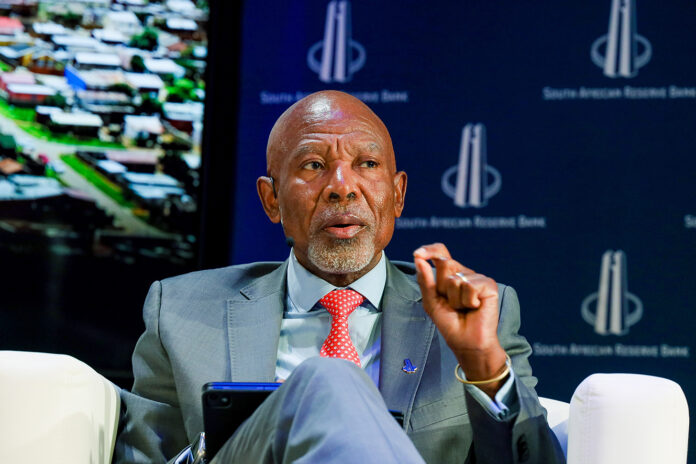
Reserve Bank governor Lesetja Kganyago has raised concerns that calls to nationalise the South African Reserve Bank (SARB) tend to resurface whenever the ANC approaches a national conference.
The debate over the nationalisation of the central bank has been ongoing for years and gained traction when it was adopted as an ANC resolution at the party’s 2017 national conference. However, the resolution has yet to be implemented.
Kganyago said the push to nationalise the Reserve Bank did not originate from politicians.
“It is driven by a foreign shareholder who had run around offices trying to convince everyone that this must be done.
“It is not our agenda, it is a foreign agenda. And those who keep on hoping for this thing are serving foreign interests, not our interests,” said Kganyago while addressing journalists at a central bank luncheon.
He warned that nationalising the Reserve Bank would have serious financial implications, requiring the government to spend billions of rand to buy out shareholders. The resources would be better spent on public infrastructure and services.
“Why would the government spend that money buying out these shareholders instead of spending it to fix the rail, roads, school or hospital?
“Why go waste the money … to nationalise the Reserve Bank?”
The governor also questioned what policy problem would be solved through nationalisation.
“After all, this institution is functioning and there are a lot of other institutions that are not functioning. Why are we obsessed in breaking the one that is working? Because that is what it amounts to.”
He said nationalising the central bank could alter its mandate, which was focused on protecting the value of the rand.
Kganyago described the Reserve Bank’s ownership structure as unusual. Private shareholders collectively received R200 000 in dividends annually, while the bulk of the profits were transferred to the state.
“We have got private shareholding but the profits go to the one party that doesn’t have shareholding in the central private. So this is a R200 000 conversation that is seasonal. It gains momentum every five years or so and then it fizzles down and then it goes up again.”
Kganyago also addressed the Reserve Bank’s decision not to disclose how each Monetary Policy Committee (MPC) member voted. “You want to know who is the Judas.” He said he was uncertain whether the public was mature enough for such transparency, warning that revealing how each MPC member voted could result in protesters gathering outside their homes.
Keeping votes confidential allowed them the freedom to debate issues without pressure from external voices, thereby avoiding political theatre.
Central bank officials in some countries arrived at meetings with prepared scripts, he said; something he believed undermined the collegial nature of committee discussions.
Speaking about the factors that could influence future interest rate decisions, Kganyago warned that the conflict involving Iran, which had pushed up fertiliser and fuel prices, could lead to rising food inflation.
“The war in the Middle East has had an impact on fuel prices. Secondly it’s had an impact on fertiliser prices and the availability of fertiliser. For South Africa, these shocks came after our planting season … As we get towards the planting season and farmers have to start the tractors and the oil prices remain elevated, that is going to feed into food prices at some point.”
- Lesetja Kganyago stated that calls to nationalise the South African Reserve Bank tend to resurface whenever the ANC approaches a national conference, but the resolution adopted in 2017 has not been implemented.
- Kganyago claimed the push to nationalise the Reserve Bank is driven by a foreign shareholder and serves foreign interests, not South Africa's interests.
- Nationalising the Reserve Bank would require the government to spend billions of rand to buy out shareholders, money which Kganyago suggested would be better spent on public infrastructure and services.
- The Reserve Bank's ownership structure is unusual, with private shareholders receiving R200,000 in dividends annually while most profits go to the state.
- Kganyago warned that the Middle East conflict is affecting fuel and fertiliser prices, which could lead to rising food inflation in South Africa.


