


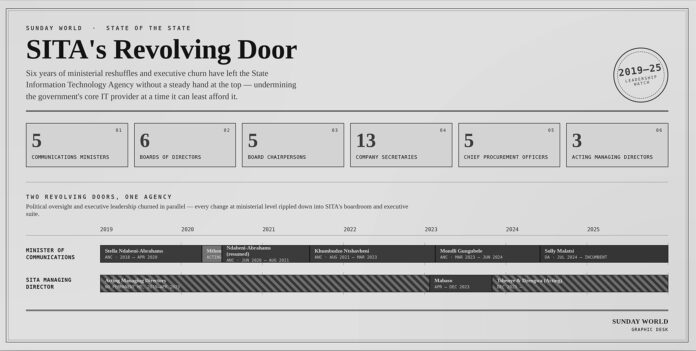
The revolving door of communications ministers in President Cyril Ramaphosa’s administration has been identified as one of the key drivers behind the governance failures that have crippled the State Information Technology Agency (Sita).
An investigation by the Public Service Commission (PSC) has concluded that political instability filtered through the organisation and undermined its ability to deliver on its mandate.
The PSC’s investigation found a direct correlation between repeated changes in political leadership and the constant turnover of the boards of the state technology agency, its managing directors and company secretaries.
“Repeated changes in ministers, board leadership and executive leadership appear to have destabilised both strategic direction and day-to-day oversight continuity,” the report states.
“Those leadership changes were not simply parallel events. They affected the ability of governance structures to sustain authority, preserve institutional memory and maintain consistent follow-through on unresolved matters.”
The communications and digital technologies portfolio has changed hands five times over a period of seven years. This while Sita battled worsening governance failures, procurement delays and declining confidence from government departments that rely on the agency for critical ICT services.
Between 2020 and 2025, Sita reported to four communications ministers and one acting minister while cycling through six boards of directors, six board chairpersons, seven managing directors and 13 company secretaries.
The communications portfolio was held by Stella Ndabeni-Abrahams before she was placed on special leave in April 2020 after breaching Covid-19 lockdown regulations. Jackson Mthembu stepped in to lead the department before he was formally appointed minister. Following Mthembu’s death in January 2021, Ndabeni-Abrahams returned to the portfolio until August 2021, when Khumbudzo Ntshavheni was appointed.
In March 2023, she was succeeded by Mondli Gungubele, who held the position before Solly Malatsi took office in July 2024, following the formation of the government of national unity.
The report found that the longest-serving Sita board remained in office for just 17 months, while the shortest served for only five months. On average, board members served just 11.5 months, and, for almost half of the review period, the organisation was governed by interim boards.
“The board is an integral part of the accountability and governance architecture of Sita, and frequent board turnover disrupted the strategic direction, independent oversight, accountability and risk governance of the organisation,” the commission found.
The instability was equally severe within Sita’s governance support structures.
Between 2020 and 2025, the agency appointed 13 company secretaries, most serving in an acting capacity. The longest-serving company secretary remained in office for only 15 months, while the shortest served for just two months. On average, company secretaries stayed in the position for only five months.
The commission found that the revolving door of company secretaries weakened governance continuity, institutional memory and the consistency of governance support provided to the board and its committees.
It concluded that the instability contributed to fragmented governance processes, unreliable record-keeping, delays in implementing board resolutions.
The PSC said the absence of clearly defined responsibilities for ministerial representatives serving on the Sita board may have blurred accountability and prevented ministers from receiving “accurate, complete and timely information necessary to exercise effective oversight”. The investigation further found that overlapping oversight responsibilities between the Department of Communications and Digital Technologies, the Department of Public Service and Administration and the Presidency’s Digital Service Unit created fragmented reporting lines and uncertainty over who was ultimately responsible for driving Sita’s agenda.
Management itself acknowledged that the constant leadership changes were affecting the organisation.
Sita executives said it generally took between six months and a year for newly appointed boards to understand the organisation, its governance challenges and how best to support executive management.
The PSC warns that governance failures have undermined government’s broader digital transformation programme by weakening oversight, delaying procurement, disrupting service delivery and eroding confidence in Sita’s ability to perform its role as the state’s technology backbone.
To arrest the decline, the commission recommends a comprehensive overhaul of
Sita’s governance model, including clarifying the role of ministerial representatives, strengthening oversight arrangements, improving board induction programmes and ensuring greater continuity in political and administrative leadership.
- Frequent changes in communications ministers and Sita leadership between 2020-2025 caused governance instability, disrupting strategic direction and oversight at the State Information Technology Agency (Sita).
- The communications portfolio changed hands five times in seven years, with Sita cycling through 6 boards, 6 board chairs, 7 managing directors, and 13 company secretaries, many in acting roles.
- Short tenures of boards (average 11.5 months) and company secretaries (average 5 months) weakened governance continuity, institutional memory, and accountability within Sita.
- Overlapping oversight roles among government departments and unclear responsibilities for ministerial board representatives led to fragmented reporting and blurred accountability.
- The Public Service Commission recommends a comprehensive governance overhaul at Sita, including clearer ministerial roles, stronger oversight, improved board inductions, and leadership continuity to restore confidence and support digital transformation efforts.


