


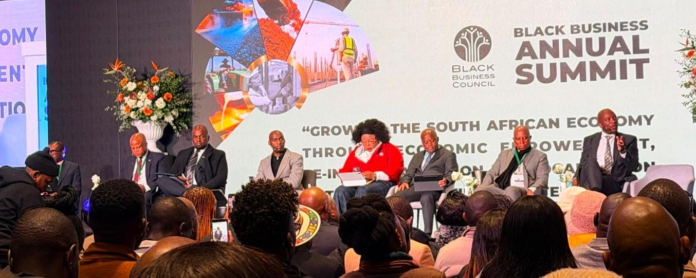
Representatives from several political parties have agreed that South Africa’s economy needs to grow by about 5% a year to create jobs and meaningfully reduce unemployment.
Speaking during a panel discussion at the Black Business Council’s annual Black Business Summit, leaders from Build One South Africa (Bosa), ActionSA, the ANC and the EFF all endorsed stronger economic growth targets. The IFP was the only party that did not specify a target.
Bosa president Mmusi Maimane said sustained economic growth of between 4% and 5% was essential to improve living standards and reduce poverty:
“I GENUINELY BELIEVE THAT THE SOUTH AFRICAN ECONOMY CAN GROW BY BETWEEN 4% AND 5%. IF WE DON’T ACHIEVE THAT WE ARE GOING BACKWARDS BECAUSE OUR POPULATION GROWTH IS OVER 3%.”
“The reality is that if you don’t achieve beyond 4% economic growth is that more and more people are entering poverty.”
Maimane expressed concern about the state of the country’s rail infrastructure, pointing out that, apart from the Gautrain, South Africa had not laid new rail tracks since 1981.
“This shows that rail infrastructure is falling behind,” he said.
He argued that a high-speed rail network linking Mpumalanga, North West and Gauteng would stimulate construction, boost manufacturing, address water and energy bottlenecks, and better integrate provinces into the economy.
Procurement and localisation
Maimane said South Africa’s economy was worth about R6 trillion, with the state appropriating approximately R2.1 trillion annually.
“Of that R2.1 trillion, the state procures particular services. For every R1 that goes into the fiscus, 22 cents goes towards debt repayment, 38 cents goes to costs of employees and the balance to the social wage.”
He said only about 25% of government procurement spending was directed towards Black-owned businesses.
“This indicates that our procurement process is not sufficiently capacitated to procure from Black businesses.”
Maimane argued that localisation efforts were being undermined by the decline of the manufacturing sector.
“There is not enough that is made in South Africa. Our manufacturing sector has all but collapsed, and if we are going to stimulate anything, we need to think about what we make here so that we can procure things from here.”
He added that South Africa needed stronger financing mechanisms to support township-based Black businesses.
“Government must also zero-rate tax for businesses started and run from townships.”
Growth and unemployment
ActionSA leader and Johannesburg mayoral candidate Herman Mashaba said economic growth below 5% would not be enough to reverse the country’s high unemployment rate.
Mashaba also argued that undocumented migration was contributing to unemployment.
“Undocumented migrants are criminals because they came into our country illegally. They bring in billions [worth] of goods on a daily basis, they are not registered with the revenue services, and they are not employing our people. If we deport them as a matter of urgency, you can imagine how much employment we would create,” he said.
Industrialisation key, says Zikalala
Deputy Minister of Public Works and Infrastructure Sihle Zikalala said 5% economic growth should be regarded as the minimum target.
“Of that 3.8% is targeted for African free continental trade,” he said.
Zikalala said South Africa needed to focus on industries with strong growth potential through industrialisation in special economic zones, the development of industrial hubs closer to townships, and support for small businesses.
He also said the government planned to advance high-speed rail projects linking Durban and Johannesburg, as well as Johannesburg with Musina and Mbombela.
“THESE PROJECTS ARE ALREADY IMPLEMENTED,” SAID Zikalala.
EFF Johannesburg mayoral candidate Tlaleng Mofokeng said her party’s economic growth target was between 5% and 8%.
“This would require a lot of negotiation and getting back to the sectors of society to see Johannesburg as a space for honesty and integrity and accountability,” said Mofokeng.
“We need to rebuild domestic manufacturing capacity, insourcing workers…” she said.
ATM leader Vuyo Zungula said 5% economic growth was an ideal target.
“You can’t let the transformation and state of the economy to be left to the hands of the market. You need the state to be intentional about growing and transforming the economy and creating jobs,” he said.
Zungula said any state tender valued below R10-million should be awarded to small businesses, arguing that such contracts should not be given to established companies.
“Government must create a conducive space for small businesses to thrive in terms of government procurement,” he said.
He added that South Africa should learn from Botswana, which passed a law requiring retailers to source at least 10% of their produce from local farmers. According to Zungula, the policy helped Botswana move from dependence on South African agricultural produce to greater self-reliance.
“The same thing could be done here… that is how you diversify the economy and create jobs,” he said.
DA representative Solly Msimanga said South Africa needed to stop spending money on non-essential projects and prioritise infrastructure development, particularly in rural areas.
He said improved infrastructure in rural communities would create jobs and attract investment.
“Right now the government spends less than 4% maintaining its infrastructure. We need to quadruple that to attract investment, and people will invest where the government is investing on infrastructure,” he said.
- Political party leaders, except the IFP, endorsed a target of about 5% annual economic growth to create jobs and reduce unemployment in South Africa.
- Bosa president Mmusi Maimane emphasized the need for 4-5% sustained growth and highlighted the poor state of rail infrastructure, advocating for high-speed rail networks to stimulate the economy.
- Herman Mashaba of ActionSA linked undocumented migration to unemployment, suggesting urgent deportations would help create jobs.
- Deputy Minister Sihle Zikalala mentioned ongoing high-speed rail projects and emphasized industrialization through special economic zones and township industrial hubs.
- ATM leader Vuyo Zungula proposed awarding government tenders under R10-million to small businesses and adopting policies like Botswana's local sourcing law to boost economic diversification and job creation.


