


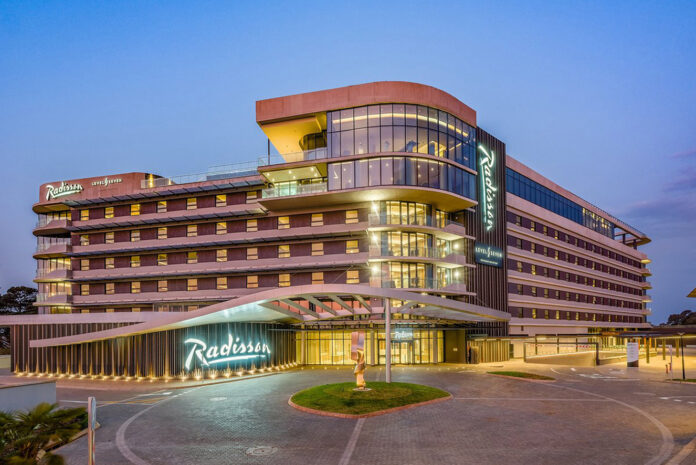
Property developer and pension fund administrator Zamani Letjane has terminated his contract with Radisson Hotel Group after a fallout that includes allegations of maladministration at his hotel in Kempton Park.
Letjane, the chairperson of Akani Retirement Fund Administrators, revealed this in an exclusive interview with Sunday World this week.
He said the agreement, which had been in place since 2018, was terminated last month because of Radisson’s alleged failure to meet gross operating profit targets and properly manage the hotel and its finances.
Radisson Hotel Group has denied the allegations.
“Radisson Hotel Group strongly rejects any suggestion of financial impropriety or misconduct and categorically refutes the allegations made,” its public relations director Saadiyah Hendricks said.
“The matters raised relate to a contractual relationship between Radisson Hotel Group and the hotel owner and are …the subject of … discussions between the relevant parties.
“Given the confidential and legal nature of these matters, it would not be appropriate for us to comment on the details,” Hendricks said. “Radisson Hotel Group takes its contractual, financial and operational responsibilities seriously and remains committed to conducting its business with integrity and in accordance with its contractual obligations.”
Under the agreement, Letjane’s hotel was allowed to trade under the Radisson brand and be managed by the international hotel group. In return, Radisson received 5% of the hotel’s gross income as a management fee.
After the deal was terminated, the hotel has been renamed Destiny.
The hotel, which began operating in 2010 as a 27-room boutique establishment, has since expanded to 284 rooms and conference facilities. Radisson came on board in 2018, a year before the expanded hotel opened, and began managing the hotel in October 2020.
Letjane said concerns about its financial performance had prompted him to scrutinise its operations.
“I started to monitor the revenue because I could see they are buying stock almost every second week. Then I asked them: Where is the revenue for this? They told me they allow a shrinkage of 30%, which is a standard in hospitality industry.
“I then told them I am asking about the actual (income) results of the stock they are buying and selling. I asked: Where is the money? They couldn’t answer because they failed to have a financial management controls.”
Letjane said there were instances where hotel and conferencing guests would buy food and beverages from the hotel restaurant, pay in cash and exit the eatery. However, the waiter would cancel the transaction.
The practice also included the beverage managers who were working. Letjane said that indicated cashiers and beverage managers were stealing from the business because of weak financial controls.
He said a financial audit had revealed that the hotel’s restaurant lost R9.6-million between 2020 until the termination of the contract in July 2026.
“Theirs was to only bring staff members who are capable of managing the hotel and setup all services where guests need to be serviced and housekeeping … They don’t bring a cent; they don’t take a risk. Radisson was terrible. They took their 5% management fee and … I had to cover all the expenses.”
“The agreement was that if they failed to meet the gross operating profit for a four-year period, then we could terminate.”
Letjane accused the hotel group of charging room rates comparable to those of neighbouring guest houses rather than aligning pricing with local hotel market standards.
“They were underselling the business which means there was no growth,” he said.
Letjane said Radisson joined the project in 2018 after he sought an operator to manage the hotel on his behalf. “When Radisson came on board, we negotiated and we agreed and I gave them a target to achieve. In the past five years, they …failed to reach the targets and even to manage the hotel properly.”
The property was at the centre of controversy in 2024. News24 reported on a transaction involving Letjane and the Municipal Employees Pension Fund (MEPF). According to the report, Letjane bought the Kempton Park hotel property for about R1.1m in 2010 and, through Akani Properties, sold it to the MEPF in 2018 for about R333m.
Letjane was responsible for managing the pension fund.
He said: “The Kempton Park property in question was a fully developed commercial infrastructure comprising Destiny Hotel and OR Tambo International Convention Centre valued at R555 million, as determined by independent valuators. In turn, Akani Properties entered into a commercial transaction with the Municipal Employees Pension Fund, to sell a 60% stake for R333 million. The transaction followed careful negotiations, due diligence and strict governance protocols.”
- Zamani Letjane terminated his contract with Radisson Hotel Group last month due to their alleged failure to meet gross operating profit targets and properly manage his hotel in Kempton Park.
- Radisson Hotel Group denies allegations of financial impropriety, stating the issues are contractual and under confidential discussions.
- Financial audits revealed the hotel's restaurant lost R9.6 million between 2020 and July 2026 due to weak financial controls and alleged misconduct by staff.
- Under the agreement, Radisson received 5% of the hotel's gross income as a management fee, but Letjane claims Radisson undersold the hotel with room rates comparable to guest houses.
- Letjane sold a 60% stake in the Kempton Park hotel and convention centre to the Municipal Employees Pension Fund for R333 million in 2018 after acquiring it in 2010 for about R1.1 million.


