



The South African Reserve Bank (SARB)’s Financial Surveillance Department (FinSurv) has published a draft framework that would bring cross-border crypto asset transactions under South Africa’s system for managing capital flows – marking one of the country’s most significant regulatory interventions in the digital asset sector.
The Draft Crypto Assets Manual outlines how Crypto Asset Service Providers (CASPs) would be authorised, supervised and required to report cross-border crypto transactions to regulators.
The manual must be read alongside the draft Capital Flow Management Regulations published for public comment in April 2026.
Only authorised crypto service providers to facilitate transactions
Under the proposed framework, only authorised crypto service providers would be allowed to facilitate transactions that are deemed to be imports or exports of capital through crypto assets. The National Treasury would retain oversight powers, while FinSurve would administer the regime on a day-to-day basis.
The manual proposes three categories of authorised CASPs. Category One providers would be allowed to facilitate certain remittance transactions using crypto assets as a settlement mechanism. Category Two providers would be permitted to offer South African custodial wallets for specific cross-border crypto transactions, while Category Three providers would be allowed to conduct both activities.
Cross-border crypto asset movement
A key feature of the proposal is the treatment of crypto asset movements across borders as capital flows. Transactions involving transfers from a South African authorised provider to an offshore provider or a non-custodial wallet would generally be regarded as exports of capital and would be reportable to regulators. Transfers from offshore providers into South African custodial wallets would be treated as imports of capital.
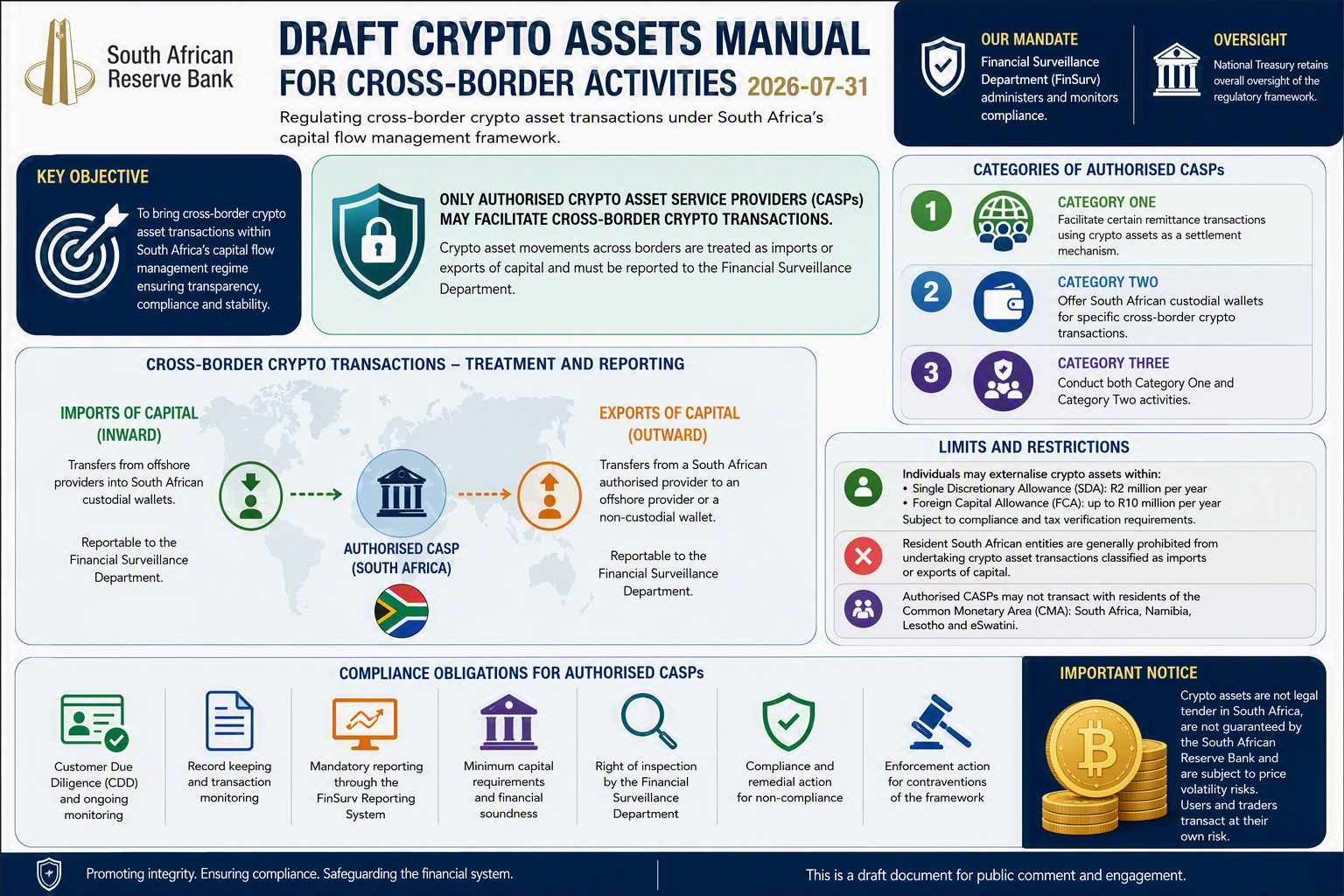
The draft also places limits on certain transactions. Individuals would be able to externalise crypto assets within the existing Single Discretionary Allowance of R2-million a year and the Foreign Capital Allowance of up to R10-million a year, subject to compliance and tax verification requirements.
However, resident South African entities would generally be prohibited from undertaking crypto asset transactions that are classified as imports or exports of capital under the proposed rules.
In addition, authorised CASPs would not be permitted to transact with residents of the Common Monetary Area, which comprises South Africa, Namibia, Lesotho and eSwatini.
The framework introduces extensive compliance obligations, including customer due diligence requirements, record-keeping, transaction monitoring and mandatory reporting through the FinSurv Reporting System. CASPs would also be subject to minimum capital requirements, inspection powers and potential enforcement action for non-compliance.
Crypto assets not legal tender in South Africa
SARB’s draft manual further states that crypto assets are not legal tender in South Africa, are not guaranteed by the central bank and remain subject to price volatility risks. Users and traders continue to transact at their own risk, with legal protections based on existing common law principles.
The proposed framework is expected to provide regulators with greater visibility over the movement of crypto assets across South Africa’s borders while integrating the sector more closely with the country’s exchange control and anti-money laundering systems.
- South Africa's Reserve Bank (SARB) released a draft framework to regulate cross-border crypto transactions under the country's capital flow management system.
- Only authorised Crypto Asset Service Providers (CASPs) can facilitate import/export capital transactions via crypto, with three provider categories defining specific transaction permissions.
- Cross-border crypto movements will be treated as capital flows, subject to reporting; individuals have allowances but resident entities face transaction prohibitions.
- The framework enforces strict compliance measures including due diligence, reporting, capital requirements, and bars CASPs from transacting with Common Monetary Area residents.
- Crypto assets are not legal tender in South Africa; the regulations aim to improve oversight, integrate crypto with exchange controls, and mitigate risks.


