


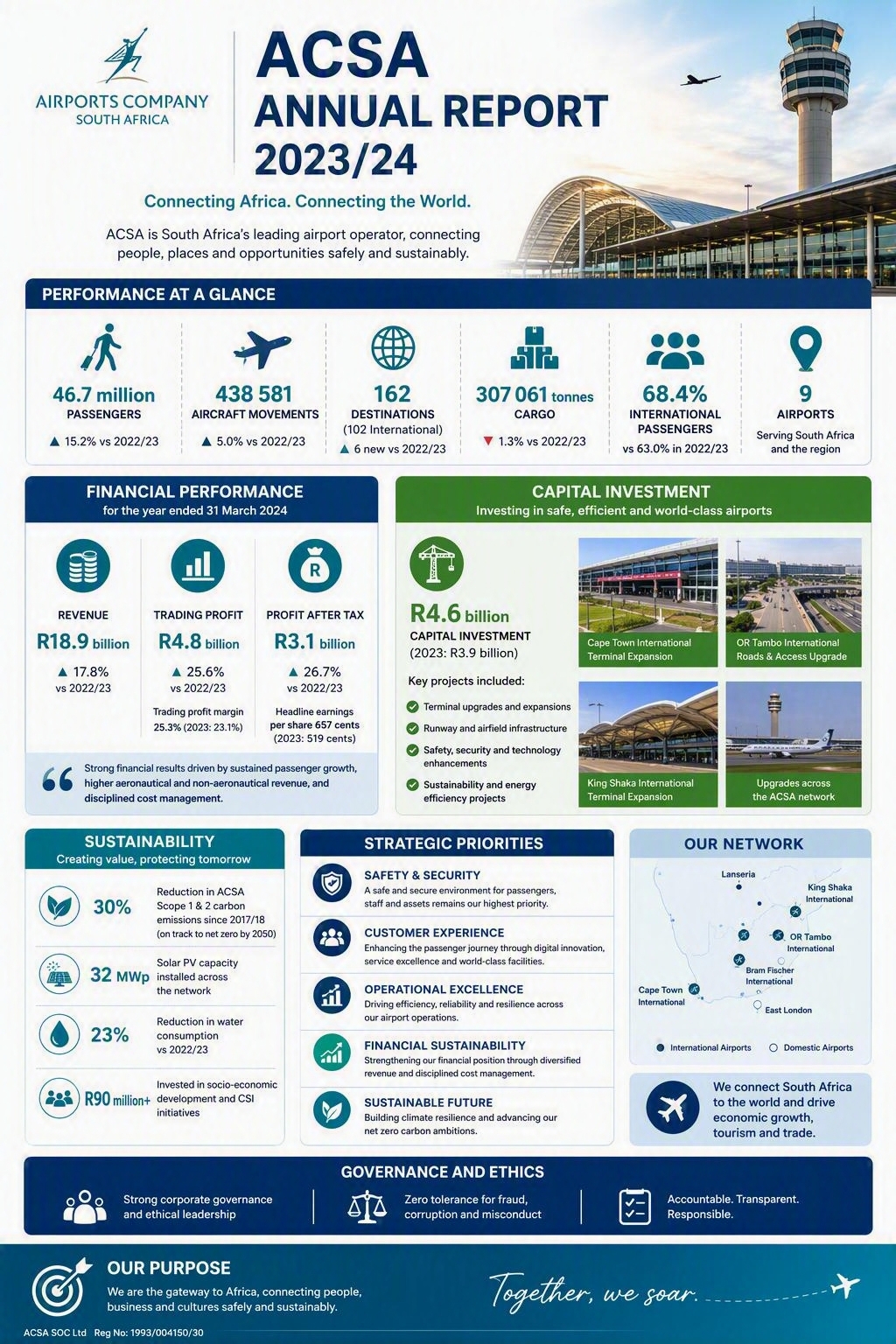
Airports Company South Africa (ACSA) reported a stronger financial performance for the year ended March 2026, with rising passenger volumes and increased commercial activity across its airport network helping push revenue above R8.8-billion.
This was revealed in the state-owned airport operator’s annual report, which also shows ACSA saw growth in property, retail and parking income, highlighting the increasing contribution of non-aeronautical revenue streams to its earnings.
Revenue increased by 11.6% to R8.81-billion, rising from R7.89-billion in the previous year, while profit after tax increased to R1.2-billion from R1.14-billion. Profit before tax climbed 10.1% to R2-billion.
OR Tambo and Bram Fischer remain growth engine
ACSA’s largest operating segment, Cluster One, comprising OR Tambo International Airport in Johannesburg and Bram Fischer International Airport in Bloemfontein, remained the dominant contributor to revenue and earnings.
The cluster generated revenue of R5.28-billion, up from R4.69-billion in the previous year. EBITDA increased to R3.5-billion from R3.04-billion, accounting for the bulk of group profitability. Aeronautical revenue in the cluster rose to R2.75-billion, while non-aeronautical income increased to R2.53-billion.
Cape Town-led Cluster Two posts strong gains
Cluster Two, which includes Cape Town International Airport, George Airport, Kimberley Airport and Upington Airport, produced revenue of R2.26 billion, up from R2.03-billion a year earlier.
EBITDA increased to R1.38-billion from R1.27-billion, making it the second-largest contributor to group earnings. Aeronautical revenue rose to R1.32-billion, while non-aeronautical revenue reached R933-million.
Eastern seaboard airports also expand
Cluster Three, made up of King Shaka International Airport, Chief Dawid Stuurman Airport and King Phalo Airport, recorded revenue growth of nearly 12%.
Revenue increased to R1.05-billion from R935-million, although EBITDA declined slightly to R158-million from R181 million because of higher operating and employee costs. Aeronautical revenue climbed to R602-million, while commercial revenue improved to R445 million.
Commercial activities emerge as major growth driver
One of the standout features of ACSA’s results was the continued growth of non-aeronautical revenue, which rose to R4.13-billion from R3.83-billion. These revenue streams now contribute almost half of total group revenue.
Among the strongest-performing segments were:
- Retail revenue: R1.38-billion, up from R1.24-billion;
- Property rental income: R1.10-billion, up from R1.05-billion;
- Parking revenue: R614-million, up from R591-million;
- Car rental income: R430-million, up from R398-million; and
- Advertising revenue: R222-million, up from R179-million.
Read more:
ACSA allays jet fuel shortage fears
Acsa dragged to court over ‘black disempowerment’
These figures demonstrate ACSA’s growing reliance on commercial and property-related income, reducing dependence on regulated passenger and landing charges.
Passenger charges and landing fees rebound
Aeronautical revenue grew strongly to R4.68-billion from R4.06-billion.
Passenger service charges were the single largest contributor at R3.09-billion, followed by landing fees of R1.52-billion and aircraft parking fees of R67-million. The performance reflects continued recovery in passenger volumes and airline activity across ACSA’s airports.
Property portfolio boosts bottom line
ACSA’s sizeable property portfolio also strengthened earnings during the year.
Investment property assets increased to R9.24-billion from R8.66-billion, while fair value gains on investment properties rose sharply to R574-million from R406-million. Rental income generated from investment properties exceeded R1.09-billion during the year.
The gains highlight growing value within airport precinct developments and logistics, retail and commercial properties situated around major airports.
Capital investment ramps up
The company increased capital expenditure to R1.1-billion, up from R861-million in the previous year, with work-in-progress projects climbing to R2.27-billion. Investment focused on airport maintenance, infrastructure upgrades and technology projects aimed at modernising airport operations.
However, ACSA fell short of its capital expenditure target of R1.85-billion, spending R1.08-billion during the year.
Despite the stronger results, ACSA faced rising impairment charges on trade receivables, which surged to R190-million from R35-million, while irregular expenditure increased to R400.3-million from R333.1-million. Fruitless and wasteful expenditure also rose sharply to R38.3-million.
Nevertheless, the company strengthened its balance sheet, reducing debt levels and lowering its gearing ratio to 6%, compared with 8% a year earlier.
- Airports Company South Africa (ACSA) reported revenue of R8.81-billion for the year ended March 2026, up 11.6% from R7.89-billion, with profit after tax rising to R1.2-billion from R1.14-billion.
- OR Tambo and Bram Fischer airports (Cluster One) generated R5.28-billion in revenue, with EBITDA increasing to R3.5-billion, while Cape Town-led Cluster Two recorded revenue of R2.26-billion and EBITDA of R1.38-billion.
- Non-aeronautical revenue grew to R4.13-billion from R3.83-billion, nearly half of total group revenue, driven by retail (R1.38-billion), property rentals (R1.10-billion), parking (R614-million), car rentals (R430-million), and advertising (R222-million).
- Aeronautical revenue increased to R4.68-billion from R4.06-billion, with passenger service charges totaling R3.09-billion and landing fees at R1.52-billion.
- ACSA's capital expenditure rose to R1.1-billion, though below the target of R1.85-billion, with investment focused on maintenance and infrastructure upgrades, while impairment charges, irregular expenditure, and fruitless spending also increased.


