


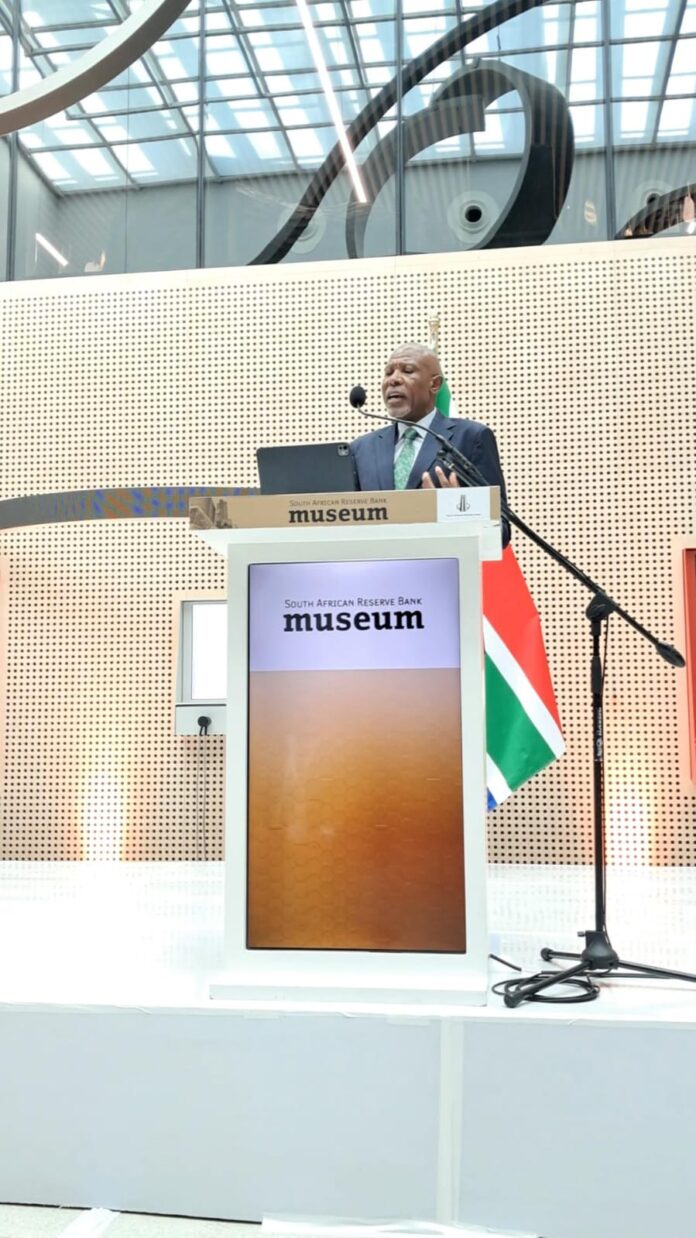
President Cyril Ramaphosa has officially launched the South African Reserve Bank museum, unveiling a space that blends economic education with cultural heritage and deep history.
The museum, located at the South African Reserve Bank in Pretoria, includes archaeological items dating back over 75,000 years, a coin collection spanning over 300 years, and South Africa’s first minting press, which is 134 years old and still works today.
Ramaphosa highlighted the often misunderstood role of central banks in everyday life, saying central banks shape lives of every citizen but remain less appreciated.
He noted that while monetary policy and financial stability may appear distant from daily concerns, their impact is direct and significant.
The work of the Reserve Bank, he said, influences the value of money, the safety of savings and the confidence businesses need to invest and grow.
Improving financial literacy
The museum is expected to play a key role in improving financial literacy, particularly among young people. Through exhibitions and outreach programmes, it aims to make complex economic concepts more accessible and practical.
“Our young people will be able to walk through these halls and understand how an economy works, how money holds its value and why the institutions that safeguard it matter,” Ramaphosa said.
Beyond economics, the museum also showcases the Reserve Bank’s extensive art collection, placing cultural expression alongside financial history. Ramaphosa said this reflects a broader understanding of national wealth.
“In devising this museum, the Reserve Bank reminds us that the wealth of our country cannot be counted in Rands alone. The wealth of our country resides in the creativity and ingenuity of our people,” he said.
He added that making the collection publicly accessible affirms that South Africa’s cultural heritage belongs to everyone, not hidden away in vaults.
Help demystify SARB work
Reserve Bank Governor Lesetja Kganyago said the museum was designed to close the gap between the institution and the public it serves.
WATCH:
Kganyago emphasised that public trust in institutions depends on understanding, adding that the museum will help demystify the Bank’s work and correct long-standing misconceptions.
“There are people who still believe that prisoners once counted the country’s money… and there are those who imagine that there are gold bars hidden somewhere in this building. Let me take this opportunity to confirm that none of that is true,” he said.
Inspire future economists, policymakers
The exhibitions trace South Africa’s economic journey from early barter systems through colonialism and apartheid to democracy, highlighting both progress and inequality. Kganyago said this historical perspective is essential in building a more inclusive financial system.
The museum also aims to inspire future economists and policymakers, with school programmes and interactive experiences such as a Monetary Policy Committee simulation game.
At its core, the initiative reinforces the importance of stability in the financial system. Ramaphosa emphasised that low inflation and sound banking are not abstract goals, but essential protections for ordinary citizens.
The launch comes in a year marked by major national milestones, including commemorations linked to the 1976 youth uprising, education pioneer Charlotte Maxeke and 30 years of South Africa’s Constitution.
Commemorative coins
The Reserve Bank is marking these events through a series of commemorative coins. They reinforce the link between history, education and economic inclusion.
“While these are circulating commemorative coins and do not increase in monetary value, they do something more meaningful. As they exchange hands, from Musina to Gqeberha, they connect us and invite us to speak to one another about our shared history. They inspire us to continue building the South Africa envisioned by the youth of 1976, Charlotte Maxeke and the authors of our Constitution.
“Through this museum, we hope to strengthen accountability and bring the institution closer to the people it serves – so that, even when our decisions are difficult or at times unpopular, they are debated in the context of the constitutional mandate and legislative responsibilities entrusted to us,” said Kganyago.
Read More: Expert concerned that banks extending credit to only few youngsters
- President Cyril Ramaphosa has officially launched the South African Reserve Bank museum, unveiling a space that blends economic education with cultural heritage and deep history.
- The museum, located at the South African Reserve Bank in Pretoria, includes archaeological items dating back over 75,000 years, a coin collection spanning over 300 years, and South Africa’s first minting press, which is 134 years old and still works today.
- Ramaphosa highlighted the often misunderstood role of central banks in everyday life, saying central banks shape lives of every citizen but remain less appreciated.
- He noted that while monetary policy and financial stability may appear distant from daily concerns, their impact is direct and significant.
- The work of the Reserve Bank, he said, influences the value of money, the safety of savings and the confidence businesses need to invest and grow.


