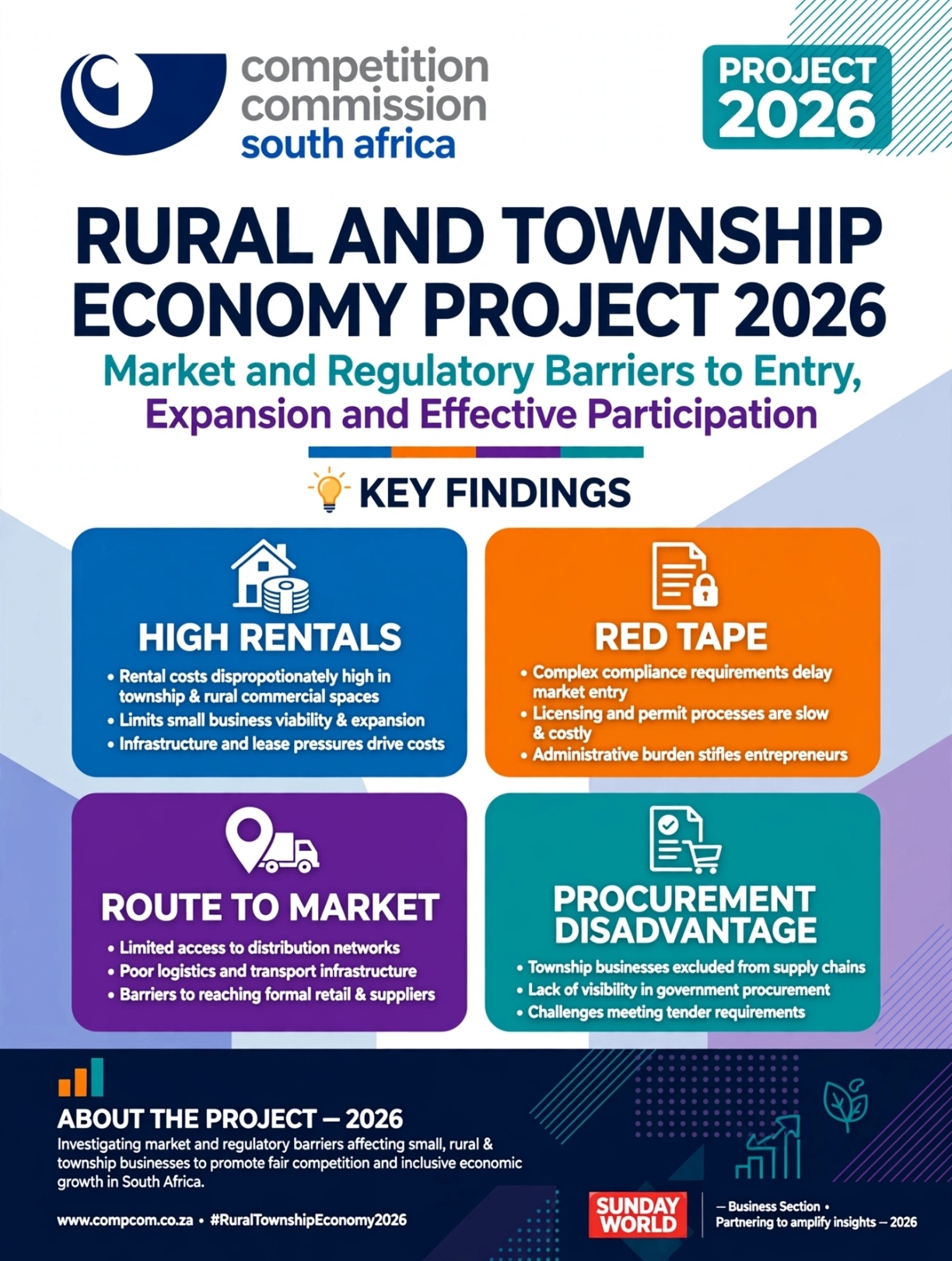
The Competition Commission has found that township and rural businesses are being squeezed from all sides, by costly suppliers, exclusion from malls and online platforms, and a mountain of municipal red tape, limiting their growth and forcing consumers to pay more and travel further.
This was stated by the Competition Commission in a new research report titled Rural and Township Economy Project 2026, released on Thursday, September 3.
The township and rural economy, home to over 40% of South Africa’s population, could be a major engine for job creation and inclusive growth if market and regulatory barriers are removed.
The economic hardship in townships and rural area is severe. The survey found 53% of rural town residents, 47% in large townships, and 39% in metro townships earn below R3 500 per month. Many fall below the poverty line.
READ: Competition Commission to press ahead with forex manipulation cases
The research found that the economic structure seen in townships and rural towns today is still shaped by apartheid’s “exclusion by design” resulting in perpetuating stagnation in the areas largely dominated by Black people.
The report noted that the negative impact of the erstwhile Group Areas Act, which empowered the heinous apartheid government to forcibly remove Black, coloured and Indian communities from urban centres to townships and homelands far from economic opportunities, destroying established neighbourhoods and business networks, were still being felt today.
As a result, “most businesses that were formed in those areas were small, informal and only survivalist in nature,” the report says. That pattern persists today.
The township economy is dominated by micro, small and informal businesses, which are generally started as a means of survival rather than wealth creation, perpetuating inequality and limiting the ability of historically disadvantaged individuals (HDIs) to enter mainstream business.
An untapped opportunity
But the same problem presents a massive opportunity.
According to Stats SA’s Quarterly Labour Force Survey for Q4 2024 cited in the report, the informal sector – one of the biggest sectors in townships, accounted for 19.5% of total employment in the country.
The commission argues that if an enabling environment is created to help township businesses formalise and grow, they could absorb a larger share of the unemployed youth and help eradicate poverty.
Another key opportunity is to increase the share of income that circulates within townships before it leaves, by strengthening local supply chains.
Two major roadblocks: market barriers and red tape
According to the study, township enterprises struggle to access markets because of spatial barriers, the high cost and difficulty of securing trading premises, and being excluded from formal retail nodes like shopping centres. Even when there is high consumption locally, small firms can’t meet volume, packaging and compliance requirements of formal supply chains.
The study found that the effects of these barriers extend beyond businesses and directly affect consumers. Limited local options often force residents to travel outside their communities to access better prices, greater variety and improved quality. This is particularly evident in sectors such as clothing, electronics and household goods.
Researchers noted that travel costs effectively increase the cost of living, especially for low-income households in rural areas and townships.
The report highlighted that regulatory barriers, including red tape, more specifically licensing, zoning, and compliance standards, which are meant to protect the public, often function as a barrier.
“When the administrative burden is high, when information is inaccessible, or when enforcement is uneven, regulation may function as a barrier to entry and a constraint on business survival and growth,” the commission says.
The 2024 Standard Draft By-Law for Township Economies is flagged as a key determinant of whether a business can enter and survive. Reducing bureaucratic burdens is critical for SMMEs and HDI-owned firms.
The commission said the findings point to the need for cooperation between municipalities, government departments, retailers, e-commerce platforms and other stakeholders to remove barriers that prevent township and rural businesses from growing.
The report recommends reducing compliance burdens, improving access to formal retail and online markets, supporting local sourcing initiatives and addressing infrastructure and service delivery failures that hinder business operations.
The commission said the findings were intended to help government, regulators and competition practitioners target interventions that will ease poverty, unemployment and inequality, in line with the National Development Plan 2030 and the Medium-Term Development Plan 2024-2029.
Mpho Sibanyoni