


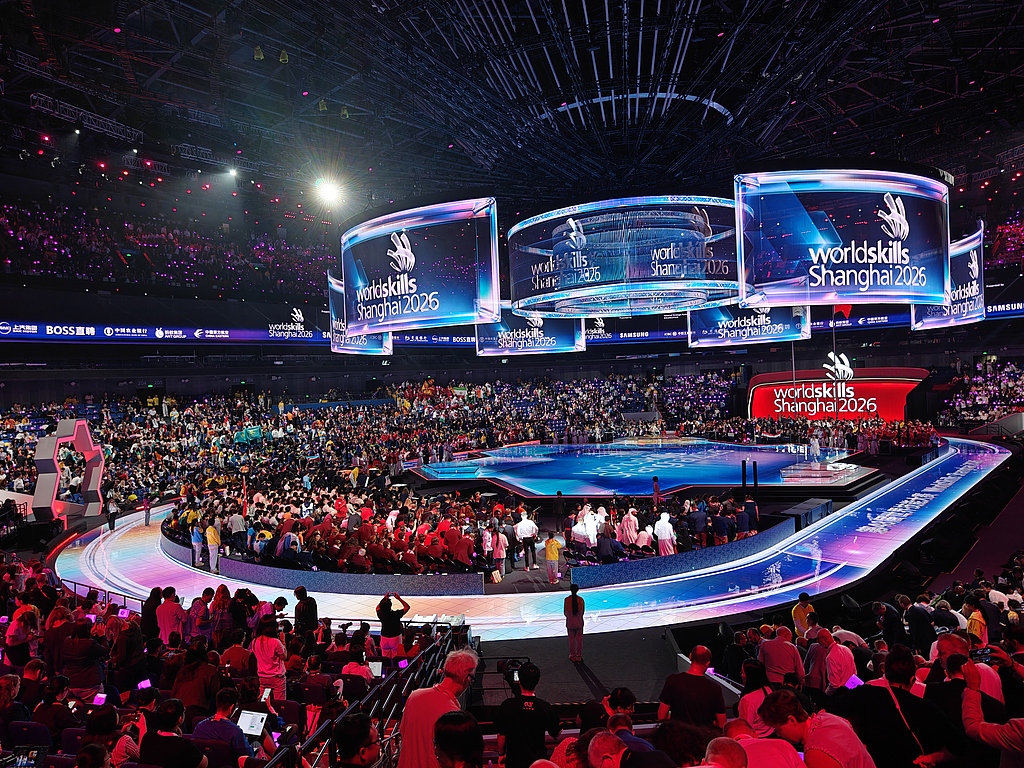
The 48th WorldSkills Competition concluded in Shanghai today, bringing together 1 385 competitors from 68 countries and regions. The event featured 64 skills, with seven making their debuts, including unmanned aerial systems, software testing and retail.
Over four days, competitions across 64 skills told a broader story of economic transformation: new technologies and shifting market needs are creating fresh demand, job roles are being reshaped and the skills economies need are evolving with them.
Francis Hourant, the president of WorldSkills International, said trades today were not the same as they were in the 1960s, adding that the competition adjusted its portfolio to remain connected with “the reality of the industry”.
New demand taking shape
The seven newcomers in Shanghai offer some of the clearest clues to where economic demand is moving.
In the unmanned aerial systems arena, competitors began with around 200 separate components. They had to assemble and calibrate a drone, write the code and prepare it for autonomous flight. Once airborne, the drone was expected to scan an unfamiliar environment, map obstacles and plan its own route — with no human intervention during the flight.
Retail presented a different scene at the Shanghai event but still reflected the same trend. Across different modules, competitors had to take on multiple roles: arranging merchandise, pitching products to customers, hosting livestreams and handling unexpected complaints.
“Where industries develop, new occupations emerge and WorldSkills sets up skills accordingly,” said Zhang Rui, the deputy director of the WorldSkills Competition China (Tianjin) Research Centre.
Among the seven new skills, software testing and digital interactive media design reflected the rise of the digital economy, while unmanned aerial systems and rail vehicle technology were among the skills tied to smart manufacturing and advanced equipment, Zhang explained.
AI rewriting the job
If changing demand helps explain why new occupations are emerging, AI is reshaping what happens inside a job.
In the web technologies competition, contestants are no longer assessed simply on their ability to write code. They must analyse user needs, decide what functions a business scenario requires, complete front- and back-end development and deliver a finished product.
Wu Yingxiang, a technical expert and coach for the Chinese team in WorldSkills web technologies, said AI was making code generation much faster, thus expanding what programmers were expected to do.
“Every programmer may now become a project manager and a product manager,” he said.
At another hall, contestants in the digital interactive media design competition moved from product planning to image processing, video production and interaction design during more than 20 hours of competition across four days.
For Hourant, the shift points to a changing division of labour rather than an either/or choice between humans and AI.
“It is not AI in the end,” he said, adding that the future lay in combining human skills with AI.
Building skills for tomorrow
The skills on display in Shanghai point to a challenge: whether the supply of skilled workers can keep pace with rapidly evolving industries.
China’s Ministry of Education added 27 programmes to the country’s vocational education catalogue in July, covering fields like the digital economy, AI, the low-altitude economy and advanced equipment, with new offerings related to humanoid robots.
Shanghai Information Technology College, for example, has added four programmes tailored to the city’s AI industry and brought real production scenarios, technical standards and company projects into the teaching environment.
Elsewhere, schools are strengthening links with industry to keep training in step with swiftly changing industry needs. At Jiangxi Software Vocational and Technical University in east China, the campus is integrated with an industrial park, with nearly 100 companies involved in tailored training.
“Vocational education cannot be run behind closed doors,” said vice-principal of Shanghai Information Technology College Sun Pengtao. “Programmes have to be updated along with industry.”
- The 48th WorldSkills Competition in Shanghai featured 1,385 competitors from 68 countries and 64 skills, with seven new skills introduced including unmanned aerial systems, software testing, and retail.
- Competitors in unmanned aerial systems had to assemble, code, and autonomously fly a drone that could scan and map obstacles without human intervention.
- AI is reshaping job roles, requiring web technologies contestants to analyze user needs, develop full products, and act as project and product managers.
- China's Ministry of Education added 27 new vocational education programs in July focused on the digital economy, AI, low-altitude economy, advanced equipment, and humanoid robots.
- Vocational education institutions like Shanghai Information Technology College and Jiangxi Software Vocational and Technical University are integrating industry projects and companies to align training with evolving market demands.
The 48th WorldSkills Competition concluded in Shanghai today, bringing together 1 385 competitors from 68 countries and regions. The event featured 64 skills, with seven making their debuts, including unmanned aerial systems, software testing and retail.
Over four days, competitions across 64 skills told a broader story of economic transformation: new technologies and shifting market needs are creating fresh demand, job roles are being reshaped and the skills economies need are evolving with them.
Francis Hourant, the president of WorldSkills International, said trades today were not the same as they were in the 1960s, adding that the competition adjusted its portfolio to remain connected with "the reality of the industry".
The seven newcomers in Shanghai offer some of the clearest clues to where economic demand is moving.
In the unmanned aerial systems arena, competitors began with around 200 separate components. They had to assemble and calibrate a drone, write the code and prepare it for autonomous flight. Once airborne, the drone was expected to scan an unfamiliar environment, map obstacles and plan its own route — with no human intervention during the flight.
Retail presented a different scene at the Shanghai event but still reflected the same trend. Across different modules, competitors had to take on multiple roles: arranging merchandise, pitching products to customers, hosting livestreams and handling unexpected complaints.
"Where industries develop, new occupations emerge and WorldSkills sets up skills accordingly," said Zhang Rui, the deputy director of the WorldSkills Competition China (Tianjin) Research Centre.
Among the seven new skills, software testing and digital interactive media design reflected the rise of the digital economy, while unmanned aerial systems and rail vehicle technology were among the skills tied to smart manufacturing and advanced equipment, Zhang explained.
If changing demand helps explain why new occupations are emerging, AI is reshaping what happens inside a job.
In the web technologies competition, contestants are no longer assessed simply on their ability to write code. They must analyse user needs, decide what functions a business scenario requires, complete front- and back-end development and deliver a finished product.
Wu Yingxiang, a technical expert and coach for the Chinese team in WorldSkills web technologies, said AI was making code generation much faster, thus expanding what programmers were expected to do.
"Every programmer may now become a project manager and a product manager," he said.
At another hall, contestants in the digital interactive media design competition moved from product planning to image processing, video production and interaction design during more than 20 hours of competition across four days.
For Hourant, the shift points to a changing division of labour rather than an either/or choice between humans and AI.
"It is not AI in the end," he said, adding that the future lay in combining human skills with AI.
The skills on display in Shanghai point to a challenge: whether the supply of skilled workers can keep pace with rapidly evolving industries.
China's Ministry of Education added 27 programmes to the country's vocational education catalogue in July, covering fields like the digital economy, AI, the low-altitude economy and advanced equipment, with new offerings related to humanoid robots.
Shanghai Information Technology College, for example, has added four programmes tailored to the city's AI industry and brought real production scenarios, technical standards and company projects into the teaching environment.
Elsewhere, schools are strengthening links with industry to keep training in step with swiftly changing industry needs. At Jiangxi Software Vocational and Technical University in east China, the campus is integrated with an industrial park, with nearly 100 companies involved in tailored training.
"Vocational education cannot be run behind closed doors," said vice-principal of Shanghai Information Technology College Sun Pengtao. "Programmes have to be updated along with industry."


