


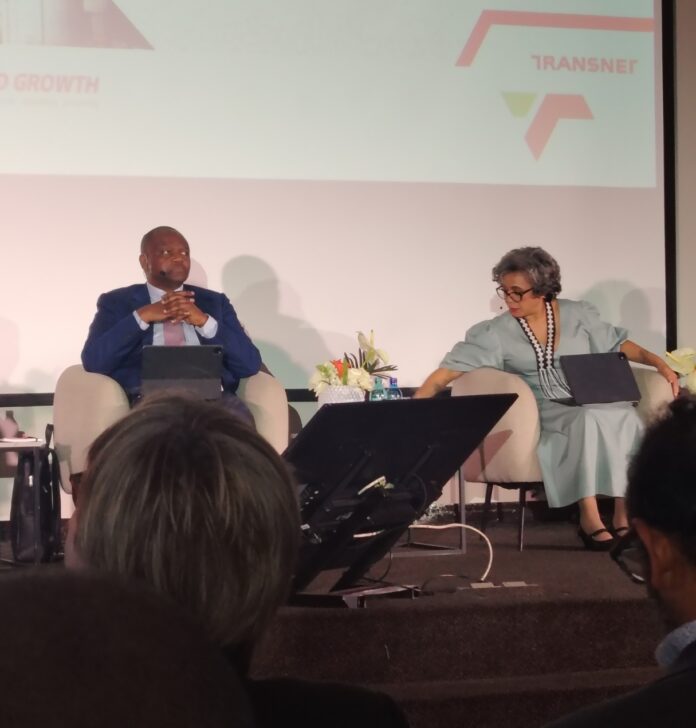
Transnet Group has defended its return to profitability, insisting that operational improvements and rising volumes underpin its recovery, despite acknowledging that a
R10.5-billion one-off transaction was the primary driver of its headline result.
The state-owned logistics company reported a net profit of R4.647-billion for the year ended March 31 2026, a sharp turnaround from the R1.906-billion loss recorded in 2025.
The result marks Transnet’s first return to the black since 2022, when it posted a profit of
R5-billion. In 2023, Transnet recorded losses of R5.7-billion, followed by R7.3-billion in 2024.
Volumes point to operational recovery
Transnet board chair Dr Andile Sangqu told Sunday World the company’s financial performance should be viewed in the context of a broader operational turnaround rather than as a standalone annual scorecard.
“We need to look at volume growth from 2023. In 2023 our volume growth was 149-million tonnes and now we are sitting at 168-million tonnes, that is phenomenal. You can see that there is an upward lift of volumes and that should give us confidence that the business is moving in the right direction.”
Sangqu said the company had also been burdened by historical challenges inherited by the current board, including a legal dispute with National Petroleum Refineries of South Africa that cost Transnet about R6-billion.
Board highlights foundation for future growth
According to Sangqu, several non-recurring issues affected the business over the past three years, while significant investments have been made to strengthen infrastructure and operational capacity.
“Part of the growth is that we had to deal with abnormal matters that are not going to recur. We have also invested a lot of capital in terms of improving the conditions of our infrastructure. These things are fundamental, and they set a very firm basis for the business going forward.”
Read more:
Transnet exec faces suspension demand over R825m Richards Bay contracts
Minister confronts Transnet over policy that could derail reforms
He credited management for improving operational discipline, governance and leadership, arguing that these reforms provide confidence in the sustainability of Transnet’s recovery.
“What is a mistake is to look at the financial report as an annual scorecard instead of focusing on the fact that we had to change the system in terms of operational discipline, governance, and leadership. It’s really what gives us confidence that there is a very important foundation that is being put in place for the future.”
Durban terminal deal drove bottom-line profit
However, Transnet’s own financial statements show that the company’s return to profit was largely driven by the disposal of nearly half of Durban Container Terminal Pier 2.
Group chief financial officer Nosipho Maphumulo said the sale of a 49.999% stake in Durban Gateway Terminal (DGT), which houses the Durban Container Terminal Pier 2 assets, was the main contributor to the year’s profit.
“The disposal of the 49.999% interest in the Durban Gateway Terminal (Pty) Ltd (DGT) impacted port volumes in the final quarter but was the main driver for the profit recorded for the financial year of R4.6 billion,” she said.
As part of its private-sector participation strategy, Transnet transferred DCT Pier 2, which had a carrying value of just R3.3-billion, into a new company, DGT.
On 1 January 2026, it sold a 49.999% stake in DGT to Philippines-based International Container Terminal Services Inc (ICTSI) for R10.5-billion.
The transaction generated a profit on disposal of R12.509-billion in Transnet’s income statement. The group also revalued its remaining 50.001% stake to R5.3-billion, resulting in an additional fair-value gain of R3.6-billion.
Core operations still under pressure
Excluding these once-off gains, the overall picture is less favourable.
Headline earnings, which strip out capital profits and losses, show that Transnet recorded a loss of R4.884-billion for the year.
Even so, revenue increased 7.1% to R88.56-billion from R82.69-billion, supported by improved rail and pipeline volumes as well as tariff increases. Earnings before interest, tax, depreciation and amortisation (EBITDA) edged up by just 0.7% to R30.86-billion.
At the same time, net operating expenses climbed 10.8% to R57.7-billion, driven by higher personnel, maintenance and security costs.
Transnet’s profit performance was uneven across its operating divisions.
The National Ports Authority generated a profit of R7.3-billion, while Port Terminals contributed R5.1-billion and Pipelines recorded R4-billion in profit.
However, Freight Rail, widely regarded as the backbone of South Africa’s logistics network, posted a pre-tax loss of R13.25-billion. Transnet Engineering also remained in the red, recording a loss of R4-billion.
Despite the return to profit, finance costs remain a major burden on the group.
Interest and related finance charges totalled R16.4-billion for the year, dwarfing Transnet’s operational profit and highlighting the challenges the company still faces in achieving a sustainable turnaround without the support of once-off asset sales.
- Transnet reported a net profit of R4.647 billion for the year ended March 31, 2026, reversing a R1.906 billion loss in 2025, primarily due to a R10.5 billion one-off transaction.
- The sale of a 49.999% stake in Durban Gateway Terminal for R10.5 billion was the main contributor to Transnet's profit and generated a disposal profit of R12.509 billion.
- Excluding one-off gains, Transnet recorded a headline loss of R4.884 billion, with core operations under pressure and EBITDA rising only 0.7%.
- Transnet's revenue increased by 7.1% to R88.56 billion, supported by higher rail and pipeline volumes and tariff increases, but operating expenses rose 10.8%.
- While National Ports Authority, Port Terminals, and Pipelines posted profits, Freight Rail reported a pre-tax loss of R13.25 billion and Transnet Engineering lost R4 billion.


