


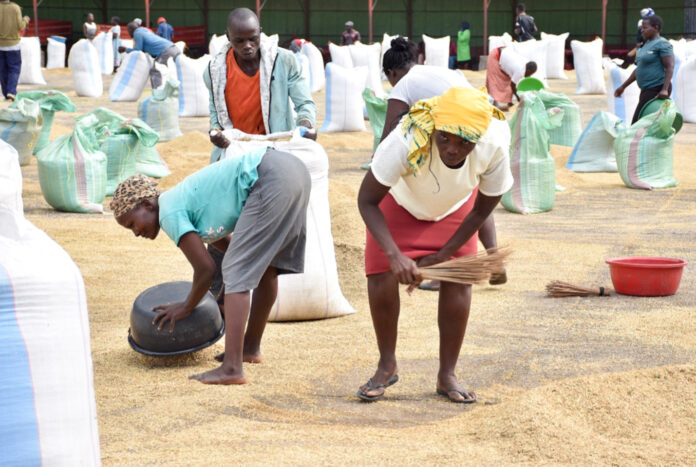
Alice Auma Obora, a mother of three, breathes a sigh of relief as 10 strong and hugely built men load 45 bags of paddy rice on a flatbed tractor after a tiring harvesting exercise at the West Kano Irrigation Scheme.
She takes out a handkerchief and wipes lines of sweat cascading down her face as she sits on one of the bags of paddy next to her two acres of rice.
“It has been a long journey. I can now rest and enjoy the fruits of my labor,” she says with a broad smile.
A few meters away from where she sits, a group of women are busy conversing in the local Luo language as one cracks a joke in Acholi.
Auma waves at them and smiles before shifting her attention to the men who were still busy arranging the bags of rice to ferry them to the National Irrigation Authority’s depot, where they dry the harvested paddy before milling.
In the past, such harvesting seasons spelled doom for her and ushered in another face of stress—accessing markets and customers.
She would struggle to sell her produce, a problem that affected the region until three years ago.
But this is no longer the case for Auma and hundreds of other farmers operating at the scheme and at the Ahero Irrigation Scheme, which is located several kilometers away.
Ease of movement
A vibrant migration and cross-border trade involving Ugandan nationals who have made the rich agricultural Kano plains their home away from home has transformed access to markets for these women.
Buoyed by the ease of cross-border movement of people enacted by the Kenyan government, the Ugandan nationals who have migrated to the region buy unprocessed rice in bulk from farmers and export it to Uganda.
Unlike the past, when one was required to have a passport or a temporary pass to travel to or from Uganda, today, it requires only a national identity card for one to cross over.
The women attribute the ease of movement to the vibrant rice value chain that is breathing life to the rice farms in the Nyando rice belt area
“They have given us a lifeline. We no longer struggle to find markets. They help us to access markets in Uganda by buying our produce,” she explains.
So significant is their influence that some of them have integrated with the community and speak the Luo and Swahili languages in near-perfection.
According to her, she relies on women migrants from Uganda to buy her produce, and they have helped her get new markets in the neighboring country with ease.
“I started rice farming in 1992. It has been a torrid journey. However, women traders from Uganda who are now a part of us are helping us find and open new markets,” she explains.
In the past, she says, they used to rely on brokers to connect them to the Ugandan traders. However, with time, they have managed to create their own links to the markets as integration gains root.
“We are really impressed with the coming in of Ugandan traders. They are the number one market for our produce,” she explains.
Georgina Kizza, a Ugandan migrant involved in the rice value chain since 2015, is happy to contribute to the economy and improve access to nutrition through rice farming.
She is among several women hoping to exploit Kenya’s efforts to embed its economic network with the African Continental Free Trade Area (AfCFTA).
The AfCFTA is an African Union Agenda 2063 initiative that is expected to be a key driver for Africa’s continental structural transformation and industrialisation.
Kenya is among the countries that have ratified the policy and is encouraging its implementation, as it aims to create a single market for goods and services, facilitated by the movement of individuals.
When we caught up with her at her farm in Nyamware in West Kano, she was inspecting her crop, which was almost due for harvesting.
Regional integration
For a person visiting the area for the first time, you cannot tell that she is not from there. She speaks the local language fluently despite having Ugandan roots and has integrated well.
“Kenya is my home. I am glad I have been able to venture into agribusiness and contribute to the production of nutritious varieties of rice,” she explains.
Initially, she would buy paddy rice from brokers who acquired it from farmers. She would then export the rice to Kampala to mill it and resell it to her customers in Uganda. Today, however, her modus operandi has changed.
She has integrated herself into the community and has gained the admiration of other farmers.
While she still exports some of her produce, a giant bulk of it is consumed locally.
She says after milling the rice, she sells some at the Ahero shopping center. In the last planting season in December, she leased three acres of land and used them to plant the pishori variety of rice.
“I work with several women who assist me in the production of rice. I also employ three casual workers who assist me with chasing birds when it is almost harvest time,” she explains.
The casuals who undertake these tasks are each paid Ksh6,000 (R788) per month.
Additionally, she believes she is contributing significantly to the economy and improving food security.
At Ahero market, we meet Joan Neza (not her real name), a Ugandan national who has settled in the busy agricultural town whose economy is largely supported by rice production.
When she first came to the country, she had hoped to sell second-hand clothes. But as fate would have it, she says she met someone who introduced her to rice production in Ahero.
“I started by hawking rice with the local women at Ahero. I did it for almost six months before I started buying paddy rice from farmers,” she says.
The woman who stays in a rental house says she has created links with other traders and helps farmers to access markets in other parts of the region.
“I have business partners in the region who buy paddy rice in bulk and in trucks. I have been helping them to get their products from farms,” says Neza.
According to a section of residents, the migration is contributing significantly to the growth of the Nyando rice belt, where the West Kano and Ahero Irrigation schemes lie.
Increased production
Joseph Ochieng, a farmer, said some of the migrants also assist rice farmers with farm inputs to help them with the production cycle.
“Some of them invest indirectly in the farms by providing the farmers with fertilizers as well as preparing the lands. After harvests, they split the income with the local farmers,” he explains.
Consequently, the arrangement has helped increase the area under rice production, which has been steadily rising in the last couple of years.
For instance, statistics by the county government indicate that the two rice schemes have seen almost 8 000 acres of rice brought under rice production.
The rise in production has also been buoyed by the shift from better harvests to reliable markets, courtesy of a new technology dubbed the system for rice intensification as well as regional integration.
The system, borrowed from the Mwea Irrigation Scheme, involves intensive utilization of water, where farmers have equal access to the limited commodity for a particular number of days, then they give it to other farmers, and the cycle continues.
The promising outlook depicts a promising scenario where rice production appears to be enticing, and farmers toiling in the paddies reap financial rewards at the end of the season.
Women participation
According to Kennedy Ouma, the National Irrigation Authority manager for Western Kenya schemes, the intense production of rice in the two schemes is a game changer, especially for women.
He noted that some of the migrants have encouraged more women to engage in rice farming.
For instance, as of the end of March, the number of women who are directly managing the farms in both Ahero and West Kano has grown up to 45 percent from 30 percent four years ago.
“Women empowerment is gaining root in the rice belt. The increasing number of women involved in rice production is a testament to the role women are playing in improving food production,” said Ouma.
He noted that the Ugandans also contribute to the production activities, as they support the women farmers with inputs
“A group of women from Uganda also support our women farmers in the provision of inputs. We also note that the immigrants come in handy to support women farmers with inputs and also some advances to be able to support some of their activities,” he said, adding that production increased in West Kano from 2 tons per hectare to around 2.8 tons per hectare.
He said the government is pursuing initiatives to plead with the women to join cooperative societies for better prices.
“I want to encourage our women to take a lead role to get a better livelihood and also to tell our men to give women the opportunity because even farms that are managed by women do better than those managed by men, and so women play a big role in rice production in this region, and they need to be supported, even financially,” he said.
New rice mill installed
According to the International Rice Research Institute, Kenya’s annual rice consumption is increasing by over 12%.
The institute projects that with a growth rate of 2.7% annually, the estimated annual national need can reach 1 290 000 tons by 2030.
As part of an effort to encourage rice production in the region, the government recently installed a new rice mill at Kibos Rice Mill to serve rice farmers from the area.
The new rice mill being managed by the Lake Basin Development Authority has a processing capacity of 4 000 tonnes an hour.
The plant is expected to promote rice cultivation across more than 6 000 acres in the Chiga, East Kano, and West Kano schemes, benefiting over 10 000 households.
It has also been tipped to improve women’s participation in rice production.
With the investments put in place and the free movement of goods and people between Kenya and Uganda, the contribution of Ugandan women in the rice value chain can only get better.
Furthermore, the partner states of the East African Community are also pursuing policies to expand cross-border trade, consequently breathing life into the regional economy and enhancing integration.
_
This content is produced by African Women in Media as part of the Move Africa 2025 project, commissioned by the African Union Commission and supported by the German Federal Ministry for Economic Cooperation and Development (BMZ) through the Deutsche Gesellschaft für Internationale Zusammenarbeit (GIZ) GmbH. The views and opinions expressed are those of the authors only and do not necessarily reflect those of BMZ, GIZ, or the African Union.
- Alice Auma Obora, a mother of three, breathes a sigh of relief as 10 strong and hugely built men load 45 bags of paddy rice on a flatbed tractor after a tiring harvesting exercise at the West Kano Irrigation Scheme.
- She takes out a handkerchief and wipes lines of sweat cascading down her face as she sits on one of the bags of paddy next to her two acres of rice.
- “It has been a long journey.
- I can now rest and enjoy the fruits of my labor,” she says with a broad smile.
- A few meters away from where she sits, a group of women are busy conversing in the local Luo language as one cracks a joke in Acholi.


