


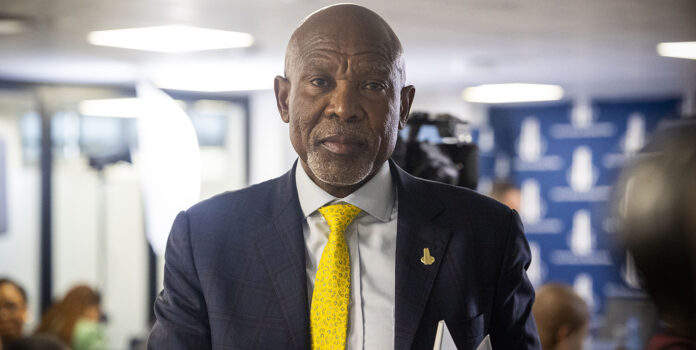
South African Reserve Bank (SARB) Governor Lesetja Kganyago has expressed frustration that the SARB’s stake in African Bank does not grant it sufficient power to steer the struggling lender.
The central bank is the African Bank’s largest shareholder, with a 50% stake. The Government Employees Pension Fund, through the Public Investment Corporation, owns 25%.
A banking consortium, which includes FirstRand, Standard Bank, Absa, Nedbank, Investec and Capitec, collectively holds the remaining 25%, while the iKamva Lethu Employee Trust Scheme owns 10% on behalf of permanent employees.
However, the Reserve Bank does not have representation on the board of African Bank.
Speaking at the 106th annual ordinary general meeting of the SARB in Pretoria, Kganyago emphasised that even though the Reserve Bank had the majority stake, it did not have a controlling stake.
“At the time of the resolution of the old African Bank, a decision was taken that the SARB is a regulator and it can’t then be the shareholder and control the institution. It was decided that once the SARB has taken shareholding it cannot have representation on the board, so we do not have an influence on the representation of the board.
“In a way, we could look back that the correct thing to have done then, which is what happens in other countries, is that African Bank was supposed to be taken by Treasury and not by the Reserve Bank but we did, or shall I say Treasury didn’t, have the money,” Kganyago said.
African Bank was placed under curatorship in August 2014 after a collapse driven by massive bad debts, aggressive unsecured lending and severe funding pressures. It was restructured and for a while, its turnaround looked promising but it has since regressed after a string of poor acquisitions that have hit profitability.
In the period ending March 2026, it reported a R624-million loss, down from a R202-million profit in the same period the previous year.
The sharp decline was driven by, among others, a surge in bad debts and costly acquisitions including Ubank, Grindrod Bank and Sasfin’s Capital Equipment Finance and Commercial Property Finance.
Ubank was acquired in 2022 as a worker-focused investment bank serving mining communities from the Mineworkers Investment Company.
Sasfin’s Commercial Equipment Finance and Commercial Property Finance was bought in 2024 to expand into specialised finance, while Grindrod Bank was bought in a R1.5-billion deal, with the intent to expand into SME banking.
The acquisitions were aimed at transforming African Bank from a specialist unsecured lender into a diversified retail and commercial bank with operations spanning consumer banking, business lending, commercial property finance and deposit-taking services.
However, the expansion has come under increasing scrutiny as the bank continues to face financial pressure.
It recently announced plans to retrench up to 1 200 employees and close 90 branches as part of a cost-cutting programme after operating costs exceeded its risk-adjusted revenue.
Zweli Manyathi, the acting CEO of African Bank, has acknowledged the aggressive risk appetite for higher-risk borrowers and said the bank had reassessed its approach to credit underwriting and was applying strict standards when evaluating loan applications.
Kganyago told the shareholders that the Reserve Bank had received interest from parties looking to acquire its stake in the troubled lender.
However, none of the potential buyers had made an offer backed by funding.
He said the interest had thus far amounted to discussions only, with no prospective investor putting forward the money needed to conclude a transaction.
Sunday World previously reported that Stuart Theobald, the executive chairperson of risk advisory firm Krutham, said the lender was unlikely to attract investors, suggesting that the best option would be to sell the bank’s various businesses separately to maximise value for shareholders.
He said shareholders had delayed facing the reality for years and argued that the bank’s ownership structure had also complicated decision-making.
“You are not going to get a bank coming to buy African Bank. There are possibly some big international banks, sometimes the Chinese or Indian banks, that talk about finding new interest in South Africa but given South Africa’s growth outlook and consumer outlook, you are not going to find it being [seen as] hot property.
“That leaves the alternative of breaking African Bank up, taking all the bits that have been accumulated over the past few years and selling them to the highest bidder, attempting to acquire as much value as possible,” Theobald said.
- The South African Reserve Bank (SARB) holds a 50% stake in African Bank but has no board representation or controlling influence, limiting its ability to steer the struggling lender.
- African Bank faces financial difficulties, reporting a R624-million loss for the year ending March 2026, driven by bad debts and costly acquisitions like Ubank, Grindrod Bank, and Sasfin’s finance units.
- The bank’s expansion strategy to diversify from unsecured lending into retail and commercial banking has faced setbacks, leading to planned retrenchments of up to 1,200 employees and branch closures.
- SARB has received interest from potential buyers for its stake, but no firm, funded offers have emerged, reflecting broader investor concerns about African Bank’s prospects.
- Experts suggest breaking up African Bank and selling its various businesses separately might maximize shareholder value due to challenging conditions and the bank’s complex ownership structure.


